

On this page
The Panini Linguistics Olympiad (PLO) is the Indian national selection exam for the International Linguistics Olympiad (IOL). It challenges students to solve logic puzzles based on the grammar, numbering systems and scripts of unfamiliar languages.
Many students assume you must be fluent in multiple languages to participate, but the exam requires absolutely no prior linguistic knowledge. The problems are entirely self-sufficient, testing your ability to spot patterns, build hypotheses and apply logical reasoning.
What is the Panini Linguistics Olympiad?
The Panini Linguistics Olympiad is India's national selection programme that identifies the top students to represent the country globally. The International Linguistics Olympiad, which the PLO feeds into, has grown to include 46 countries and territories as of the 2026 edition.
The PLO is structured in multiple rounds to filter and train the best analytical minds. The Open Round is a national-level written exam, typically held late in the year, which serves as the first filter. Top performers from this round are invited to an intensive residential camp, often hosted by IIIT Hyderabad. At the camp, students are introduced to advanced problem-solving techniques and linguistic theory. The final stage selects teams of four students to travel to the IOL.
Who is eligible for the linguistics olympiad in India?
The exam is open to school students across India, divided into two distinct age groups. The Junior Contest is for students in Grades 6, 7 and 8, and the Senior Contest is for students in Grades 9, 10, 11 and 12.
There are strict rules regarding repeat participation and graduation. Students who have completed Class 12 are no longer eligible to participate. Furthermore, if you have already attended the invitational camp in a previous year, you must compete in the Senior category regardless of your current grade. This ensures that older or more experienced students do not crowd out newcomers in the junior bracket.
How do language puzzles work?
Linguistics olympiad questions resemble mathematical code-breaking exercises more than traditional language tests. A classic problem type involves presenting a few words or sentences in an unknown language alongside their English translations. Your task is to decode the rules connecting the two, and then use those rules to translate new phrases.
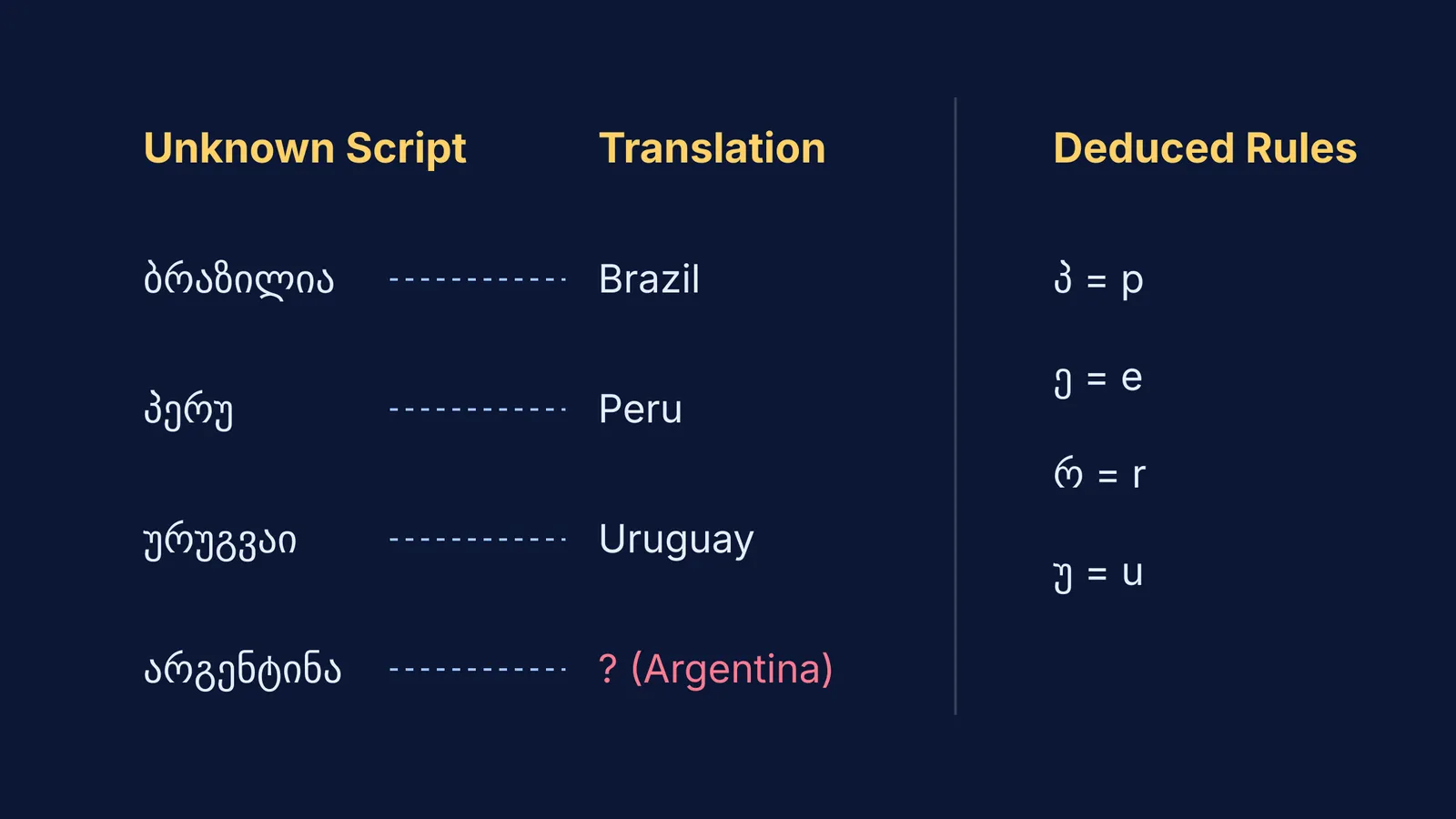
Consider a simplified version of a script decipherment puzzle. You might be given a list of South American countries written in the Georgian alphabet, such as ბრაზილია for Brazil and პერუ for Peru. By comparing the shapes of the Georgian characters to the English letters, you can gradually map individual sounds. Once you realise that პ corresponds to 'p' and რ corresponds to 'r', you can read an entirely new word like არგენტინა (Argentina).
Other common problem types include:
Rosetta Stone problems: Matching complex phrases in an unknown language to their English equivalents by identifying recurring word roots and grammatical markers.
Numeral systems: Figuring out how a culture counts, which might involve base-12, base-20, or systems that use parts of the body instead of traditional digits.
Phonetics and morphology: Deducing how sounds shift when words are combined, or how prefixes and suffixes change the tense of a verb.
How can you practise for the exam?
Success in the PLO comes down to practice and exposure to different types of logical structures.
Start with past papers: The most reliable way to prepare is to attempt previous years' problems from the PLO and IOL websites. Begin with the easier problems from the Junior contest before moving up to the complex team challenges.
Read the solutions carefully: When you get stuck, do not just look at the final answer. Read the provided reasoning to understand the logical steps the setter expected you to take.
Build a step-by-step habit: Treat these puzzles exactly like mathematics. Write down your hypotheses clearly, test them against all the given examples, and discard them immediately if a single counter-example breaks the rule.
If you struggle to organise your thoughts when faced with a blank page, you might find that systematic practice helps. Whether you are deciphering a base-20 counting system or breaking down a mechanics problem, Fermi's AI tutor works out what you already know and builds a plan for the session, holding a line of reasoning across a whole session to teach through it.
By training your brain to spot hidden rules in language, you sharpen the same analytical skills needed for IOQM number theory questions or Boolean logic for CBSE Class 11. The Panini Linguistics Olympiad is ultimately a test of how well you think, making it one of the most rewarding academic challenges a student can take on, and a great way to help children learn without adding pressure.


