

On this page
If you are days away from your science fair and your experiment has "failed", the first instinct is panic. Your plants died, the rocket didn't launch, or the data points are scattered everywhere but on the trendline you predicted.
You might think a negative result means a failing grade. In reality, a failed experiment is a hidden opportunity. Real science is full of null results, and judges know this. Here is how to present what went wrong and turn a failed project into a display of genuine scientific thinking.
Why do negative results matter in science?
A negative result — where your data does not support your hypothesis — is a valid scientific finding. It tells the community that a particular relationship does not exist under the conditions tested.
However, professional science has a bias problem. A 2014 study by Franco et al. in *Science* found that while 62% of social science experiments with strongly significant results were published, only 21% (10 out of 48) of those with null results made it into a journal. This "file drawer problem" leads to wasted time and money as other researchers repeat the same dead-end experiments because the failures were never made public.
By reporting your negative results honestly, you are practising the exact kind of transparency that the scientific community is actively trying to encourage. When you stand in front of your board and explain what didn't work, you are doing exactly what professional researchers do at conferences.
My school project failed: what to do?
Do not scrap your data, and do not change your hypothesis to match what actually happened. Judges want to see your original reasoning, even if it turned out to be incorrect.
Instead, shift the focus of your project board and your written report from the final outcome to the troubleshooting process.
Keep the original hypothesis: State clearly what you expected to happen and why you thought it would happen.
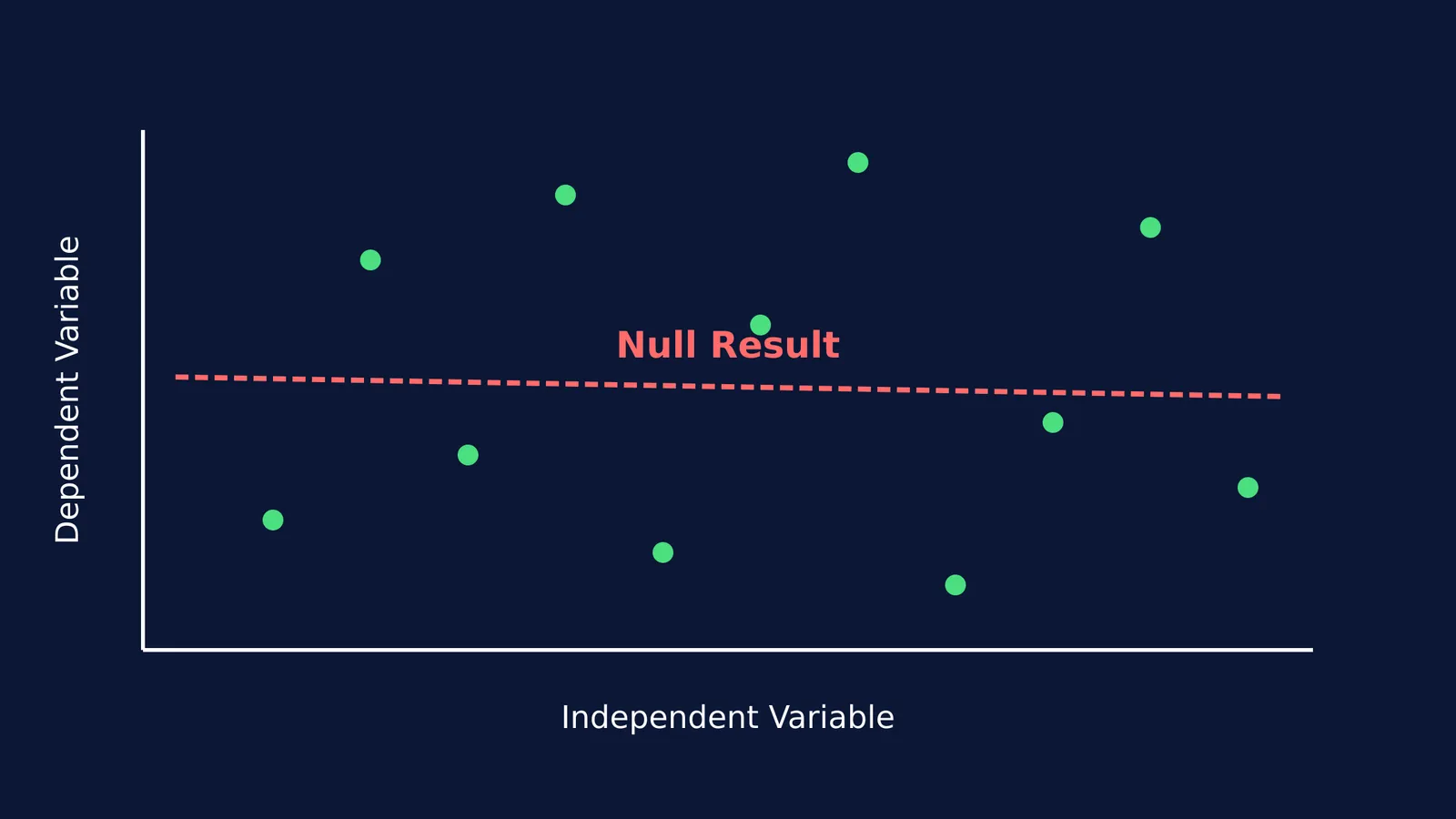
Report the real data: Put your messy, unexpected numbers into graphs and tables. A scatter plot with no correlation is still a valid result.
Write a "Troubleshooting" section: This is where you score your marks. Document exactly what went wrong. Did a sudden drop in room temperature ruin the reaction? Did your equipment lack the sensitivity to measure the change? Were the materials you bought faulty or expired?
Define the next steps: End by explaining how you would redesign the experiment to fix these flaws.
If your project was a standard school practical — like plotting a prism i-d curve experiment or doing ray tracing through a glass slab — and your numbers don't match the textbook, discuss systematic errors. Perhaps the glass had a different refractive index than expected, or the pins were too thick for a precise angle measurement.
What do judges look for in a failed project?
Science fair judges evaluate your process, not just your product. They are grading your use of the scientific method: identifying a problem, forming a hypothesis, running a fair test, and analysing the data. When they see a hypothesis that wasn't supported, they look for:
Scientific honesty: Admitting a flaw shows maturity and ownership of your work. Judges trust students who are honest about what didn't work over those who try to hide anomalies.
Critical analysis: Can you explain the physics, chemistry, or biology behind why it failed? If you are struggling to trace the theory, Fermi's AI tutor can work through the concepts with you, helping you figure out if a hidden variable or competing force interfered with your design.
Deep understanding: A student who can confidently discuss the limitations of their experimental setup demonstrates a higher level of critical thinking than a student who just followed a kit to a perfect result.
How should I talk to the judges?
The Q&A is the most important part of any science fair. When a judge asks about your project, do not apologise for it not working. Own the outcome. Prepare a few clear sentences that reframe the failure as a learning experience:
"My original hypothesis was that X would happen, based on this principle. However, the data showed Y. When I analysed why, I realised that my control variable fluctuated."
"While the experiment didn't produce the result I expected, it taught me that this method is too sensitive to ambient temperature. If I were to run this trial again, I would use an insulated water bath."
By treating your failure as a discovery, you show the judges that you understand how real science works, turning a potential disaster into a winning presentation.


