

On this page
NPTEL (National Programme on Technology Enhanced Learning) is a massive resource for engineering students in India, offering recorded lectures from IIT and IISc professors. According to its official site, NPTEL has seen over 15.8 million enrollments across 3,496 completed courses. However, many students use these lectures the same way they watch television—sitting back and letting the video play. This approach rarely translates to good exam scores. To truly benefit from NPTEL, you have to choose courses strategically, watch them actively, and test yourself rigorously.
Why do passive lectures lead to lower grades?
When you watch a brilliant professor solve a complex thermodynamics or calculus problem on the board, the steps make perfect sense. It feels like learning is happening. But a massive 2014 study published in the Proceedings of the National Academy of Sciences found that failure rates under traditional lecturing increase by 55% over the rates observed under active learning. Without active engagement, the information simply does not stick in your long-term memory.
Similar results were found in Hake's study on interactive engagement, which showed that students learn physics far better when they are forced to participate. Watching a screen is a passive activity. Unless you deliberately build habits to force your brain to work during the video, you will likely forget the concept by the time mid-semester exams arrive.
Which NPTEL courses should you choose?
The biggest mistake students make is trying to replace their entire college curriculum with NPTEL lectures. There is not enough time in a semester for that.
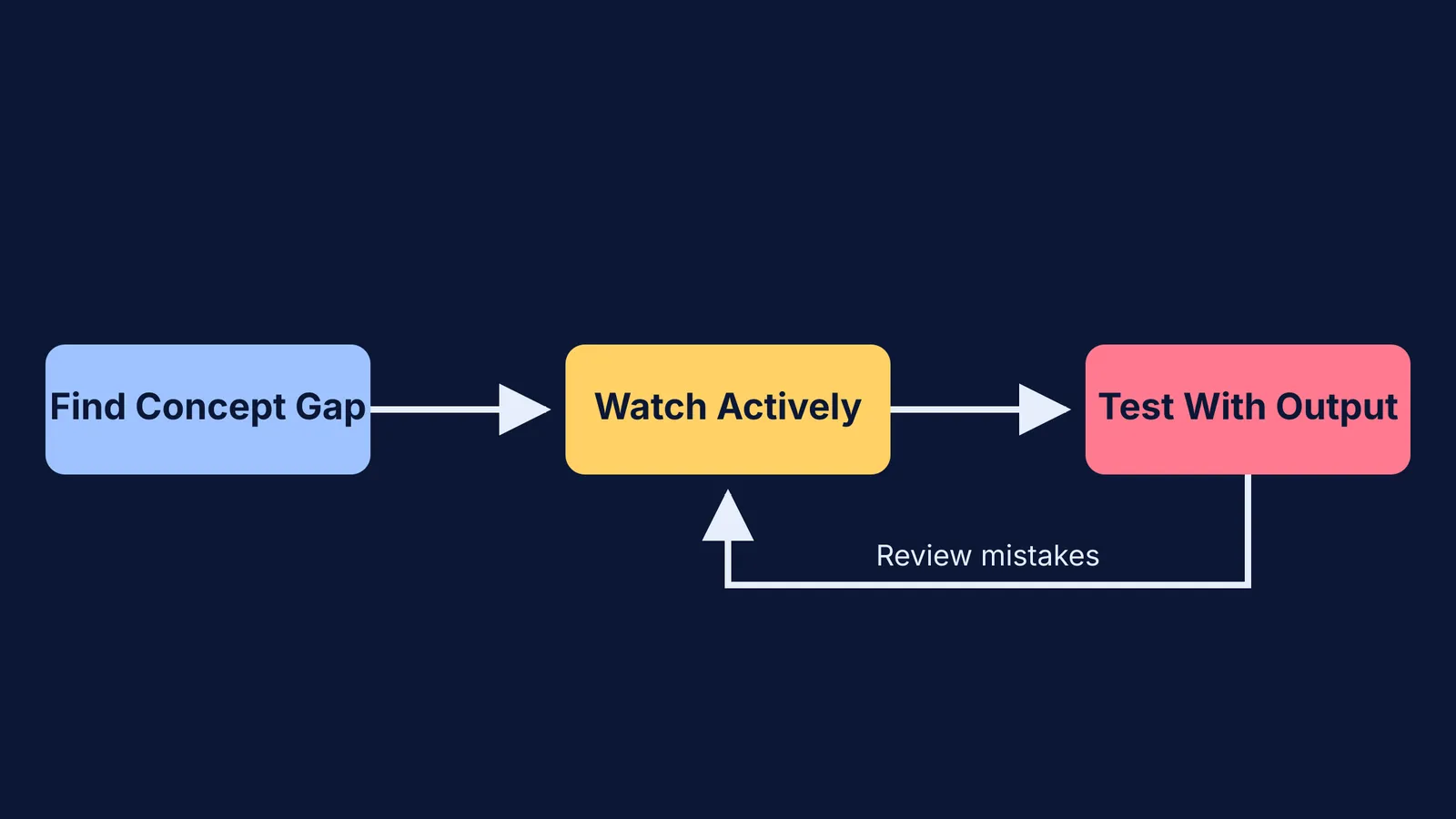
Find your concept gaps: Pick only the subjects or specific modules where you are struggling. If you understand fluid mechanics but struggle with heat transfer, only enroll in the heat transfer modules.
Check the prerequisites: NPTEL courses are often taught at a rigorous, university level. If your high school maths or physics fundamentals are weak, the IIT professor's derivations will be difficult to follow.
If you find yourself stuck because of a missing fundamental idea, a recorded lecture cannot pause to teach you the prerequisite. This is where Fermi's AI tutor can step in. A student brings a topic, a course, a problem set or a scanned assignment. Fermi works out what they already know, builds a plan for the session, and teaches through it. Once the foundational gap is filled, you can return to the NPTEL lecture and follow the reasoning.
How can you watch engineering lectures actively?
Once you have selected a lecture, you must change how you watch it.
Pause and predict: Before the professor solves the equation on the board or finishes a derivation, pause the video. Try to write down the next step yourself on a piece of rough paper. Even if you get it wrong, the effort of trying primes your brain to remember the correct method when you press play.
Self-explain: At the end of every 15-minute chunk, pause the video and explain out loud what was just covered, as if you were teaching a classmate. This forces you to organise the information, translates the academic language into your own words, and reveals what you actually understood. This is a variation of the self-explanation effect, a proven method for studying worked examples.
Take notes by hand: Do not just screenshot the slides or download the lecture PDFs to read later. Writing notes by hand forces you to synthesise the material. Focus on the 'why' behind a step, not just copying the mathematical symbols.
How should you use NPTEL assignments?
NPTEL provides weekly assignments for its certification courses. These problem sets are arguably more valuable than the videos themselves, as they are your best tool for exam preparation.
Attempt before reviewing: Treat the weekly assignment like a real, timed test. Do not look at your notes or re-watch the lecture while solving the problems for the first time.
Review your mistakes: When you get a question wrong, do not just read the correct answer, nod, and move on. Go back to the specific timestamp in the lecture and re-watch the professor's explanation of that exact concept.
Focus on the method: For complex engineering problems, the final numerical answer matters less than the logical method used to reach it. If you keep making wrong-method mistakes, you can practice similar problems in the Fermi Problem Library. It offers worked problems with a step-by-step solver that explains the reasoning rather than printing an answer.
By treating NPTEL as an active training ground rather than a passive cinema, you can master the toughest engineering subjects and drastically improve your exam performance over the course of the semester. Consistently applying these active learning strategies will ensure that the hours you spend watching these lectures translate directly into genuine comprehension and better results.