

On this page
When you start college science practicals, the first thing you have to do is find a lab partner. Your instinct might be to find someone exactly like you and to divide the work neatly in half. One of you handles the equipment, while the other writes down the numbers.
However, educational research shows that this "divide and conquer" approach can actually hurt your learning. To get the most out of your practical sessions, you need to rethink how you and your partner tackle the bench.
Why should you avoid the "fair split"?
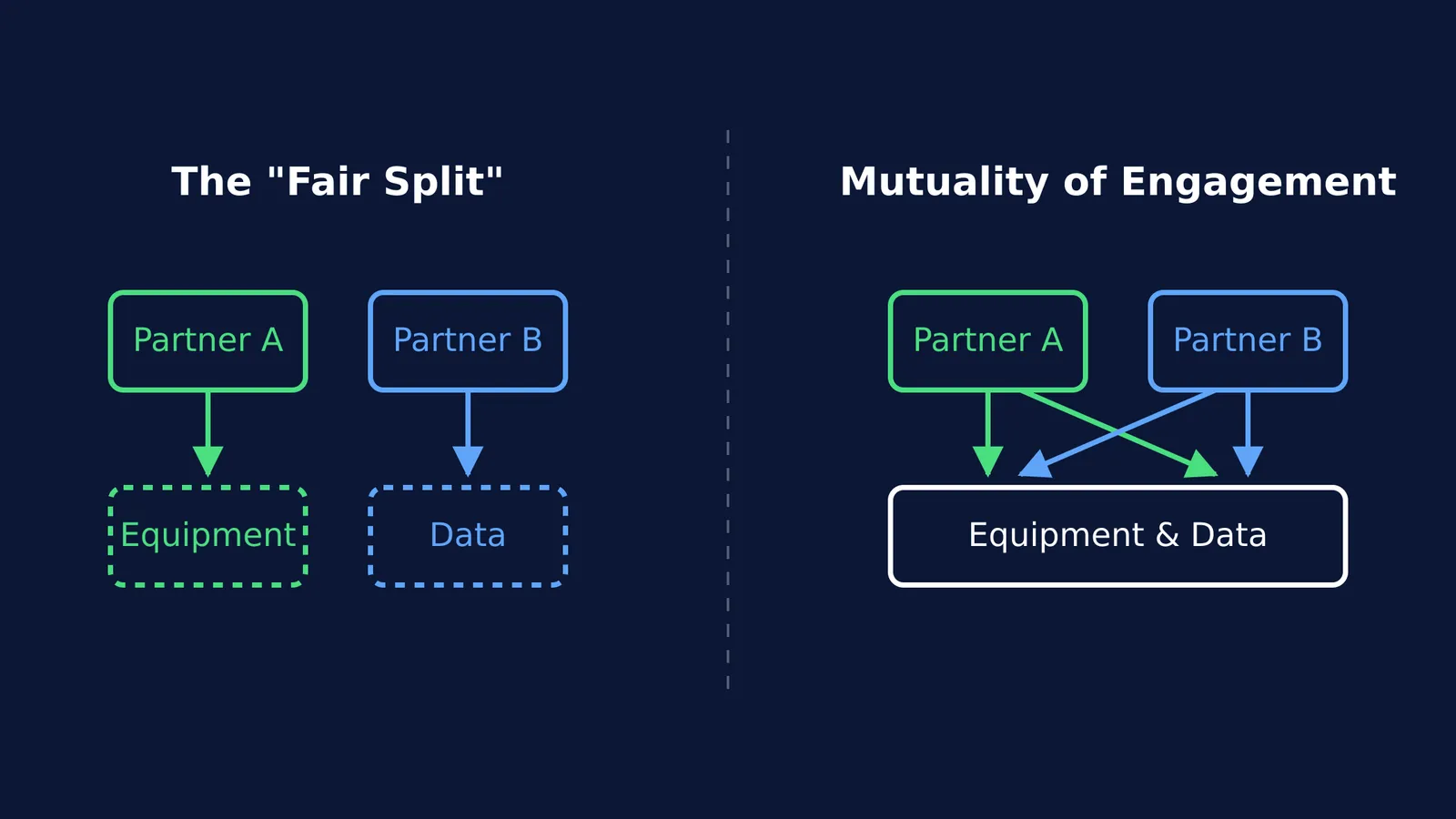
In a 2020 study of introductory physics classes, researchers looked at how students organise their lab time (What Makes a Good Physics Lab Partner?, 2020). They found that most students prefer a "fair split", where one student acts as the "tinkerer" who operates the apparatus, while the other acts as the "secretary" who records the data.
While this feels efficient, it leads to unequal learning. The student taking notes misses out on the physical skills and the troubleshooting experience. The researchers found that students benefit much more from "mutuality of engagement"—where both partners participate equally in all aspects of the experiment. Students who shared the physical tasks and the data analysis reported significantly higher interest and self-efficacy in physics. This shared approach was found to disproportionately benefit women, who are more often pushed into clerical roles in traditional lab splits.
What if my lab partner has a different skill level?
You might worry that pairing up with someone who knows more, or less, than you will drag you down. A 2012 study published in *CBE—Life Sciences Education* tested this by pairing undergraduates with graduate students in a biotechnology lab (Student Learning Outcomes and Attitudes When Biotechnology Lab Partners Are of Different Academic Levels, 2012).
Initially, 66% of the undergraduates said they preferred a partner of their own academic level. But the results showed that differing abilities were an advantage. The average grades of the undergraduates increased on every single assessment method when they were paired with a graduate student. The graduate students saw their grades rise modestly too, likely because explaining the concepts to their partner reinforced their own knowledge. By the end of the course, only 4% of the undergraduates in these mixed pairs still preferred working with someone of their own level.
If your partner is struggling, explaining the steps to them will help you remember the material for your viva. If they are far ahead, working closely with them will lift your own standard.
How should you share the lab bench?
To build a true mutuality of engagement, you need a routine. Here is a framework for working with your lab partner so that you both walk away understanding the experiment.
Prepare independently: You cannot share the work if only one of you knows what is going to happen. Read the lab manual before you arrive. If the theory is unclear, you can upload the manual to Fermi's AI tutor. It works out what you already know, builds a plan for the session, and teaches through it—drawing the figure and checking understanding as it goes—so you sit down at the bench ready to act.
Rotate roles by the run: Instead of one person doing all the pouring and the other doing all the writing, swap halfway. For example, when tracing a ray through a glass slab, person A places the pins for the first angle of incidence while person B measures the angles. Then, you swap. If you are titrating oxalic acid with KMnO4, you can take turns operating the burette for each reading.
Speak your thoughts aloud: Talk through what you are doing, even if it seems obvious. "I am opening the stopcock slowly because the solution is turning faintly pink." This prevents the secretary from zoning out, and allows your partner to catch mistakes before you make them.
Co-write the conclusion: Do not divide the lab report so that one writes the method and the other writes the discussion. The discussion is where the learning is solidified. Sit together, look at the graph you have plotted, and agree on what it means before you write it down.
How can you prepare for the viva together?
Your lab partner is also your best study resource for the end-of-term practical exams. When the experiment is over, spend ten minutes quizzing each other. Ask why you used a specific reagent, or what would have happened if the temperature had been higher. If neither of you knows the answer, you can look it up in the Fermi Concept Library to see how the idea fits into the wider topic.
By sharing the tools, the notes and the theory, you ensure that both of you leave the laboratory as better scientists.


