

On this page
The Joint Seat Allocation Authority (JoSAA) manages the counselling process for admissions into IITs, NITs, IIITs and GFTIs. After working hard to qualify for JEE Main or JEE Advanced, the next hurdle is the choice filling process. A common question among students and parents is how many of the available college and branch combinations they should select to secure a seat.
How many choices are available in JoSAA?
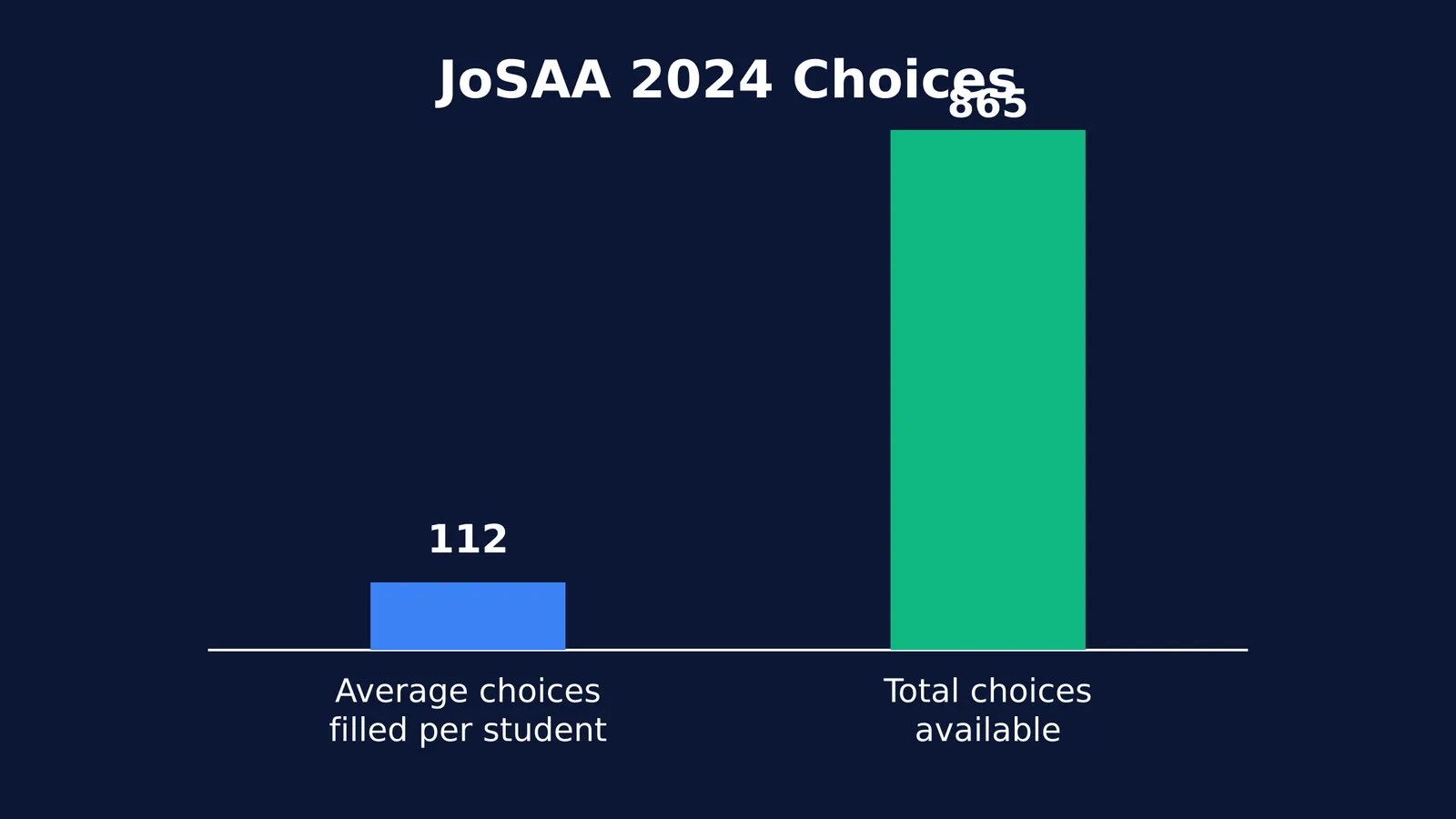
The total number of options depends on your eligibility. In the 2024 counselling cycle, a total of 865 choices (institute-program combinations) were available across 121 participating institutes, according to the official seat matrix. Each choice represents a specific academic program at a specific institute, such as Mechanical Engineering at an IIT or Computer Science at an NIT.
This total was split between the two systems:
IITs: 295 choices across 23 Indian Institutes of Technology, available only to candidates who qualified in JEE Advanced.
NIT+ System: 570 choices across 32 NITs, 26 IIITs and 40 GFTIs, available to all candidates who cleared JEE Main.
Understanding the sheer volume of available options is the first step in building a realistic preference list. Many students are surprised by the variety of programs beyond the traditional branches, including specialized dual-degree and integrated master's programs.
How many choices should I fill in JoSAA?
There is no maximum limit on the number of choices you can submit. You can fill all 865 if you are eligible for them. The system does not penalize you for having a long list.
In the 2024 cycle, 1,72,782 participating students submitted a total of 1,93,71,842 options during the mock allotment phase, meaning the average candidate filled approximately 112 choices, based on JoSAA data. The mock allotment phase acts as a trial run, showing students which seat they might be allocated based on their current preference list and rank, allowing them to make adjustments before the final submission deadline.
While high-ranking students often fill fewer choices because they are confident of getting their top preference, students with average or lower ranks should fill at least 80 to 100 choices. A common mistake is filling fewer than 20 choices, which leaves many students with a "No Seat Allotted" result if cut-offs shift unexpectedly. By expanding your list, you create a safety net against unpredictable year-to-year variations in opening and closing ranks.
Does filling more choices hurt your chances?
No. The JoSAA software processes your list from top to bottom (preference 1, then 2, then 3). The moment it finds a seat where your rank meets the cut-off, it stops and allots that seat. It will never look at the choices below that point.
Adding safe backup options at the bottom of your list (e.g. at position 85) has zero effect on whether you get the seat at position 5. The system will only ever try to upgrade you to choices 1 through 4 in subsequent rounds. You are never penalized for giving the algorithm more options to consider if your primary preferences are unavailable.
To apply this model effectively, reach choices should be programs where last year's cut-off was slightly better than your rank. Target choices are those where your rank falls comfortably within the previous year's range. Safe choices are programs where your rank is significantly better than the historical cut-off, ensuring you have a guaranteed fallback option.
How should you order your preferences?
Always order your choices by genuine preference, ignoring your rank. Put your absolute dream college and branch at number 1, even if you think you have no chance of getting it. If you qualify for it in a later round, the system will automatically upgrade you.
Avoid "block filling"—listing all IITs first, followed by all NITs. A top-tier NIT in computer science is often a better choice than a newer IIT in a branch you have no interest in. Mix the institutes based on what you actually want to study. Research the faculty, placement records, and campus facilities for each option on your list to ensure you are comfortable attending any program you rank highly.
Before you reach the counselling stage, preparing for the exams is the hard part. If you are stuck on a difficult topic, the Fermi Problem Library provides worked problems with a step-by-step solver that explains the reasoning rather than printing an answer. However, when it comes to JoSAA, the allocation is purely algorithmic, so a well-researched preference list is your best tool.
To understand the broader process, read about the JoSAA counselling basics and what happens in the CSAB special rounds if seats remain vacant.


