

On this page
In India, the final rounds of engineering, medical and state counselling often stretch weeks past the official start of the academic year. If you joined college late, you are not alone in feeling overwhelmed by missed lectures, pending lab records and the fast-approaching first internal exams.
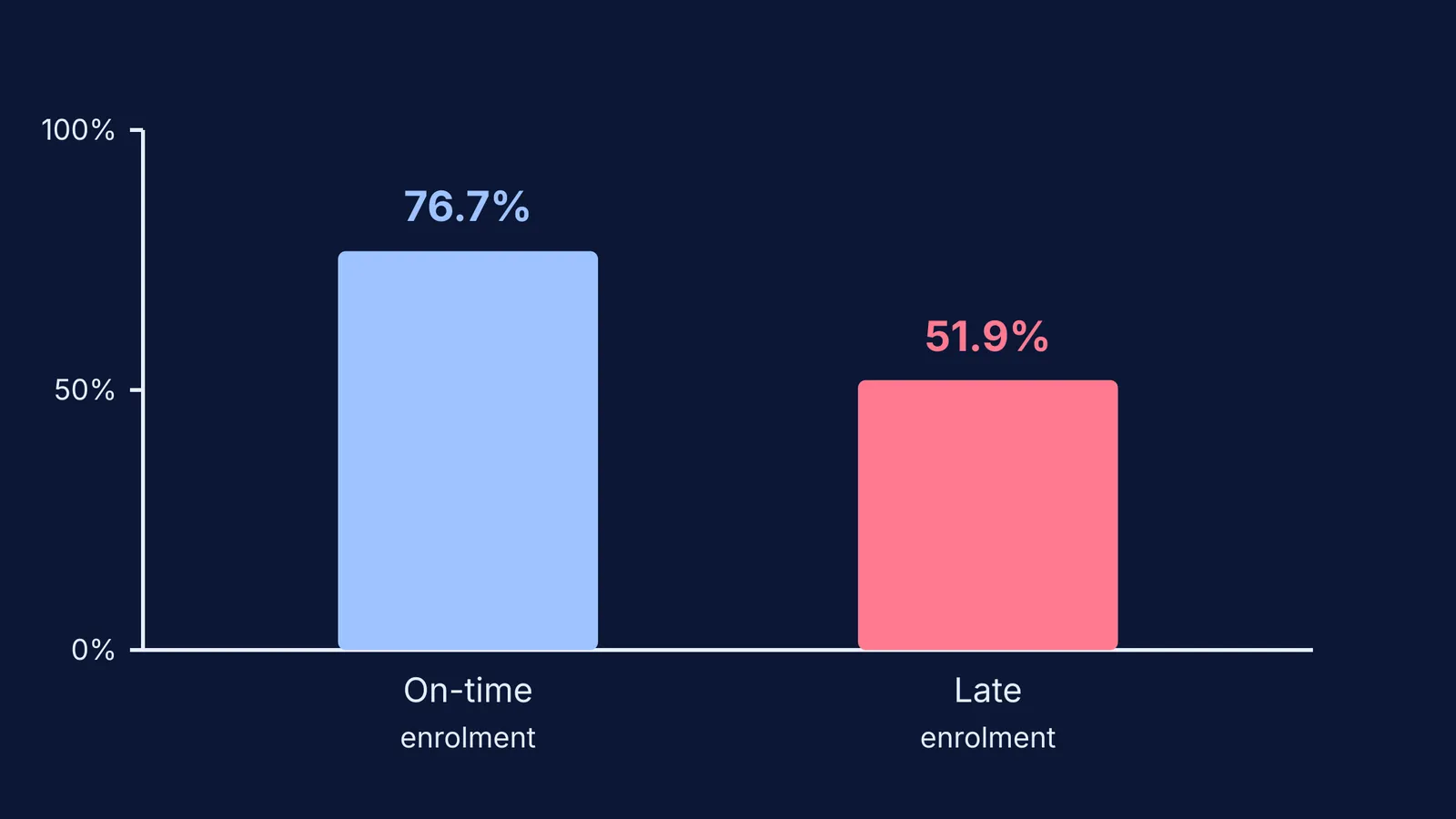
The gap between the start of classes and your first day matters. According to a 2009 study of over 7,000 students published via the US Department of Education (ED526991), students who register late persist in their courses at a much lower rate (51.9%) than on-time enrollees (76.7%). To beat those odds, you cannot just try to read everything you missed from page one. You need a targeted strategy.
What happens if I join college late after the final counselling round?
Most Indian colleges run their first internal assessment (often called the first sessional or IA) just a few weeks into the semester. If you joined late, you might only have a short time to prepare for an exam covering multiple units of the syllabus.
Professors usually continue with the schedule, meaning you are trying to understand the current unit in class while simultaneously self-studying the earlier units at home. The most immediate impact is the sudden pressure of "term work": submitting practical records, copying missed notes, and completing assignments to secure your internal marks.
How to catch up on missed syllabus in engineering first year?
The first few days after admission are critical. Do not just ask classmates for their notes. Ask for the official syllabus copy and the list of textbooks the professors actually follow. In many universities, internal exam questions are drawn straight from one prescribed textbook or the professor's own slides.
Next, triage the missed syllabus using the "Traffic Light" method:
Green: Foundational topics you already know from previous classes. Read them quickly and move on.
Yellow: Topics you understand conceptually but need practice on. Focus on solving numericals here.
Red: Completely new concepts. These require active learning, such as watching short targeted video explanations, rather than passive reading.
When you hit a "Red" topic, you need to find the gaps in your prerequisite knowledge fast. Fermi's AI tutor can work out what you already know and build a plan for the session, so you sit down to a clear next step instead of a blank page.
How to prepare for the first internal exams after joining late?
Your goal for the first internal exam is not to score full marks, but to pass comfortably and bridge the gap.
Prioritise Previous Year Questions (PYQs): Get the internal and university question papers from recent years from your seniors or the college library. You will notice a pattern of repeating questions. Master these first.
Focus on the early units: Usually, the first internal exam covers only the initial modules of the syllabus. Dedicate your weekend entirely to these units.
Target numerical subjects: Theory subjects can sometimes be managed shortly before the exam, but subjects like Engineering Mechanics, Mathematics, or Programming require consistent practice.
For numerical subjects where you keep making wrong-method mistakes, the Fermi Problem Library has worked problems with a step-by-step solver that explains the reasoning rather than just printing an answer.
A weekly catch-up framework
To avoid burnout, structure your recovery over several weeks. You can incorporate this into a broader study routine that lasts rather than relying on all-nighters.
First week: Backlog Clearing. Complete all missed lab records and mandatory assignments. Inform your professors about your late joining; most are lenient with attendance for late admissions and might highlight what is important for the exams.
Second week: Foundation Building. Clear your "Red" and "Yellow" topics. Use the Fermi Concept Library to target specific concept gaps without having to read an entire textbook chapter.
Third week: Exam Prep. Shift entirely to solving PYQs and practising high-weightage numericals for the upcoming internal exams.
By accepting that you cannot learn everything perfectly in the first month, you can focus on passing the immediate hurdles. Once the first internals are behind you, you will be in sync with the rest of the class, avoiding the trap that explains why some JEE aspirants plateau when they fall behind schedule.


