

On this page
Building a simple Internet of Things (IoT) system is one of the most effective ways to see how physics and computer science work together. Instead of just writing code that runs on a screen, an IoT project connects the physical environment to the digital world. By building a sensor project that sends data to a phone or web page, you learn the realities of electronics, networking, and programming.
What is a simple IoT project?
At its core, an IoT project reads a physical quantity—like light, temperature, or moisture—and transmits that information over a network so you can read it elsewhere. A classic first project is a room temperature and humidity monitor.
The device sits on your desk, measures the air, and sends a live graph to a dashboard on your phone. If the temperature crosses a certain threshold, the system can send you an alert. Another practical option is a smart plant waterer. A soil moisture sensor checks if a plant is dry; if the soil resistance is too high, the microcontroller logs the data online and can even trigger a small water pump.
These projects transform abstract science into tangible results. The same 2025 study mentioned earlier noted that secondary students who participated in hands-on workshops successfully developed functional IoT systems from scratch. The immediate feedback of seeing a physical sensor change a number on a screen makes the concepts stick.
What hardware do you need?
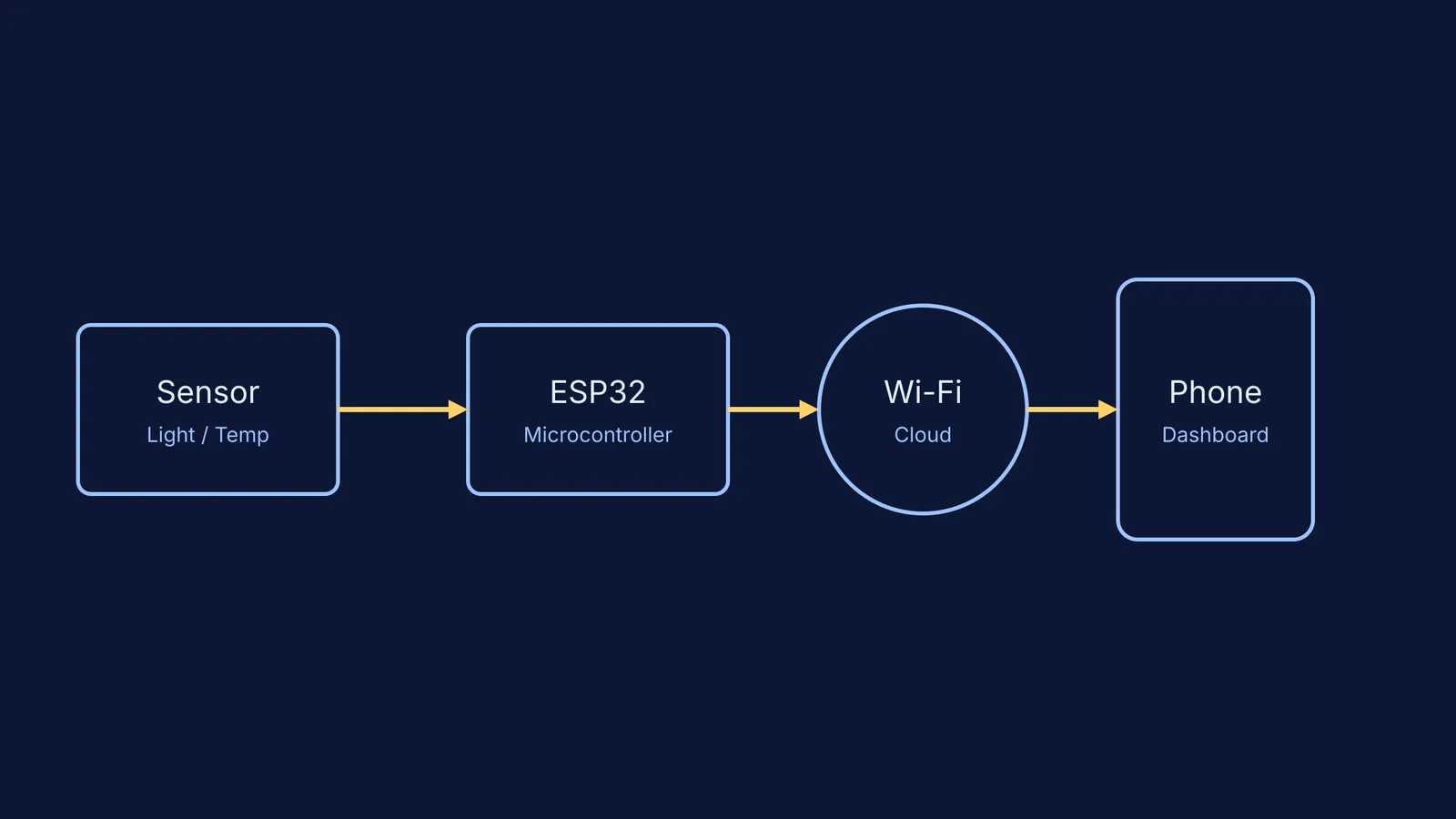
To build an IoT device, you need three main components: a sensor, a microcontroller, and a network connection.
The sensor: This is your input device. An LDR (light-dependent resistor) measures brightness, while a DHT11 measures temperature and humidity. These sensors change their electrical properties based on the environment.
The microcontroller: This is the brain of the project. While an Arduino Uno is popular for basic circuits, an ESP32 or ESP8266 is usually better for IoT because it has Wi-Fi built in. It reads the voltage from the sensor and converts it into a digital number.
The output: You need jumper wires and a breadboard to connect the pins of the sensor to the microcontroller without soldering.
When you start assembling these parts, you are doing more than just plugging things in. You are applying physics. For example, reading a sensor often requires building a voltage divider. If you have concept gaps about how resistance and voltage work together, the Fermi Concept Library has every concept in physics and computing, helping you understand the theory before you wire the circuit.
How does the data reach your phone?
Getting the data from the microcontroller to your phone requires writing code, usually in C++ or MicroPython.
First, the microcontroller connects to your home Wi-Fi network. Then, it uses a lightweight messaging protocol like MQTT or HTTP to send the sensor reading to a cloud server.
You do not have to build the cloud server yourself. Platforms like Blynk, ThingSpeak, or Adafruit IO act as the middleman. They receive the data from your board and display it on a pre-built mobile app dashboard. You log into the app on your phone, link it to your cloud account, and drag a gauge or graph widget onto the screen to visualize your data in real time.
If you are new to programming and do not know where to start with the Wi-Fi code, Fermi's AI tutor can work out what you already know and build a plan for the session, guiding you through the logic step by step.
What does an IoT project teach you?
An IoT project forces you to troubleshoot across different domains. If your phone shows no data, the problem could be a loose wire (electronics), a wrong password (networking), or a syntax error in your loop (code). You learn to isolate variables and test one thing at a time, which is the exact same skill you need when doing a science project: from a good question to a fair experiment.
You also learn how to read datasheets. Every sensor has an operating voltage and a specific pin layout. Connecting a low-voltage sensor to a higher-voltage power supply can destroy it, so you learn to check the specifications first.
Finally, building a physical project builds resilience. Unlike a maths problem that you solve once, an IoT device runs continuously. You might find that your sensor disconnects intermittently, requiring you to rewrite your code to automatically reconnect to the network. Returning to a project repeatedly is a great way to practice consistency, much like learning how to build a study routine that lasts longer than a week. By the end of your first IoT project, you will have built a complete system from the physical hardware all the way up to the cloud.


