

On this page
Why is introducing yourself in college so stressful?
Standing up in a hall or tutorial room full of unfamiliar faces makes almost everyone's pulse spike. Whether entering an engineering lecture or an orientation club meeting, the dread of a round-robin introduction is universal. The discomfort rarely stems from speaking itself, but from the fear of being judged before peer groups form. A 2006 study in *Psychological Science* by Janine Willis and Alexander Todorov found that observers form stable judgments about traits like trustworthiness and competence within 100 milliseconds of seeing a face. Additional exposure time increases confidence in that judgment, but does not substantially alter the initial impression.
Recognising that people form rapid impressions takes the burden off your words. Your peers are not evaluating every syllable; they look for basic warmth and clear identity. Trying to suppress your nerves often backfires. A 2014 study in the *Journal of Experimental Psychology: General* by Alison Wood Brooks showed that reappraising physiological arousal as excitement, rather than attempting to force calmness, significantly improved public speaking performance. Acknowledge your racing heart as energy, take a steady breath, and focus on delivering a brief, friendly introduction.
What is the next-in-line effect in a classroom circle?
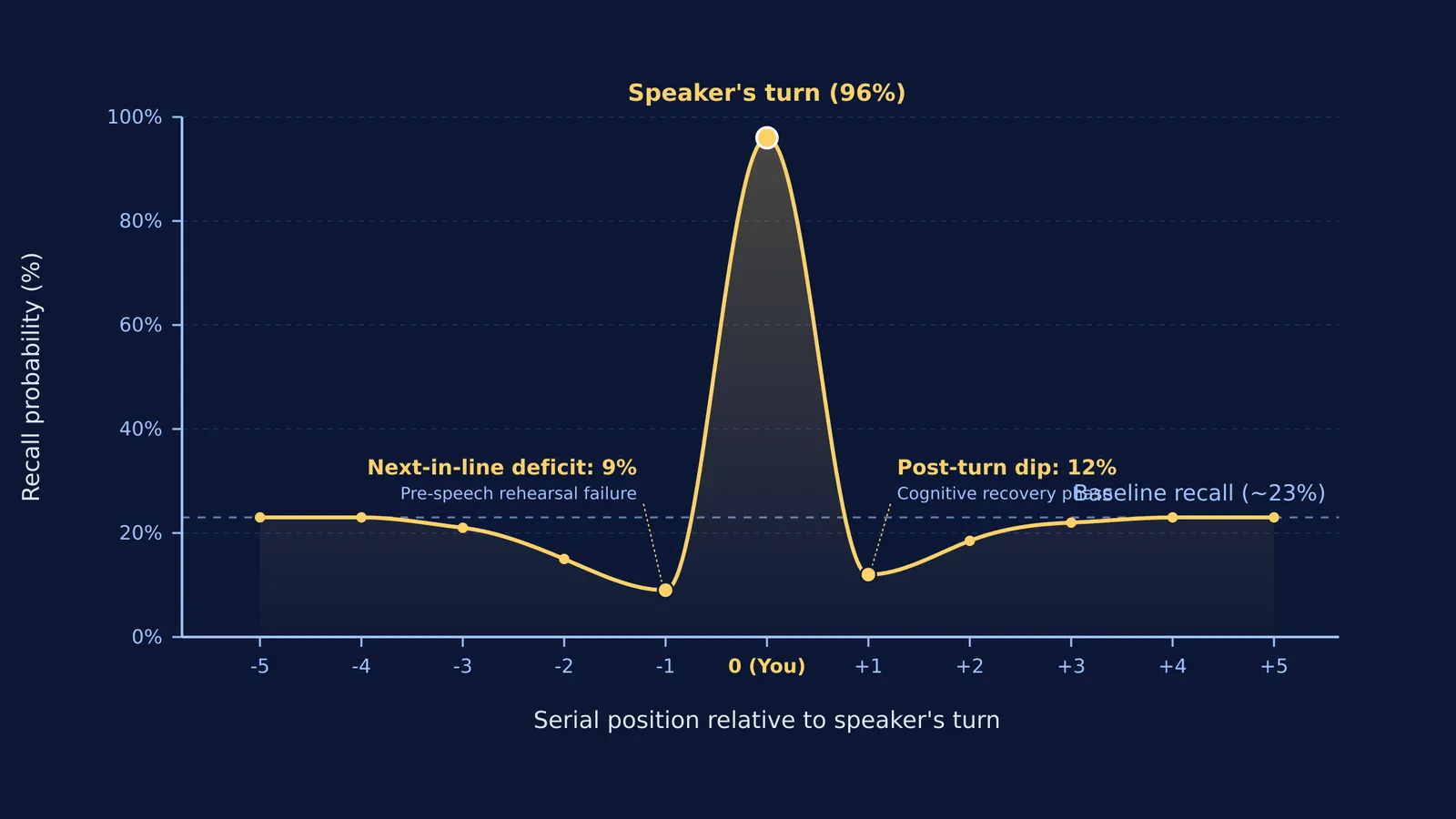
If you have ever sat in an icebreaker circle and realised you cannot remember what the student next to you just said, you experienced a proven cognitive phenomenon. In a landmark 1973 study in the *Journal of Verbal Learning and Verbal Behavior*, psychologist Malcolm Brenner80076-3) identified the "next-in-line effect." Participants taking turns reading words aloud recalled roughly 9% of items spoken immediately before their turn, compared to a baseline recall rate of approximately 23% for words spoken earlier in the sequence. Recall for a speaker's own turn peaked at nearly 96%, but plunged back to about 12% for the person immediately following.
This deficit is not a memory flaw; it is an attentional bottleneck. In 1985, Charles F. Bond, Jr. demonstrated in the *Journal of Personality and Social Psychology* that the next-in-line effect stems from an encoding failure. As your turn approaches, your attention shifts inward toward rehearsal and performance anxiety, leaving no cognitive bandwidth to store what your neighbour says. Understanding this dynamic brings immediate relief: the classmates immediately before and after you are focused on their own turns. Nobody is scrutinising your pauses.
How should you structure a 30-second college introduction?
The most effective introductions avoid lengthy autobiographies and stick to a three-part framework lasting under 30 seconds:
Name and origin: State your full name clearly, note your preferred name, and mention your hometown or department.
One conversational anchor: Mention a single specific interest, hobby, or project that gives peers an easy opening to talk to you after class.
Forward-looking curiosity: State what you hope to learn or explore in this specific course or club.
This structure works because it limits cognitive load. Listing five hobbies and past test ranks sounds like reciting a CV. A single vivid detail gives classmates an anchor they can remember.
When navigating your first semester at science or engineering college, sharing genuine curiosity also simplifies forming study groups. If an advanced syllabus feels intimidating, the Fermi Concept Library offers lessons mapped across physics, chemistry, biology, mathematics and computing, providing the conceptual foundation you need for class discussions.
What scripts work best for class, clubs, and lab partners?
Having a rehearsed template prevents your mind from freezing during anticipatory surges. Here are three practical scripts:
For a lecture or tutorial: "Hi everyone, I am Aarav Sharma from Bhopal, joining the Electrical Engineering branch. Outside class, I build amateur robotics and follow Formula 1. I look forward to circuit analysis labs this term and hope to connect with folks for study groups."
For a student club or society: "Hello, my name is Priya Patel from Ahmedabad, and I am a first-year Computer Science student. I spend free weekends tinkering with Linux and building small web apps. I joined this society to collaborate on open-source projects."
For a lab practical pair-up: "Hey, I am Rohan. I feel comfortable with theory, but I want more practice with hardware breadboards. If you like, we can partner up, work through the calculations, and split lab measurements evenly."
Finding reliable partners early assists with building a study routine that lasts. When tackling assigned problem sets together, the Fermi Problem Library provides worked problems with a step-by-step solver that explains the reasoning rather than printing an answer, giving group members a shared reference.
How do you remember your classmates' names on day one?
Overcoming the next-in-line effect requires deliberate focus:
Repeat names silently: Charles F. Bond's 1985 research showed that conscious advance intention can reverse the encoding deficit. Silently repeat each classmate's name the moment they state it.
Jot notes discreetly: Keep a notebook open and write down the names and seat positions of the two students sitting on either side of you.
Use their name when leaving: As class ends, say goodbye using their name: "Good luck with the assignment, Vikram."
Managing early nerves with strategies like treating exam nerves as energy ensures you enter your first college classes with poise, memorable anchors, and lasting connections.


