

On this page
You have finished your internship, and now you have to write a report. This report is not just a formality; it is the academic proof of your practical work and what ultimately earns you your degree credits.
Writing a full document from scratch can feel daunting. However, if you understand what your college expects and how to maintain a structured daily log, the final report will essentially write itself.
What do AICTE and colleges expect?
Under the All India Council for Technical Education (AICTE) Internship Policy, internships are a mandatory part of the curriculum for engineering and diploma students in India. A B.Tech student is expected to complete 14 to 20 credits of internship work, which translates to 600–700 hours of practical exposure over the course of their degree.
To evaluate this massive time investment, colleges rely on two main documents:
The Daily Diary (Format 5): A daily record of your tasks, signed regularly by your industry supervisor.
The Final Report: A comprehensive, chapter-wise summary of your entire internship experience, defended during a viva voce.
How do you structure your daily log (Format 5)?
The biggest mistake students make is waiting until the last week of their internship to write their daily diary. Memory fades, and generic entries like "worked on the project" will not earn high marks.
The AICTE Format 5 diary requires specific fields: Day & Date, Time of Arrival/Departure, Department, Name of Finished Product, Main Points of the Day, and the Supervisor's Signature.
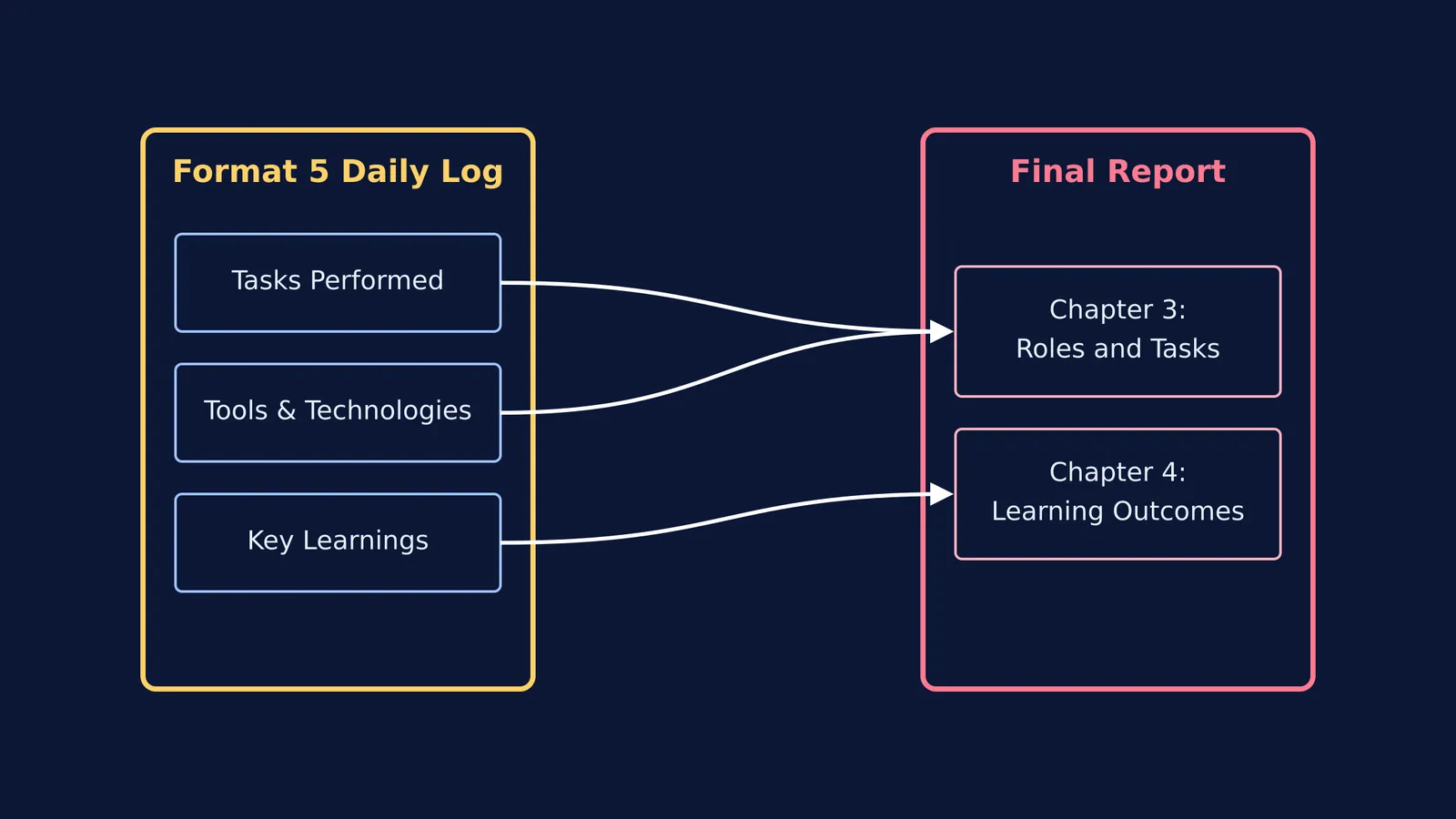
To make this log genuinely useful for your final report, structure your "Main Points" using this four-part framework:
Tasks Performed: Be specific. Write "Developed a responsive navigation bar using CSS Flexbox" instead of "Did web design."
Tools & Technologies: List the software or equipment used (e.g., Python, AutoCAD, oscilloscopes).
Key Learnings: What new concept did you master today?
Challenges & Solutions: Did you face a Git merge conflict or a stubborn bug? Note how you fixed it.
If a daily task requires applying a university concept you have forgotten, Fermi's AI tutor can work out what you already know and build a plan for the session to teach it to you, so you can apply it at work and document it in your log.
What is the structure of a final internship report?
If you have maintained a detailed Format 5 diary, writing the final report is just a matter of grouping your daily entries into chapters. Most universities expect a standard five-chapter structure:
Chapter 1: Introduction
Start with the background of your internship. Why did you choose this specific role? Outline your core objectives and the scope of your work.
Chapter 2: Company Profile
Provide a brief overview of the organization, its vision, mission, and services. Include an organizational chart to show exactly where your department fits into the broader company structure.
Chapter 3: Roles and Tasks
This is the heart of your report. Open your daily diary and group your daily tasks into larger projects. Describe the problem statements, the methodologies you followed, and the technical tools you used. Use the STAR method (Situation, Task, Action, Result) to explain your contributions clearly.
Chapter 4: Learning Outcomes
Reflect on your growth. Divide this chapter into two sections:
Technical Skills: The hard skills and software proficiency you gained.
Soft Skills: Professional growth such as teamwork, communication, and workplace ethics.
Chapter 5: Conclusion and Future Scope
Summarise whether you met your initial objectives. Provide professional recommendations for the company based on your observations, and explain how the internship has prepared you for your future career.
What are the common mistakes and how do you fix them?
Forgetting signatures: An unsigned daily diary is invalid. Get your industry supervisor to sign your logbook at the end of every week.
Lack of connection to coursework: Examiners want to see how you applied classroom theory to real-world problems. Explicitly mention which university courses helped you during specific projects.
Plagiarism: Never copy company confidential data or another student's report. Keep your descriptions focused on your personal learning journey and ensure you submit a signed declaration of originality.
For more advice on improving your academic performance, see our guide on Why some JEE aspirants plateau despite studying every day or read about How to evaluate an AI tutor: 8 tests you can run in 20 minutes.


