

On this page
Getting an internship offer letter is exciting, but it is also a legal document that sets the terms of your work. Before you sign, you need to read the details carefully to ensure the role meets your academic requirements and is not a scam.
Here is exactly what you should check in your offer letter before accepting.
What should the duration and working hours be?
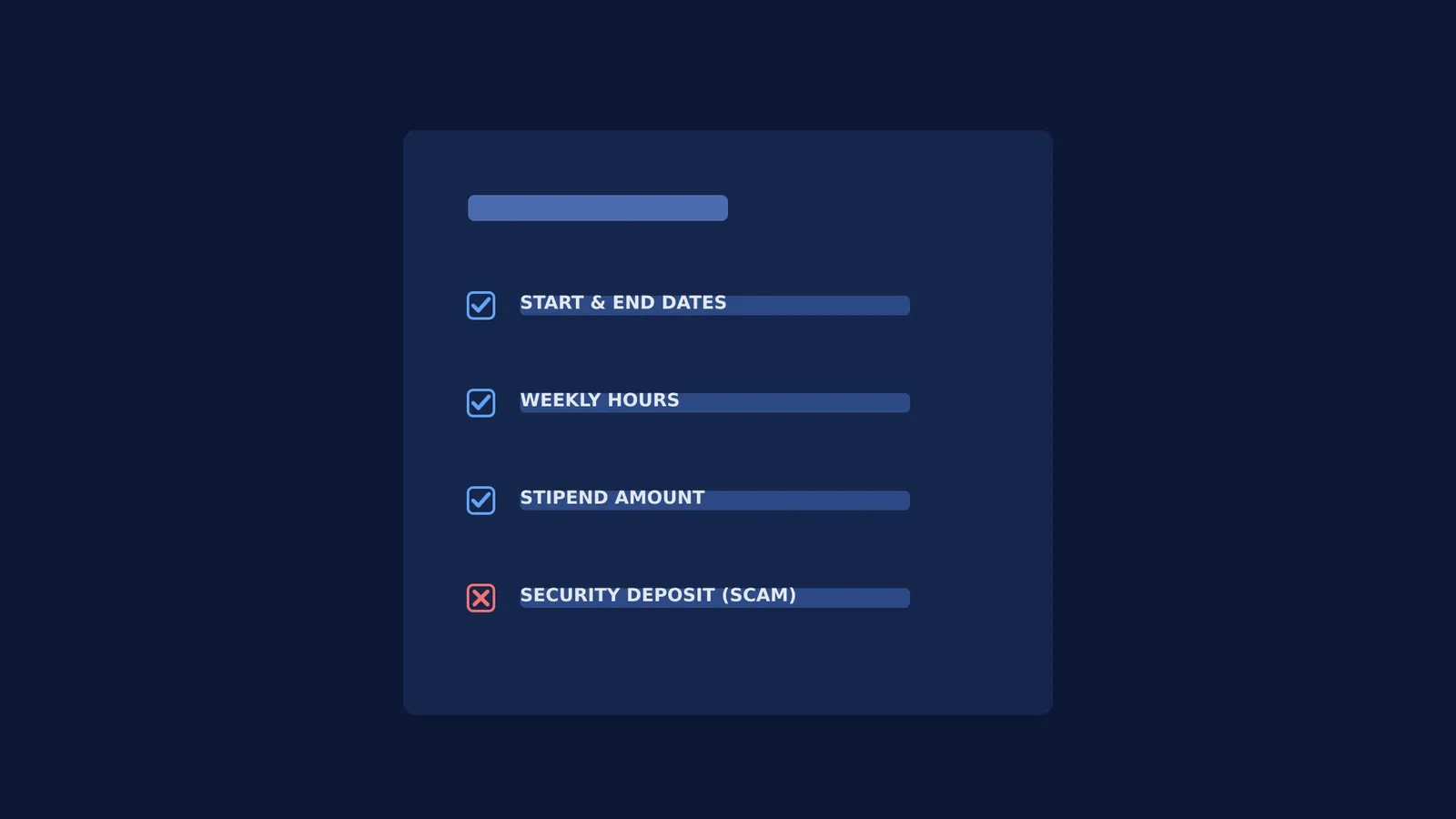
Your offer letter must state a clear start date, end date, and your expected weekly hours. According to the AICTE Internship Policy, a full-time intern is expected to commit 40 to 45 hours per week. If you are a B.Tech student, the AICTE mandates 14 to 20 credits for internships, which translates to a total of 600 to 700 hours of work over your degree.
Check that the dates in your letter give you enough time to meet your college's credit requirements. If the letter is vague about your daily schedule, ask the human resources department to clarify it in writing so you are not overworked during your semester.
Is a stipend mandatory?
The offer letter must explicitly state your compensation. The AICTE strongly encourages industries to pay a stipend to cover travel and living expenses, but it is not universally mandatory for all private companies.
If the internship is paid, the letter should list the exact amount per month. If it is an unpaid role for college credit, the letter should clearly state "Unpaid" or "For Academic Credit". Never assume you will be paid unless the number is written in the document.
Are security deposits or fees normal?
No. A legitimate employer will never ask you to pay money to work for them. If the offer letter asks for a "security deposit" for a laptop, a "registration fee", or a "training masterclass" fee, it is a scam.
Scammers frequently target students with fake letters that promise high stipends but require an upfront payment. If you are asked to pay any money, stop all communication immediately. You can report these fraudulent offers to the National Cyber Crime Reporting Portal by calling the 1930 helpline.
What are the hidden red flags in an offer letter?
Beyond upfront fees, there are other warning signs that an internship might not be worth your time. Be cautious if the offer arrives out of the blue without a formal interview process. Legitimate companies want to evaluate your skills before hiring you.
Another major red flag is a generic email address. If your offer letter is sent from an address ending in `@gmail.com` or `@yahoo.com` rather than an official corporate domain, it is highly likely to be fraudulent. Additionally, watch out for high-pressure tactics. If the email tells you that you must sign and accept immediately or the offer will expire, the sender is trying to force you into making a poor decision without thinking critically.
How to verify the certificate terms?
Most students take an internship to earn a completion certificate for their university. The offer letter should outline the exact deliverables required to earn this certificate, such as submitting a daily log, a final project report, and receiving a positive evaluation from your industry supervisor.
If your internship requires you to use unfamiliar technical skills to complete those deliverables, Fermi's AI tutor can work out what you already know and build a plan for the session, teaching you the concepts step-by-step.
Before signing, verify that the company is a registered legal entity. You can search for the company name on the Ministry of Corporate Affairs (MCA) portal to confirm they actually exist.
A script for replying to your offer
When you are ready to reply to the offer, use this script to ensure you have covered everything politely and professionally:
"Dear [HR Manager's Name],
Thank you for offering me the [Role Title] internship position. I am excited to join the team and accept the offer, starting on [Start Date].
Before I sign the attached letter, I noticed that the document does not specify the daily working hours or the name of my reporting manager. Could you please send an updated copy that includes these details?
Thank you again for this opportunity.
Best regards, [Your Name]"
This script ensures you do not accidentally accept terms that are missing or unclear.
For more advice on navigating university, read about your first semester at college or how to find research internships for science undergraduates.


