

On this page
Joining the merchant navy offers a life of global travel, high earning potential, and months of uninterrupted leave between contracts. However, the path to the bridge or the engine room begins with a rigorous selection process. In India, the gateway to this maritime career is the Indian Maritime University Common Entrance Test (IMU CET).
What are the eligibility criteria for IMU CET?
The IMU CET is the mandatory entrance examination for undergraduate maritime programs, including the B.Tech in Marine Engineering, B.Sc in Nautical Science, and the Diploma in Nautical Science (DNS).
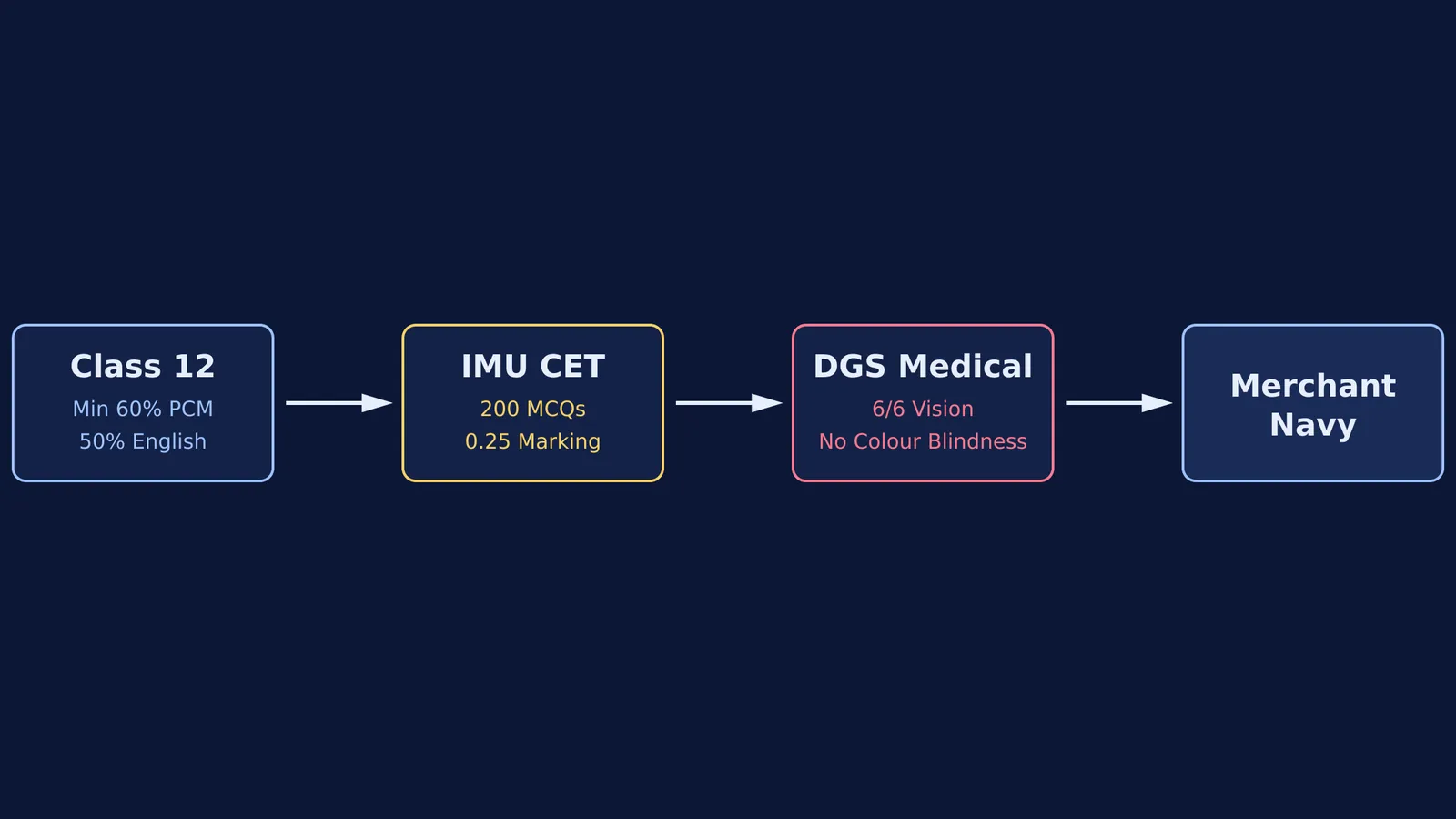
The academic baseline is strictly enforced. According to the official Indian Maritime University guidelines, you need a minimum of 60% in your Class 12 Physics, Chemistry, and Mathematics (PCM) aggregate. Candidates must also secure at least 50% in English in either Class 10 or Class 12. While SC/ST categories receive a 5% relaxation on the PCM aggregate (making it 55%), there is no relaxation for the English language requirement for most candidates.
Additionally, candidates must meet specific age limits. For general category students, the maximum age is 25 years as of the start of the academic session. Standard relaxations are applied for OBC (28 years) and SC/ST (30 years) candidates.
What is the IMU CET syllabus and exam pattern?
The IMU CET is a three-hour computer-based test featuring 200 multiple-choice questions. Speed and accuracy are critical because the exam carries a negative marking of 0.25 marks for every incorrect answer, according to the IMU CET information brochure.
The paper is heavily weighted towards your Class 11 and Class 12 NCERT syllabus:
Physics (50 questions): Focuses heavily on mechanics, kinematics, electromagnetism, and optics.
Mathematics (50 questions): Emphasises calculus, algebra (including matrices and complex numbers), and three-dimensional geometry.
Chemistry (25 questions): Covers physical, organic, and inorganic chemistry basics.
English (25 questions) and General Aptitude (25 questions): Tests grammar, reading comprehension, logical reasoning, and data interpretation.
General Knowledge (25 questions): Broad current affairs and basic maritime knowledge.
Because the physics and mathematics sections dictate half of your total score, regular problem-solving is essential. If you are stuck on the kinematics or vector problems that often appear in the Physics section, the Fermi Problem Library has worked problems with a step-by-step solver that explains the reasoning rather than printing an answer.
For mastering the specific mathematics of motion, understanding Motion in a plane from r(t): velocity and acceleration vectors is highly relevant to maritime navigation. You will also need to be comfortable with kinematics, such as calculating the Distance in the nth second.
What are the medical and physical fitness standards?
Passing the written exam is only half the battle. Before stepping foot on a ship, you must be certified medically fit by a doctor approved by the Directorate General of Shipping.
The eyesight requirements are stringent and non-negotiable. For the B.Sc Nautical Science and DNS courses, you must have 6/6 vision in both eyes without the use of glasses or contact lenses. Furthermore, colour blindness is strictly not permitted for any seagoing role. Distinguishing red (port) and green (starboard) navigation lights against a pitch-black horizon is quite literally a matter of life and death at sea.
What is life at sea really like?
Life in the merchant navy is financially rewarding but demands exceptional mental resilience. You will spend months away from home in a high-stress, isolated environment.
A 2024 report by the Mission to Seafarers, which tracks the Seafarers Happiness Index, noted a general happiness score of 7.05 out of 10 for the third quarter of the year. This score is heavily influenced by internet connectivity and workload. While underway, shifts can easily stretch to 12 hours a day, seven days a week, leaving little time for rest.
However, the isolation is countered by deep camaraderie. The same survey highlighted that crew interaction and social bonds on board remain the highest-scoring drivers of morale (at 7.67 out of 10).
If you are struggling to build a study schedule that covers the vast NCERT syllabus, Fermi's AI tutor can help. When you bring a topic or a problem set to Fermi, it works out what you already know, builds a plan for the session, and teaches through it—writing on a board, drawing the figure, running the simulation, and checking understanding as it goes.


