

On this page
If you missed the 75% mark (Wikipedia) in Class 12 or fell short of a college cutoff, you might be considering an improvement exam. The good news is that the Central Board of Secondary Education (CBSE) and entrance bodies like the Joint Seat Allocation Authority (JoSAA) have clear rules that make taking the exam a low-risk decision.
Here is how the rules work for 2024 and beyond, and a framework to help you decide whether the extra effort is worth your time.
The CBSE "Best-of-Two" rule
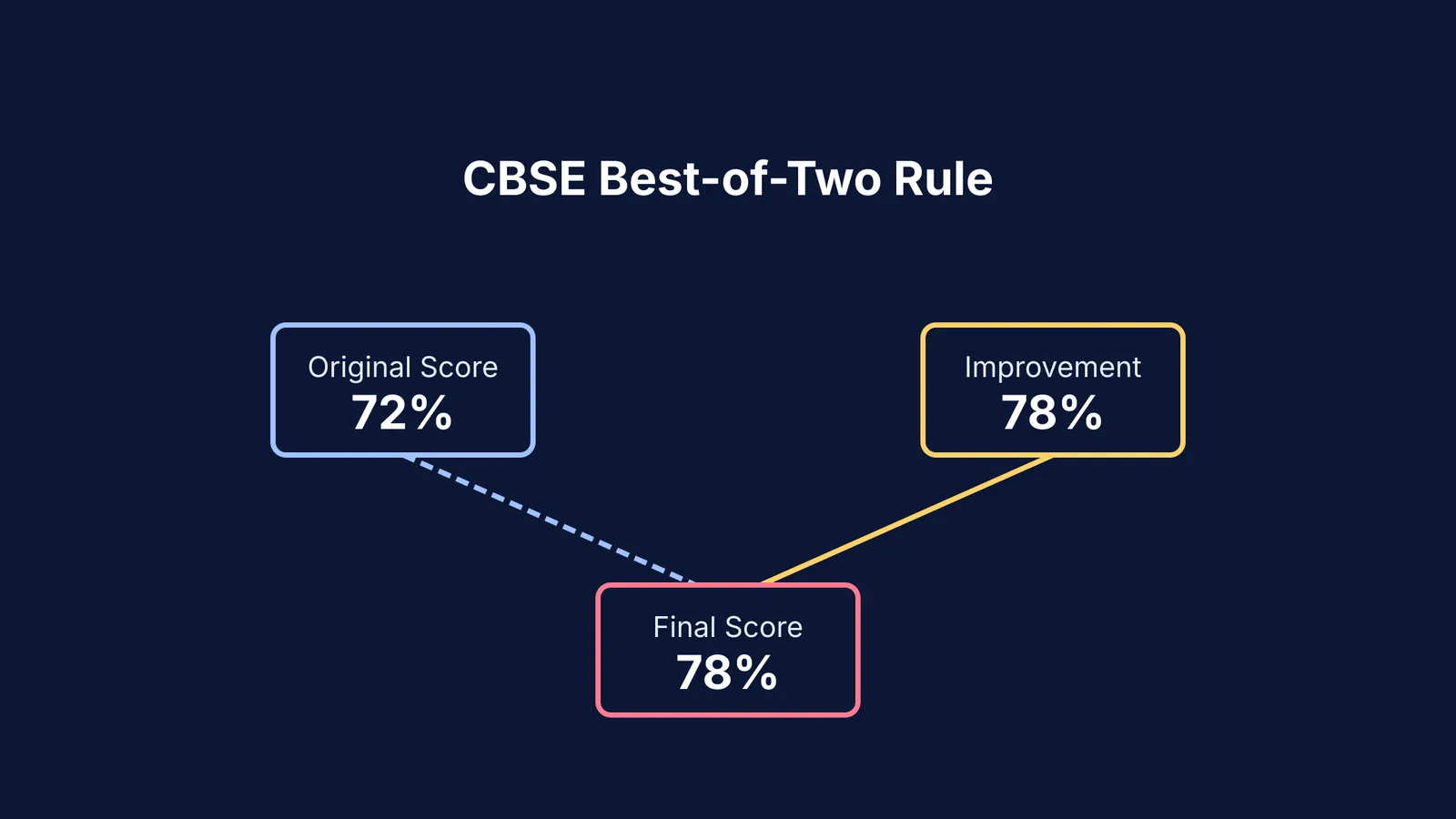
The most common worry students have is whether their percentage will drop if they perform poorly on their second attempt. Under the CBSE's "higher of the two" rule, if you score lower in the improvement exam, your original higher marks are retained. If you score higher, the new marks replace the old ones.
This means attempting the exam carries no risk of lowering your percentage. To be eligible, you must have already passed all subjects in the main board examination. If you failed a subject, you must take the compartment exam instead.
You have two choices for when to take the exam:
The immediate attempt: Usually held in July, this allows you to improve your score in exactly one subject.
The next-year attempt: If you need to improve in multiple subjects, you must appear as a private candidate in the main board exams the following February or March.
When you pass an improvement exam, you receive a fresh marksheet that says "Appeared for Improvement", which you will submit alongside your original marksheet during college admissions.
Does the improvement exam count for the JEE 75% criteria?
Yes, it does. For admission to NITs, IIITs and GFTIs (and IITs via JEE Advanced), JoSAA enforces a 75% eligibility criteria. Candidates must secure at least 75% aggregate marks in their Class 12 exams, or 65% for SC, ST and PwD candidates (Wikipedia).
If you take the improvement exam to meet this threshold, JoSAA will look at both your original and improvement marksheets and select the highest marks achieved in each subject. The aggregate is calculated across five subjects: physics, mathematics, a language, one from a specified list (like chemistry or biology), and one other subject.
However, the rule changes if you are aiming for the "top 20 percentile" route. To qualify for JEE Advanced by being in the top 20 percentile of your board, you must appear for improvement in all subjects (JEE Advanced Official). You cannot use the top 20 percentile cutoff of a different year unless you rewrite the entire exam.
Should I take the improvement exam after class 12?
Your decision comes down to your current marks and your target institutions. Here is a practical framework for making the call, based on the 75% criteria (Wikipedia).
Take the July exam (one subject) if:
You are just a few marks short of the 75% aggregate required for JEE.
You have already secured a college seat but need to clear a specific subject cutoff.
Take the next-year exams (multiple subjects) if:
You are taking a drop year anyway to prepare for JEE.
You need to improve in two or more subjects to meet the 75% rule.
You want to qualify via the top 20 percentile route (JEE Advanced Official) which requires taking all subjects.
Skip the exam if:
You already have above 75% and are aiming for engineering; an extra 2% will not change your admissions outcome.
Your target colleges rely entirely on entrance exams like the CUET, where board percentages act only as a tiebreaker.
Balancing board improvement with entrance exam preparation is hard, especially when navigating policies like the 75 percent board marks rule for NIT and IIIT admission. Once you are clear on your strategy, tracking the JEE Advanced qualifying marks will help you stay focused and set a realistic target.
If you find yourself stuck on difficult concepts while studying alone, Fermi's AI tutor can help. It works out what you already know and builds a clear plan for your study session. When you are working through previous years' papers, the Fermi Problem Library acts as a step-by-step solver that explains the underlying reasoning rather than just printing the final answer.
The improvement exam is a useful tool for crossing hard cutoffs. Once you meet your required percentage, you can turn your full attention to the entrance ranks that ultimately decide your admission.


