

On this page
Who is eligible for the IIT preparatory course?
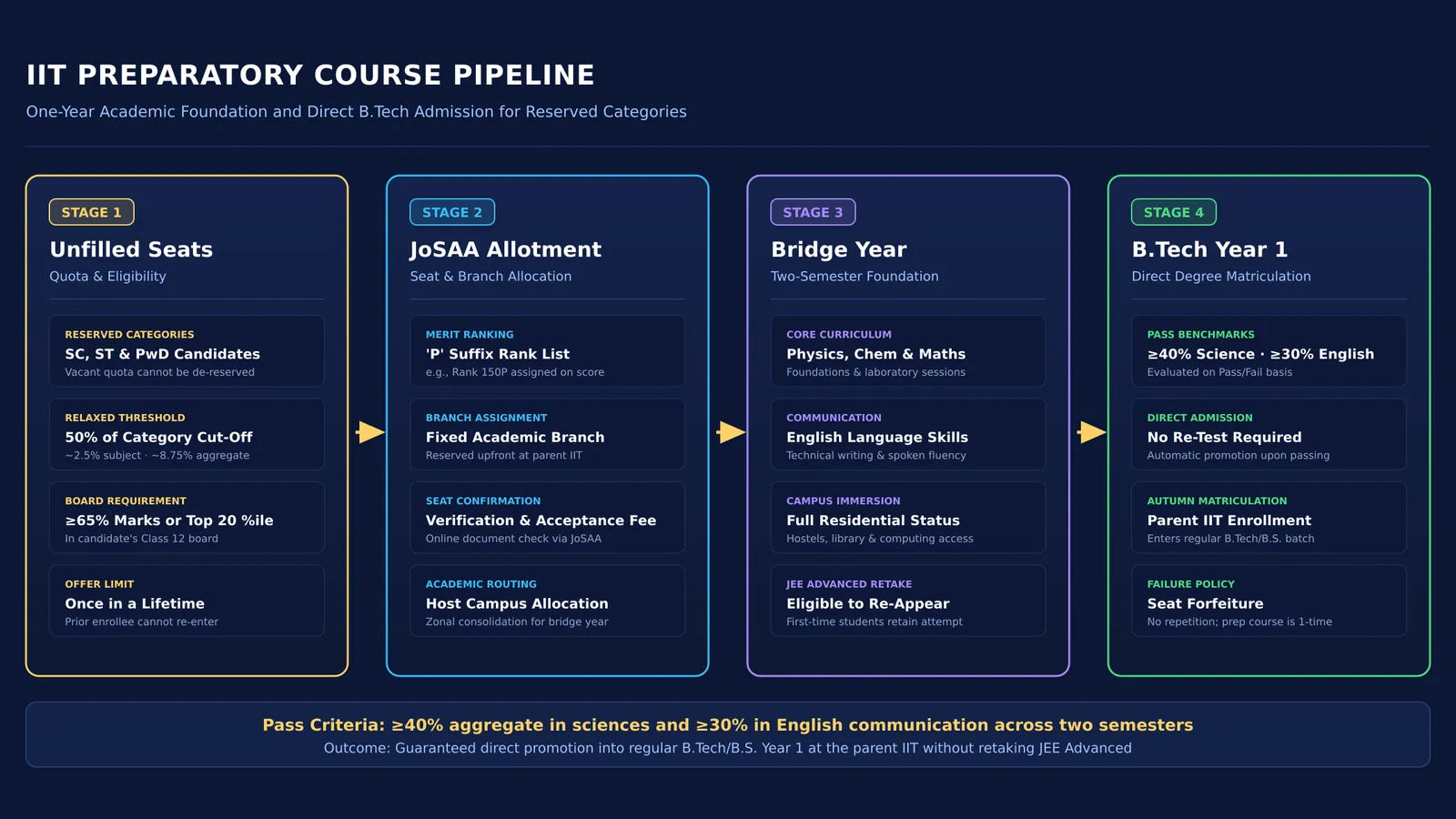
The IIT preparatory course is a one-year bridge program across the Indian Institutes of Technology for reserved categories. According to the official JEE Advanced Information Brochure, it is offered exclusively to candidates belonging to Scheduled Caste (SC), Scheduled Tribe (ST), and Persons with Disabilities (PwD) categories. General, General-EWS, and non-PwD OBC-NCL applicants are not eligible.
The preparatory track activates only when seats reserved for SC, ST, or PwD categories remain unfilled after regular counseling rounds. Because vacant reserved seats cannot be transferred to general applicants under statutory quotas, the Joint Admission Board creates a preparatory rank list when too few candidates meet the standard JEE Advanced qualifying marks.
Inclusion in the preparatory rank list requires meeting a relaxed threshold set at 50% of the standard SC or ST qualifying criteria. Under published JEE Advanced criteria, this typically translates to roughly 2.5% in each subject and 8.75% aggregate marks, compared to 5% subject marks and 17.5% aggregate marks on regular category lists. Candidates must also satisfy Class 12 requirements by securing at least 65% aggregate marks (or placing in their board's top 20 percentile), as described in the Class 12 board marks eligibility criteria.
This bridge offer is strictly a one-time opportunity in a candidate's lifetime. Anyone who accepted or enrolled in an IIT preparatory course previously cannot receive another offer.
How does JoSAA allocate preparatory course seats?
Preparatory seats are not an additional quota created upfront. Instead, they are unfilled statutory seats allocated through the Joint Seat Allocation Authority. Official rules on the JoSAA portal specify that preparatory seats appear only after regular category lists are exhausted.
Eligible candidates receive a scorecard with a preparatory rank suffixed by "P" (such as 150P). JoSAA applies the student's existing choice list, allocating vacant category seats to the highest-ranking preparatory candidates.
Each allotment letter fixes both the admitting parent institute and the academic branch, such as Mechanical Engineering at IIT Kanpur or Chemical Engineering at IIT Bombay. Candidates must complete online document verification and pay seat acceptance fees to secure the place.
What happens during the one-year preparatory course?
The preparatory year functions as a full-time, two-semester academic foundation program. In several academic zones, multiple IITs consolidate their preparatory cohorts at designated host campuses to ensure focused teaching. Academic regulations at host campuses, including IIT Bombay, mandate that preparatory students reside in campus hostels and enjoy full access to libraries, computer centres, sports complexes, and student facilities.
The curriculum concentrates on four core subjects: physics, chemistry, mathematics, and English communication skills. The coursework revisits fundamental principles from Class 11 and Class 12 while transitioning students toward university-level engineering analysis:
Mathematics: differential calculus, vector algebra, matrices, and coordinate geometry
Physics: classical mechanics, wave optics, electricity, and basic lab experiments
Chemistry: stoichiometry, chemical kinetics, organic mechanisms, and qualitative lab analysis
English communication: technical writing, reading comprehension, and spoken fluency
To help students map foundational ideas across physics, chemistry, and mathematics before mid-semester assessments, the Fermi Concept Library covers every concept in physics, chemistry, biology, mathematics and computing, each with its own lesson and its place in the map. When practicing multi-step mechanics and calculus derivations, students can use the Fermi Problem Library, which provides worked problems with a step-by-step solver that explains the reasoning rather than printing an answer.
Students write mid-semester examinations, quizzes, and end-semester tests. Evaluation is conducted on a Pass/Fail grading system. Passing the program typically requires securing an aggregate of at least 40% in physics, chemistry, and mathematics, alongside at least 30% in English language evaluations, according to IIT academic norms.
What happens after the preparatory year ends?
Completing the bridge year leads to direct promotion. When a student passes both semesters, the host institute forwards their completion certificate to the parent IIT. The candidate is automatically matriculated into the first year of their allotted B.Tech or B.S. program for the upcoming autumn semester. They do not have to sit for JEE Advanced again.
Students who face learning gaps during the transition often find that independent revision makes a substantial difference. Working with Fermi's AI tutor allows students to explore where they are stuck, as the tutor works out what they already know and builds a plan for the session.
If a candidate fails the end-of-year examinations, the provisional seat offer is forfeited, and the preparatory program cannot be repeated. However, the official JEE Advanced eligibility criteria include a key provision: candidates enrolled in a preparatory course for the first time remain permitted to re-appear for the next JEE Advanced exam, as specified by the JEE Advanced Information Brochure, provided they meet standard attempt and age limits. This policy ensures students retain the option to compete for an upgraded branch or alternate institute while completing their foundation year.
Key milestones from allotment to B.Tech Year 1
JoSAA preparatory allotment: verify category certificates and accept the allotted engineering branch.
Host campus registration: complete document checks and hostel admission for the two-semester program.
Autumn semester: study foundational physics, chemistry, mathematics, and English communication.
Spring evaluation: pass laboratory exams and finals under host IIT academic standards requiring at least 40% in science subjects.
First-year matriculation: join regular B.Tech classes at your parent IIT in the subsequent academic session.
To track official seat matrices and upcoming allocation schedules, visit the JoSAA portal.


