On this page
An ideathon tests your ability to define a problem and design a solution, without expecting you to write the code. A hackathon typically lasts 24 or 48 hours, with teams working overnight to build a functional software or hardware prototype Wikipedia. In an ideathon, you spend your time researching the market, estimating feasibility and preparing a pitch deck.
Because there is no prototype to demonstrate, judging focuses entirely on the quality of the idea and how well you present it. Research into ideathon group discussions shows that successful teams explore different facets of the problem and focus on user value before moving to concrete implementation Procedia CIRP.
What is the difference between an ideathon and a hackathon?
The primary difference is the final deliverable. A hackathon demands a working minimum viable product (MVP) or functional code, which often means teams must include experienced programmers. An ideathon, however, demands a thoroughly researched concept, a solid logical foundation, and a compelling pitch.
This means ideathons are accessible to students from all backgrounds, as technical coding skills are not required to participate or win. Instead, you need strong analytical thinking, clear communication, and the ability to work well with your teammates. You might sketch wireframes or draw diagrams to explain your concept, but no one expects you to launch a live application at the end of the event.
How are ideathons judged?
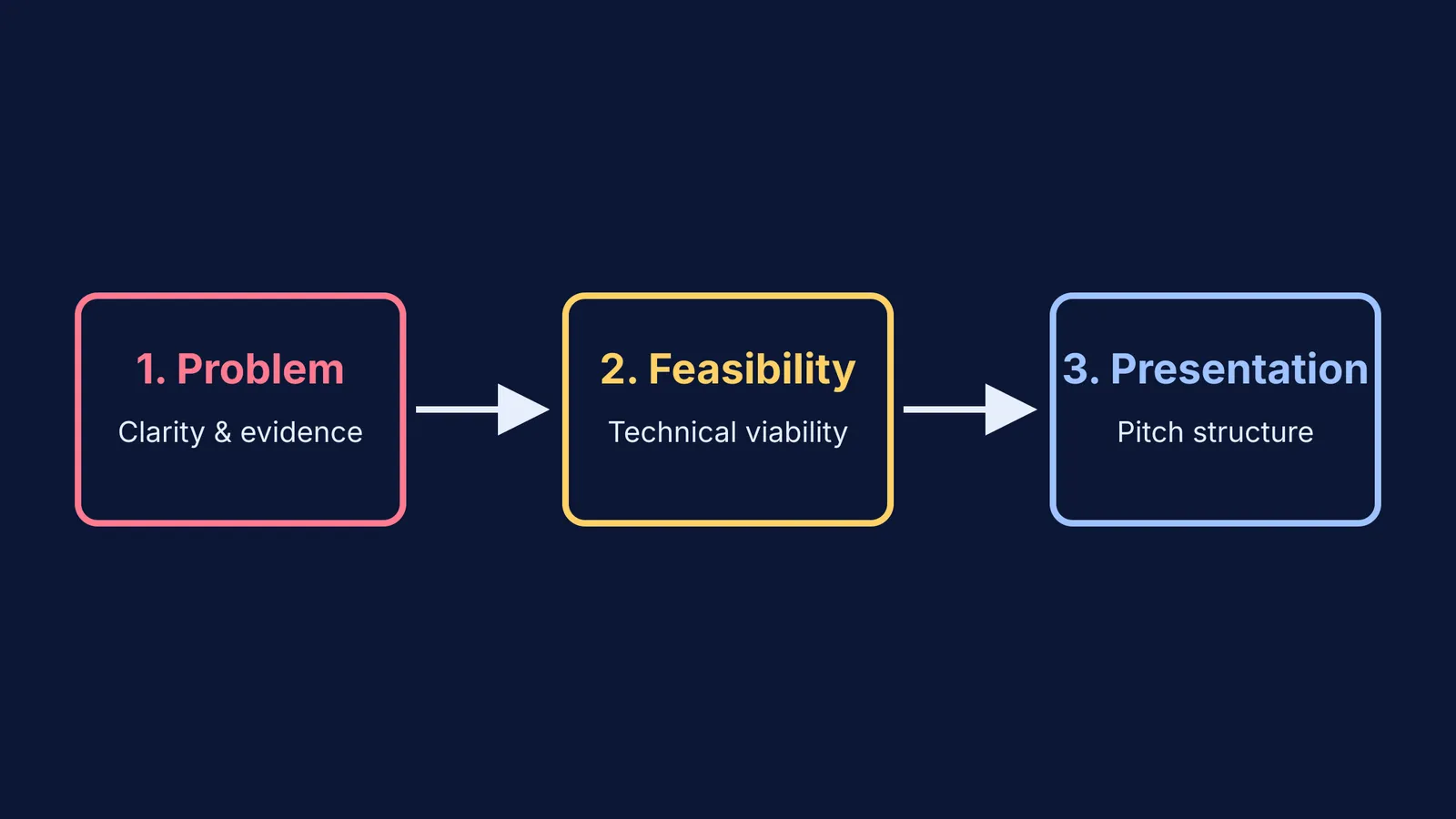
Most rubrics break down into three main areas that evaluate your research and logic rather than your technical execution.
Problem clarity: Can you state the problem simply? Judges look for evidence that the problem is real, not just an assumption. You need to show who suffers from it, how many people are affected, and why current alternatives fail to solve it. Gathering actual data or conducting a quick survey during the event can give your pitch a massive advantage.
Feasibility: Since you are not building the product, feasibility is your reality check. Could this be built with current technology? Is it financially sustainable? Judges want to see that you have thought through the real-world constraints. If your idea relies on a scientific or mathematical principle you haven't mastered yet, the Fermi Concept Library has a lesson for every concept in physics, chemistry, biology, mathematics and computing.
Presentation: This is the pitch itself. Can you explain your solution clearly, defend it during the questions that follow, and keep the judges engaged? A strong presentation balances passion with hard facts and respects the time limit.
What is a simple pitch structure for your presentation?
The most common mistake teams make is spending too much time explaining their solution and too little time on the problem it solves. A winning pitch acts as a hook and sinker, pulling the audience in before explaining the mechanics.
The Hook (The Problem): Start with a specific story or a validated fact. Make the judges feel the pain of the problem before you offer them the cure. A single, relatable example is often more powerful than a slide full of statistics.
The Reality Check (Feasibility): Explain how your solution works practically. This is where you might need to estimate energy requirements, costs, material properties or scales. If you are stuck on the physics or maths behind your idea's feasibility, the Fermi Problem Library has worked problems with a step-by-step solver that explains the reasoning.
The Bridge (The Impact): Map your solution directly back to the problem you opened with. Show exactly why your approach is better than what exists today, and leave the judges with a clear vision of the outcome.
If you need to quickly estimate how big a problem is or how much a solution might cost, read our guide on how physicists estimate and check answers in Fermi problems.