

On this page
If you are in Class 10 or 12, you may own a guide book with far more sample papers per subject than you could ever write. You do not need to finish it. The number that helps is the number you can write under exam conditions and then review properly, and for most students we suggest about five to eight full papers per subject.
How many sample papers should you solve before boards?
No study gives a magic number. What research does show is that testing yourself builds memory better than rereading. In a classic experiment, students who took recall tests remembered more of a passage 2 days and 1 week later than students who reread it, even though rereading made them feel more confident (Roediger and Karpicke, 2006). A review of 10 study techniques rated practice testing as one of only two “high utility” methods (Dunlosky and colleagues, 2013). A meta-analysis found practice tests more beneficial for learning than restudying and every other comparison condition (Adesope and colleagues, 2017).
So the limit is not how many papers exist. It is how many you can review. The official CBSE Class 10 Science sample paper for 2026-27 has 39 questions, 80 marks and 3 hours allowed (CBSE Science sample paper). Here is the arithmetic for five subjects:
6 papers per subject × 5 subjects = 30 papers
3 hours writing + about 1.5 hours reviewing = 4.5 hours a paper
30 × 4.5 = 135 hours, or about 13.5 hours a week over 10 weeks
That fits beside your revision. At 15 papers per subject the same sum is about 338 hours, which leaves little room for the review, the part that teaches.
Where to get them: first the current CBSE sample paper and marking scheme for each subject (Class 10, Class 12), then CBSE's own previous years' question papers, which include the 2026 papers. CBSE's notice for 2026-27 says there is no change in the question paper design and assessment pattern (CBSE notification, 21 September 2026), so last year's papers are still a fair match. Guide-book papers come last.
When should you start solving sample papers?
Start full papers once you have covered a subject's syllabus at least once. Before that, use single sections of the sample paper as chapter tests. Then spread the papers out. In a study of more than 1,350 people, the best gap between study sessions grew as the time until the final test grew (Cepeda and colleagues, 2008). That study taught facts, not exam papers, but three papers of one subject crammed into the last week are likely to help less than the same three spread over a month.
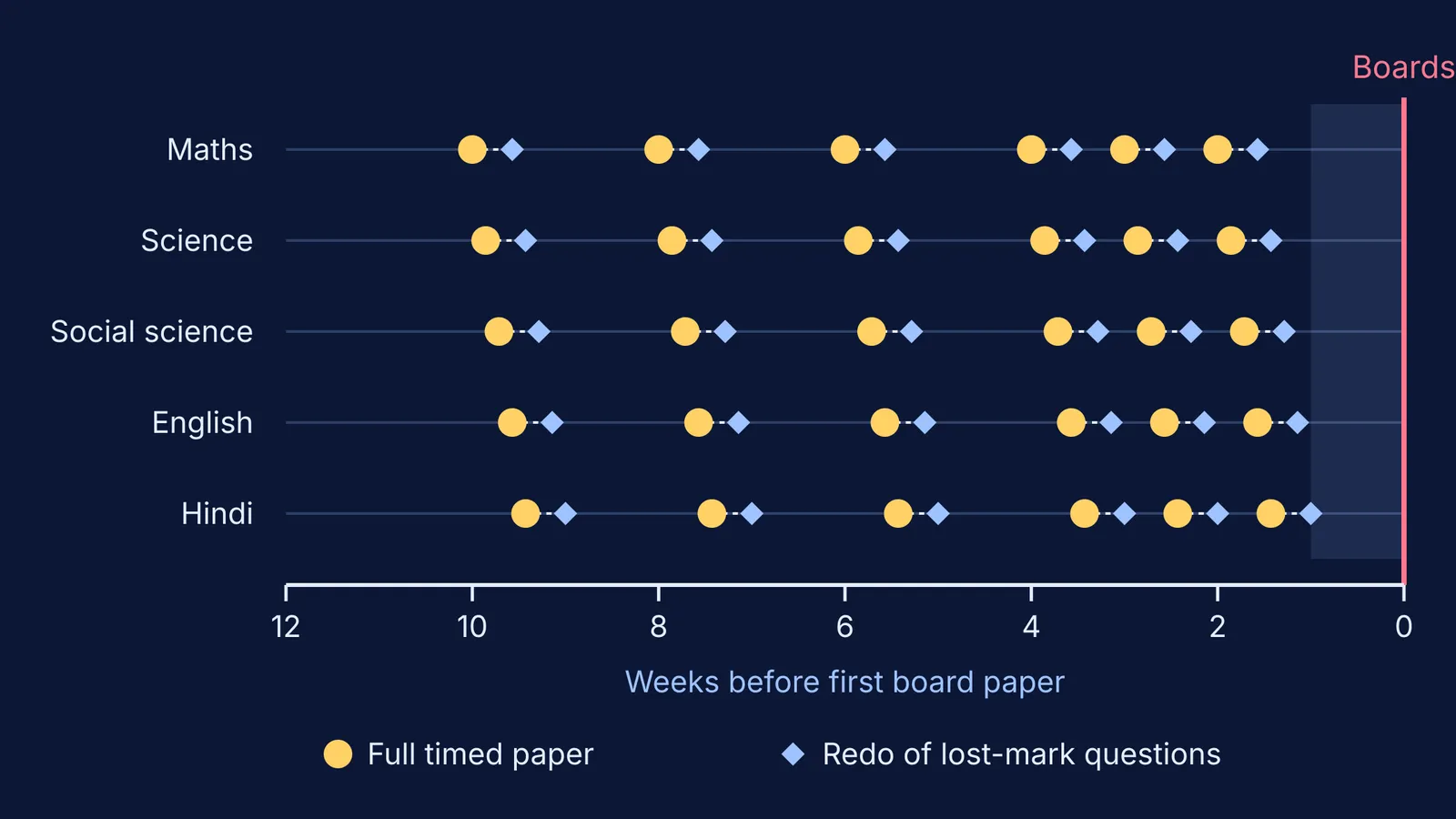
A 10-week plan for six papers per subject:
Weeks 10, 8 and 6 before your first board paper: one full timed paper per subject every two weeks, with different subjects on different days.
Weeks 4, 3 and 2: one paper per subject each week.
The final week: no new full papers. Redo the questions you lost marks on and revise from your error log.
How do you review a sample paper so it counts?
Do this the same day or the next:
Mark it strictly with the official marking scheme, step by step. “I basically knew this” earns nothing.
Sort every lost mark into one of four buckets: did not know the idea; knew it but slipped (sign, unit, copying); used the wrong method; ran out of time or wrote too little.
Write one line per lost question in an error log: question, bucket, fix.
Two or three days later, redo those questions without looking at the solution.
Pick one change for the next paper, such as “attempt the long answers first” or “write the formula before substituting”.
Each bucket needs a different fix. “Did not know” means going back to the chapter; the Fermi Concept Library has a lesson for every concept in physics, chemistry, biology, mathematics and computing. “Wrong method” needs a worked solution that shows why; the Fermi Problem Library has a step-by-step solver that explains the reasoning rather than printing an answer. For time trouble, see our guide to reading accuracy and time in your mock test data. And if a long error log feels discouraging, here is why making mistakes helps you learn.
What can parents do to help?
Ask about buckets, not totals. One useful question after each paper: “Which bucket lost you the most marks, and what is the one fix for next time?” Scores bounce between papers of different difficulty, but a shrinking “slipped” bucket is real progress. If pre-board marks came back low, read our guide to reading pre-board marks and planning the weeks left.
If exam pressure is affecting sleep, food or mood, talk to a school counsellor, or call Tele MANAS on 14416, the government's toll-free 24/7 mental health helpline (PIB).
Pick your first sample paper this week, set a 3-hour timer, and book the review slot for the next day.


