On this page
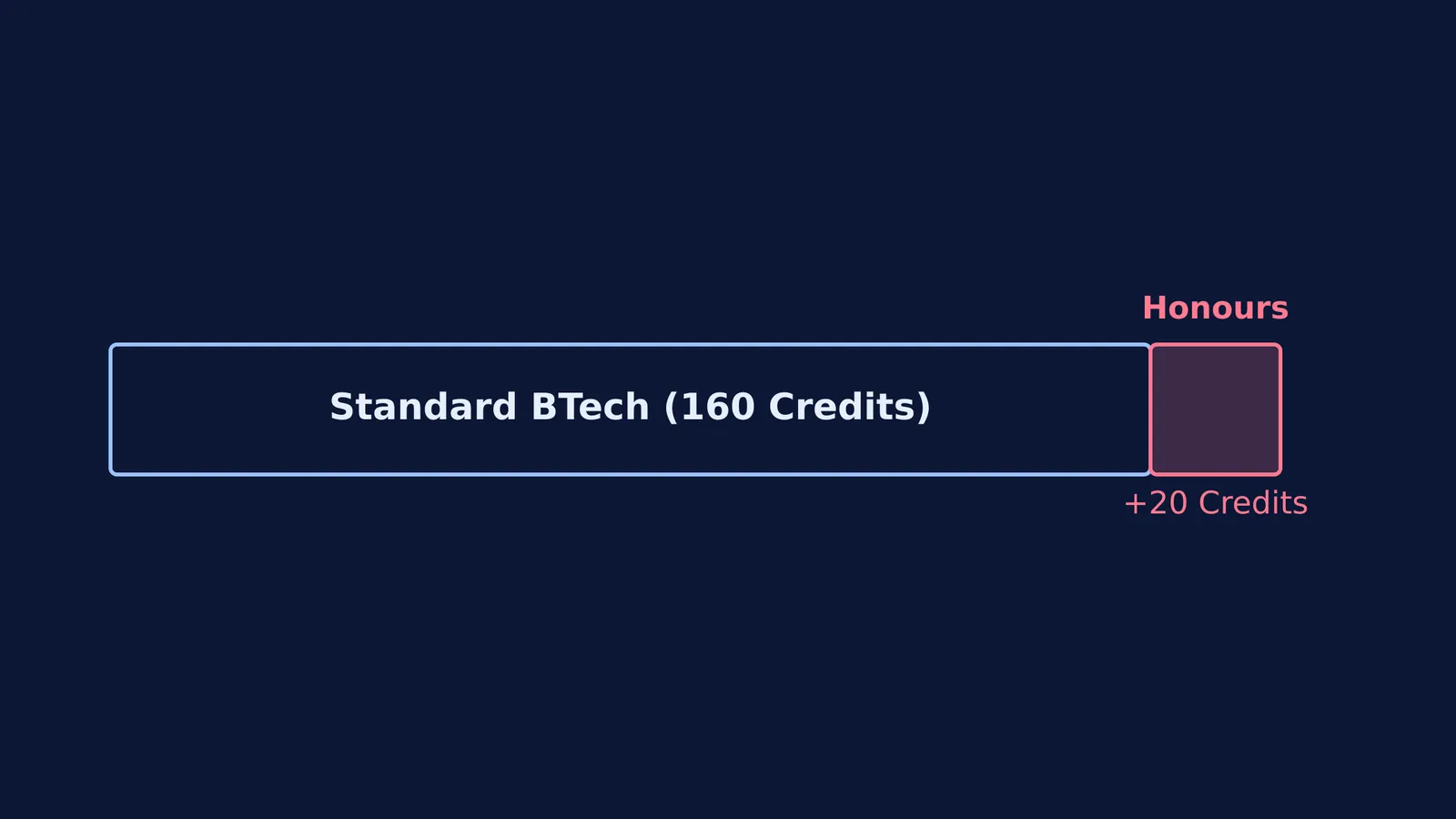
Under the AICTE model curriculum, a standard BTech degree requires 160 credits. However, many universities offer an "Honours" track for students who want to specialise deeply in their core branch.
What does a BTech Honours degree involve?
To earn a BTech with Honours, you must complete an additional 18 to 20 credits over and above your regular 160-credit coursework. These extra credits must be in advanced subjects within your own discipline, such as a mechanical engineering student specialising in robotics. If you take 18 to 20 credits in a completely different branch, you earn a "Minor" rather than an Honours degree.
Most students earn these extra credits through MOOCs (Massive Open Online Courses) on platforms like NPTEL or SWAYAM. You must register for the courses, watch the lectures, submit weekly assignments, and pass a proctored end-term examination. Universities typically follow AICTE guidelines to require you to maintain a high CGPA (often 7.5 or 8.0) and have no active backlogs to remain eligible for the Honours track.
How much extra work is 20 credits?
It is easy to underestimate what an extra 20 credits looks like on top of a full engineering schedule. Under the UGC Credit Framework, one credit is generally defined as 15 hours of theoretical instruction.
NPTEL recently aligned its recommended credit structure: an 8-week course is typically worth 2 credits, and a 12-week course is worth 3 credits. To reach 20 credits, you would need to complete nearly seven 12-week courses before you graduate.
Each 12-week course requires about three hours of video lectures and one to two hours of self-study and assignments every week. This means earning your Honours degree adds roughly 300 extra hours of study to your overall BTech, usually spread across your third and fourth years. You will be taking one or two advanced electives every semester while your peers have free time.
Is a BTech honours degree worth it for placements?
Whether the extra coursework translates into a better job depends entirely on your career goals and the specific companies visiting your campus.
For high-end, niche roles in fields like machine learning, data science, or cybersecurity, an Honours degree is highly valued. Employers at Tier-1 tech companies and Global Capability Centres view the extra credits as proof of deeper technical expertise and the discipline to handle rigorous academic work independently. In some campus placements, Honours students are shortlisted or given first preference for specialised technical interviews.
However, for standard software engineering or IT consulting roles in mass recruitment, the "Honours" tag rarely changes your starting salary. These companies prioritise coding fundamentals, aptitude test scores, and communication skills over your specific degree title. If the extra coursework prevents you from practicing Data Structures and Algorithms (DSA) or building your own software projects, it might actually harm your placement chances.
Where the Honours degree truly shines is in higher education. If you plan to pursue an MTech, MS, or a PhD at top institutions in India or abroad, the advanced coursework demonstrates your academic capability. Admissions committees look for students who have challenged themselves beyond the minimum requirements.
How to manage the extra academic load
Taking on 20 extra credits requires careful time management to ensure that the added workload does not cause your core CGPA to drop.
Start early: Begin your extra MOOCs in your fourth or fifth semester. Your seventh and eighth semesters should ideally be reserved for your major engineering project, internships, and placement preparation.
Align with your core: Choose Honours electives that overlap with your career interests or future projects. For example, if your final year project is about predictive maintenance, take your extra credits in industrial IoT or machine learning. The knowledge should compound, not conflict.
Master the foundations: Advanced electives often dive straight into complex university-level concepts. When you need to review the underlying theory, the Fermi Concept Library has every concept in physics, chemistry, biology, mathematics and computing, each with its own lesson and its place in the map.
Do not fall behind on assignments: In MOOCs like NPTEL, your final certification score usually combines your weekly assignment marks (around 25%) and the proctored exam (75%). Missing assignments can disqualify you from earning the credit, even if you do well on the final test. If you are stuck on a difficult problem set, Fermi's AI tutor teaches rather than answers; it holds a line of reasoning across a session and works out what you already know, helping you learn the method rather than just copying a solution.
An Honours degree is a demanding path. If you are already struggling with the standard engineering workload or need to improve your CGPA, adding extra courses might lead to burnout. However, if you are past your first semester at engineering college and have a clear specialisation in mind, those 20 extra credits provide a concrete way to stand out in a competitive job market.