

On this page
The transition from a Hindi-medium school to an English-medium college is a steep learning curve. You are no longer just learning physics; you are translating it in real-time.
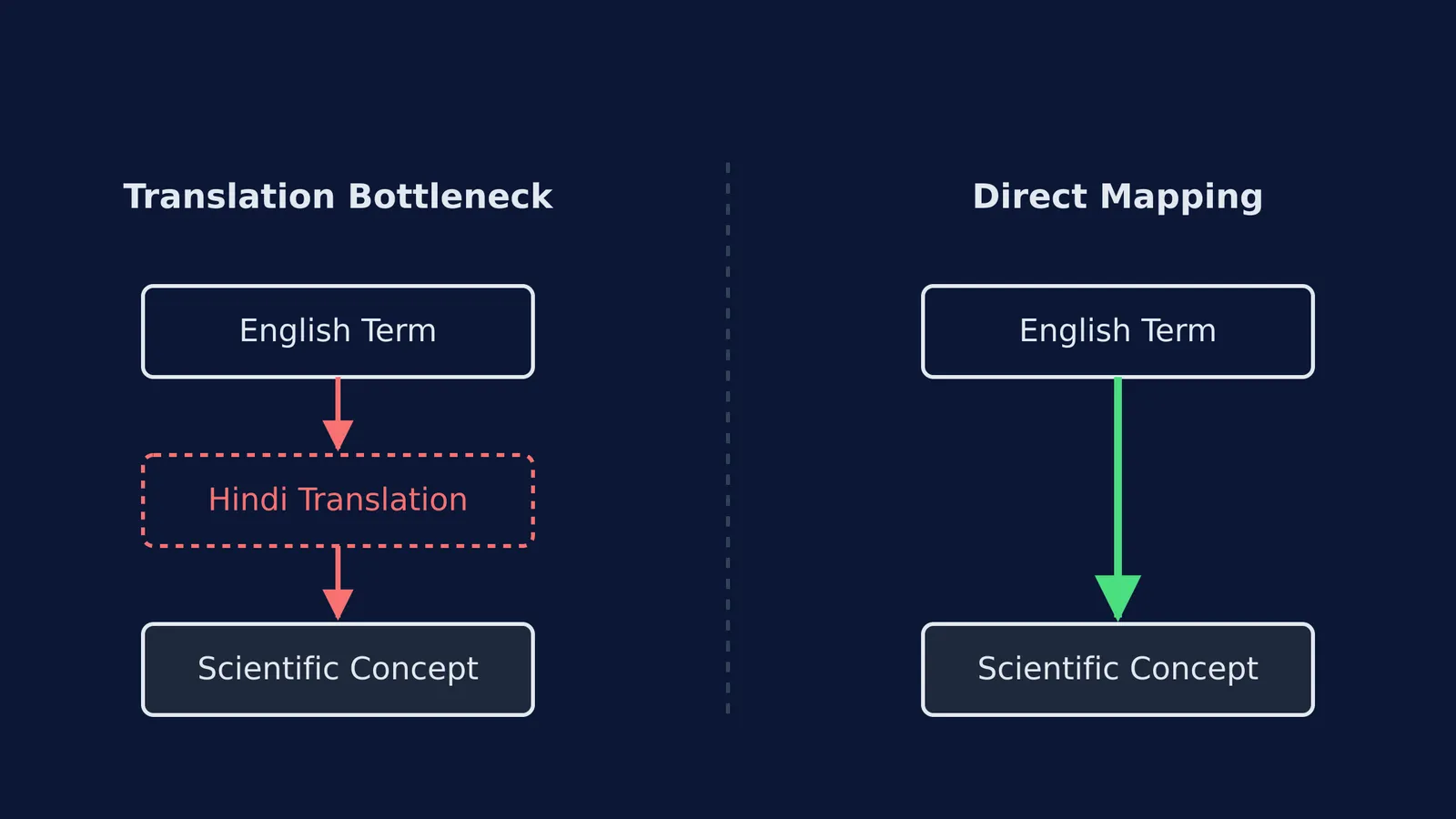
This is not an intellectual gap, but a linguistic bottleneck. The scientific concepts are the same ones you mastered in school, but decoding a new language drains the mental energy needed for complex problem sets. When you study thermodynamics, your brain is simultaneously trying to parse complex English grammar.
Here is how you can systematically adapt by separating language acquisition from scientific learning.
Why is the transition so hard?
The primary block is terminology. Words like "velocity," "titration," "mitosis," or "torque" do not have everyday equivalents you can guess from context. In a Hindi-medium school, you learned these as *veg*, *anumapan*, *samsutri vibhajan*, and *balaghurn*. Re-mapping fundamental concepts to new sounds takes immense effort.
Your reading speed also drops when you encounter unfamiliar syntax. While the average adult reads general non-fiction English at about 238 words per minute (WPM), technical college reading drops to 149 WPM even for native speakers (WordsRated). When memorising new material, that speed can fall under 100 WPM.
How do you build a science vocabulary list?
Do not learn English by reading a physics textbook cover to cover. Instead, isolate the vocabulary from the science.
Keep a running list of technical terms. When you encounter a new word, write it down, but resist writing the Hindi translation next to it. Relying on translation adds an extra step to your thinking process, slowing you down during exams. Instead, try this method:
Write the formal English definition.
Draw a small diagram, graph, or symbol beside it to anchor the meaning visually.
Use the word in a short sentence related to the specific scientific concept.
Instead of just translating "titration," write that it is a method to find the concentration of a solution, sketch a burette dripping into a flask, and write "The titration reached its endpoint when the indicator changed colour." This technique builds a direct mental link between the English word and the scientific concept, skipping the Hindi translation step in your brain entirely. Test yourself by making flashcards that work for physics and chemistry, focusing on these new terms.
Why should I read textbooks slowly at first?
Because your brain is learning a language and a complex subject at the same time, you must deliberately slow down. Skimming pages will leave you with a false sense of security and severe gaps in your foundational knowledge.
Science textbooks are dense with diagrams, bold terms, and summary boxes. Before you read the main text, look at the headings, study the graphs, and read the end-of-chapter summaries. This gives you a map of the chapter and pre-loads the key English vocabulary.
Break your assigned chapters into 15-minute chunks. Read a single paragraph, cover it with your hand, and explain it out loud to yourself. If you cannot articulate the idea clearly, you have not grasped the vocabulary or the concept. Expect a standard page of technical material to take up to 15 minutes to digest. Give yourself permission to be slow in the first semester; reading speed will come naturally.
When the textbook feels impenetrable, Fermi's AI tutor can help. If you bring a confusing topic or a problem set, Fermi works out what you already know and teaches through it—drawing the figure and checking your understanding as it goes, so you don't get lost in dense paragraphs of unfamiliar English.
How can bilingual peers help?
Isolation makes the language barrier far worse. Attempting to figure out every translation alone can lead to frustration. Successful students seek out communities where they can discuss concepts in their native language while practising English terminology.
Find a study group with bilingual peers who are comfortable in both Hindi and English. An effective way to bridge the gap is to have a difficult concept explained in Hindi while pointing at the English terminology in the textbook. This approach allows you to grasp the scientific theory immediately, while anchoring it to the English words you need for the exam.
Speak up in your group, even if you make mistakes. Forcing yourself to say the English scientific terms out loud is critical for moving words to active memory. Explain a derivation to a friend using English technical nouns but Hindi grammar to connect them. As you build a study routine that lasts, make peer discussion a daily habit. By tackling the vocabulary systematically and leaning on your peers, you will close the gap and succeed.