

On this page
Most advice here is a slogan: “eat the frog”. The research is more useful. Hard, focused work usually goes better early, but a short, planned warm-up helps if your real problem is getting started.
Should you study the hardest subject first?
For most students, yes: put it in your first long block, while your head is clearest.
In Danish public schools, test scores fell by 0.9% of a standard deviation for every hour later in the day the test was taken, and a 20 to 30 minute break raised scores by 1.7% of a standard deviation, according to Sievertsen, Gino and Piovesan in PNAS (2016). The authors link this to cognitive fatigue building up across the school day.
A study of nearly 2 million students in Los Angeles County, in grades 6 to 11, found that having maths in the morning instead of the afternoon raised a student's GPA by 0.072 points, according to Nolan Pope in the Review of Economics and Statistics (2016). Maths was affected more than English.
Both studies looked at the school day, not home study, and the effects are small. But they point the same way, and reordering your evening costs nothing.
Does willpower run out if you start with something hard?
You may have heard that self-control is a tank that empties. A large test of that idea, run in 23 labs with 2,141 people, found an effect close to zero (Hagger and colleagues, 2016). The better reasons to go hard-first: you are fresher at the start, and the hard task is the one most likely to be put off.
In a review of 691 correlations, how unpleasant a task feels (task aversiveness) was among the strong and consistent predictors of putting it off (Piers Steel, Psychological Bulletin, 2007). Leave your weakest subject until 9:30 pm and it is easy to put it off again. We go into the emotional side in why procrastination is about feelings, not laziness.
When is a warm-up better than diving in?
A warm-up helps when the block is the start, not the work. Use one if:
you sit down and freeze, scroll, or tidy your desk instead
you have just come home from school or coaching
you are a night owl studying early (see what chronotype research says about morning or night study)
Time of day also depends on the kind of task. In one study of 428 undergraduates, insight puzzles were solved more often at students' non-optimal time of day, while analytic problems showed no time-of-day effect (Wieth and Zacks, 2011, summarised by the British Psychological Society). Step-by-step numericals still belong in your sharpest slot; a stuck “aha” problem can get a second try later.
What does a good daily study order look like?
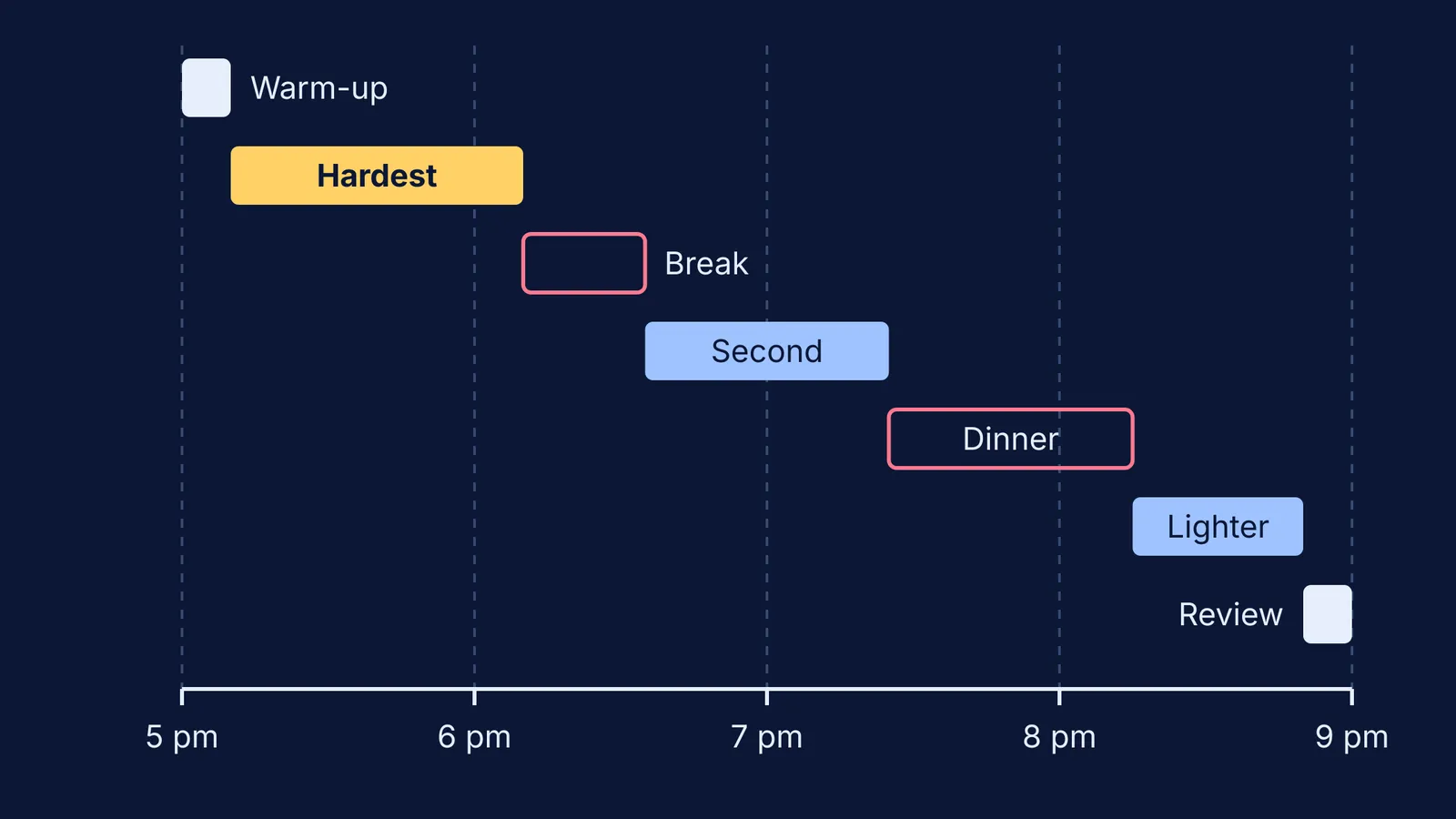
Here is a sample school-day evening for a Class 11 or 12 student, with physics as the hardest subject. Swap in your own.
5:00 to 5:10 pm: warm-up. Redo two problems from yesterday's physics homework without looking.
5:10 to 6:10 pm: hardest block. New physics numericals or the chapter you keep avoiding. Phone in another room.
6:10 to 6:35 pm: real break. Walk, eat, talk. Not reels.
6:35 to 7:25 pm: second subject that needs new learning, such as maths.
7:25 to 8:15 pm: dinner and family time.
8:15 to 8:50 pm: lighter work, such as NCERT reading, chemistry reactions or biology diagrams.
8:50 to 9:00 pm: review, and write down the first task for tomorrow's hard block.
That last step is what keeps the next warm-up short. If you do not know where to start a chapter, Fermi's AI tutor works out what you already know and builds a plan for the session, so the hard block begins with a clear first step. For the warm-up itself, the Fermi Problem Library has worked problems with a step-by-step solver that explains the reasoning.
On a holiday or weekend, put the hardest block soon after breakfast, with a real break after it.
How do you know if your order is working?
Run it for two weeks, then check honestly:
Did the hard block start within ten minutes of sitting down on most days?
Did the warm-up stay at ten minutes, or creep to forty?
Did your hardest subject get studied on most school days?
Are you more tired at 9 pm than you can recover from with sleep?
If the hard block keeps sliding, drop the warm-up and begin cold. If you are exhausted, shorten the evening rather than moving the hard subject later. For keeping a plan going past the first week, read how to build a study routine that lasts.
Tonight, write tomorrow's first hard task on a sticky note and put it on your desk.


