

On this page
When you open a maths or physics exam and see a long paragraph, the immediate challenge is not the calculation. The challenge is extracting the data from the English. It is easy to lose track of whether the train was moving at 40 km/h or 60 km/h, or whether a measurement referred to the radius or the diameter.
Why do students struggle with word problems?
It turns out that reading the problem is where most things go wrong. A study of elementary school students using Newman's Error Analysis found that 51.96% of students made comprehension errors when solving word problems, compared to only 9.8% who made "transformation" errors (such as choosing the wrong formula or mathematical operation).
When you read a long paragraph, your working memory fills up quickly. You are trying to hold multiple facts in your mind while simultaneously planning the next step. This overload often leads to calculating the wrong thing, missing a crucial detail, or combining numbers that have nothing to do with each other. A word problem intentionally hides the mathematical structure inside a story, forcing your brain to act as a translator before it can act as a calculator.
How to understand long word problems in an exam?
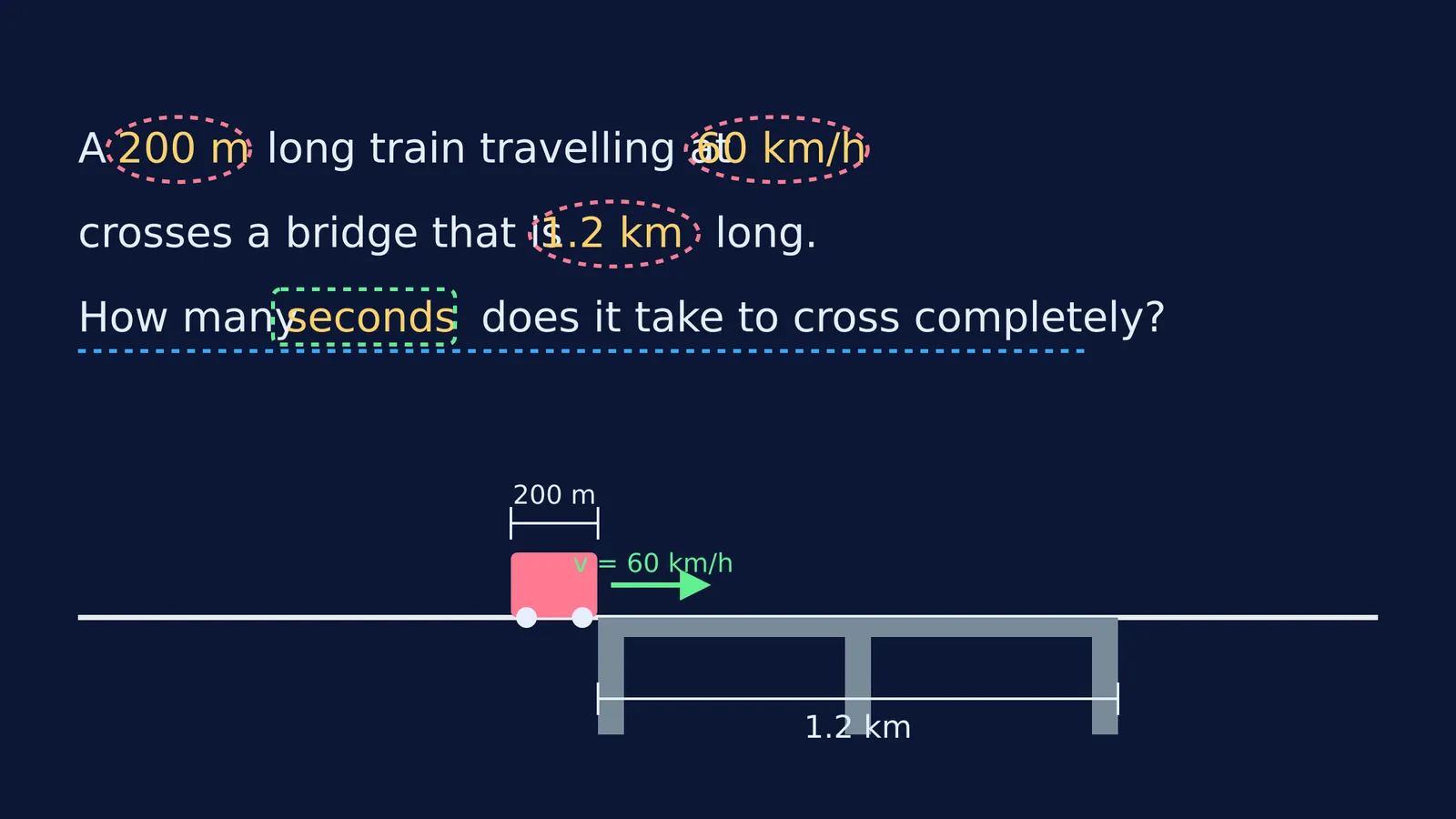
To stop your brain from doing too much at once, you need an active reading strategy. One of the most popular is the CUBES method, which gives you a checklist to follow before you even think about writing an equation:
Circle the numbers. Find the values and units you will actually use.
Underline the question. Find the exact sentence with the question mark or the word "find", and draw a line under it.
Box the keywords. Look for words that indicate a mathematical operation (for example, "total", "difference", "rate", "initially").
Evaluate and draw. Make a sketch of the physical situation.
Solve and check. Run the calculation and then check if your final answer matches the specific question you underlined.
By physically marking the paper, you externalise your memory. You no longer have to scan back and forth through the paragraph to find the velocity; it is already circled and ready to use. For example, if you are dealing with Quadratic word problems in Class 10: speed, age and area, boxing the keywords helps you correctly set up the equation before you start solving.
Why is a quick sketch powerful?
You do not need to be an artist to draw an effective diagram. A sketch simply translates words into a spatial format.
A study of 614 students in Japan and New Zealand found that while diagrams are effective tools for problem solving, students often avoid drawing them spontaneously because it takes mental effort to convert a story into an abstract sketch. The cognitive cost of starting the drawing feels higher than just plugging numbers into a formula.
However, spending those 10 seconds drawing a block on a slope, a circuit diagram, or a train passing over a bridge, pays off immediately. It allows you to write the numbers directly onto the picture, which clears your working memory. The geometry of the problem often reveals the correct mathematical operation intuitively. If you want to practice extracting data from difficult scenarios, the Fermi Problem Library has worked problems with a step-by-step solver that explains the reasoning rather than printing an answer.
Why should you restate what is asked?
Before you write down an equals sign, write down what you are looking for in mathematical symbols. If the question asks for "the time taken to hit the ground", write down t = ?. If it asks for "the final velocity", write v = ?.
This is especially important in probability and statistics questions, such as those involving With and without replacement: probability problems compared. In these multi-step scenarios, losing track of the final goal often leads to calculating the wrong branch of a probability tree or stopping one step early. Restating the question guarantees that your final line of working actually answers what the examiner wanted.
When you build the habit of underlining, drawing, and restating the question, the length of the word problem no longer matters. You stop feeling overwhelmed by the wall of text and instead have a reliable, step-by-step system to extract exactly what you need for the calculation.


