

On this page
Geometry is often seen as abstract, but geometric constructions force you to prove theorems physically. Drawing an accurate perpendicular bisector or a circle through three given points is not just about making a neat diagram; it is a mechanical exercise in logic and constraint satisfaction.
Why does spatial accuracy matter?
The physical act of drawing—setting a compass radius, predicting where an arc will land, and finding the exact intersection—is a powerful form of spatial training. A 2013 meta-analysis of 217 studies by David Uttal in the *Psychological Bulletin* found that training spatial skills yields an average effect size of 0.47. The study proved that spatial reasoning is highly malleable and that physical exercises directly improve a student's capacity to rotate and visualise objects mentally.
When you fail to close a circle or your tangents miss the curve, you must re-evaluate your spatial strategies. This feedback loop builds the intuition needed for higher-level physics and engineering.
If you find geometric properties difficult to grasp from static drawings, the Fermi Simulation Lab has interactive simulations for the ideas that are easier to see than to read.
How do you set up your tools for accuracy?
Small mechanical errors propagate quickly. If your first arc is misaligned by one millimetre, the final bisector might be off by several degrees.
The two-pencil rule: Keep one short, sharpened pencil permanently locked in your compass and use a second pencil for drawing straight lines and labelling. This prevents you from having to repeatedly remove and re-align the compass lead.
Choose the right grade: Use a hard pencil (such as a 2H or H) for your compass. Harder leads hold a sharp point longer and draw crisp, thin lines that make finding exact intersections much easier.
Check the hinge: Your compass must have a tight hinge. A loose friction hinge will allow the radius to drift as you sweep the arc, ensuring your circle will never perfectly close.
Align the points: Before drawing, press the compass closed and ensure the steel needle and the pencil tip are exactly level.
How should you present constructions in an exam?
Examiners marking a board paper want to see your working, not just the final result. They need evidence that you used the correct algorithmic sequence rather than estimating with a ruler or protractor.
Draw a rough figure: Always sketch a freehand diagram in the corner of your page and label it with the given measurements before you begin.
Leave your construction arcs visible: Never erase the sweeping arcs you used to find a point. These are the mathematical proof of your method.
Avoid overwriting: If a line or arc is too faint, do not draw over it a second time. A double line creates ambiguity. Erase it completely and draw it once more with firm, even pressure.
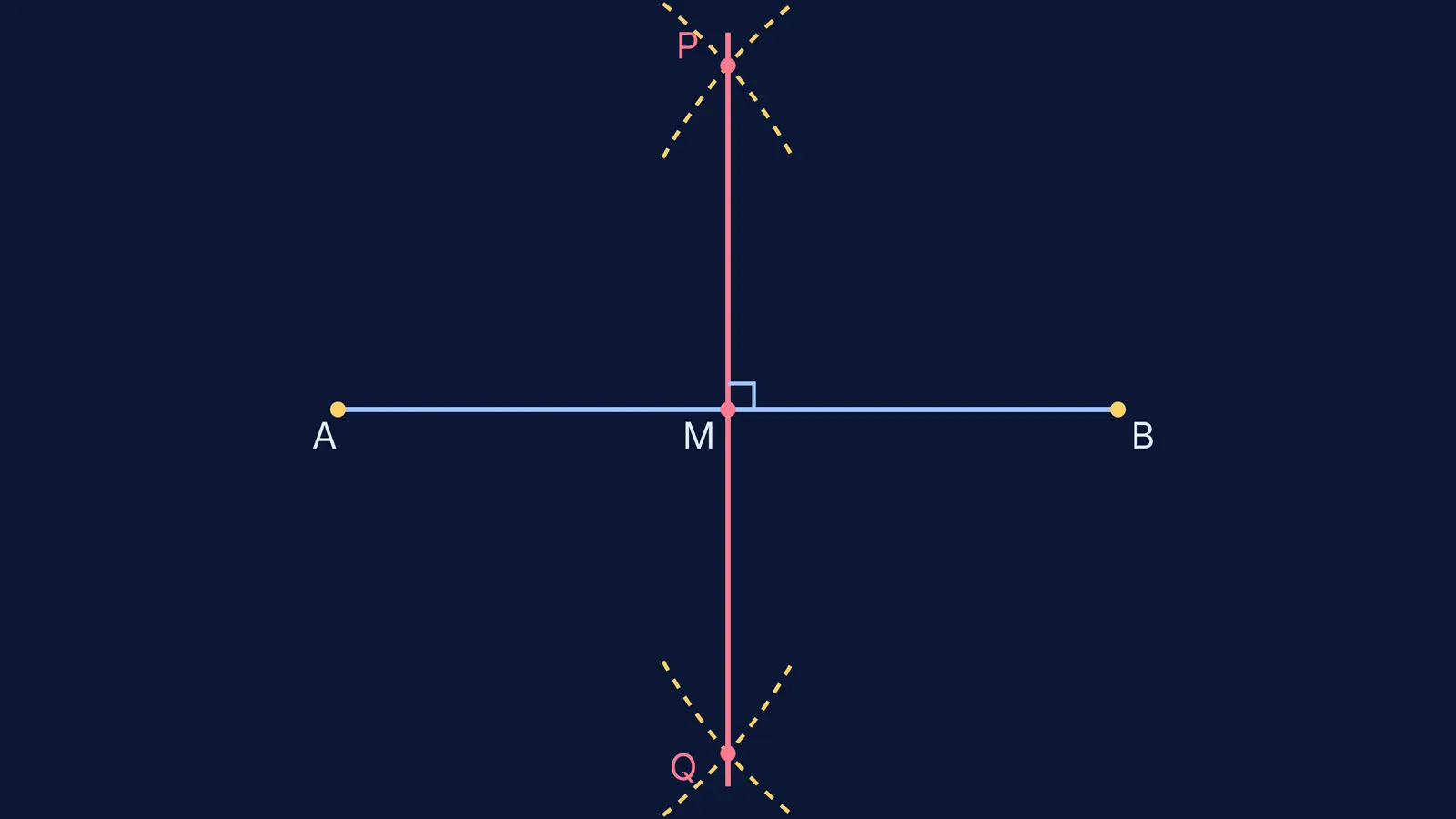
Mark and label intersections: Place a distinct dot at the exact intersection of two arcs before you place your ruler down. Label every key point with a capital letter (A, B, P, Q).
Write the steps of construction: Clearly list the procedure you followed (e.g., "With A as the centre and a radius of 4 cm, draw an arc").
What are the common mistakes in geometric drawing?
Even with the best tools, poor technique can ruin a construction.
Pressing too hard: Gripping the compass by its legs or pressing the pencil too hard into the paper causes the legs to spread apart mid-sweep. Always hold a compass by the knurled knob at the top and twirl it lightly between your thumb and index finger.
Skipping the steps: Many students try to jump straight to the final shape, resulting in common answer mistakes. Following a strict algorithmic order—such as constructing a 60° angle, then bisecting it to get 30°—is essential for earning full marks.
Using markings instead of arcs: A ruler's markings should only be used to measure given lengths (like a 5 cm base). To find the midpoint of a line, you must use the compass to draw a perpendicular bisector, not divide the length on your ruler.
If you struggle with the theorems behind the drawings, check our guide on Circles in Class 10: tangent theorems with worked examples. Connecting the physical construction to the formal proof is the clearest way to master geometry.


