

On this page
Learning French or German often feels like trying to hold water in your hands. You memorise a table of German verb conjugations or a list of French adjectives on Tuesday, but by the exam on Friday, half of them are gone. If you are aiming for top marks in your school language papers, the solution is not to stare at the textbook for longer. It is to change how you schedule your practice.
Why do vocabulary and grammar vanish so quickly?
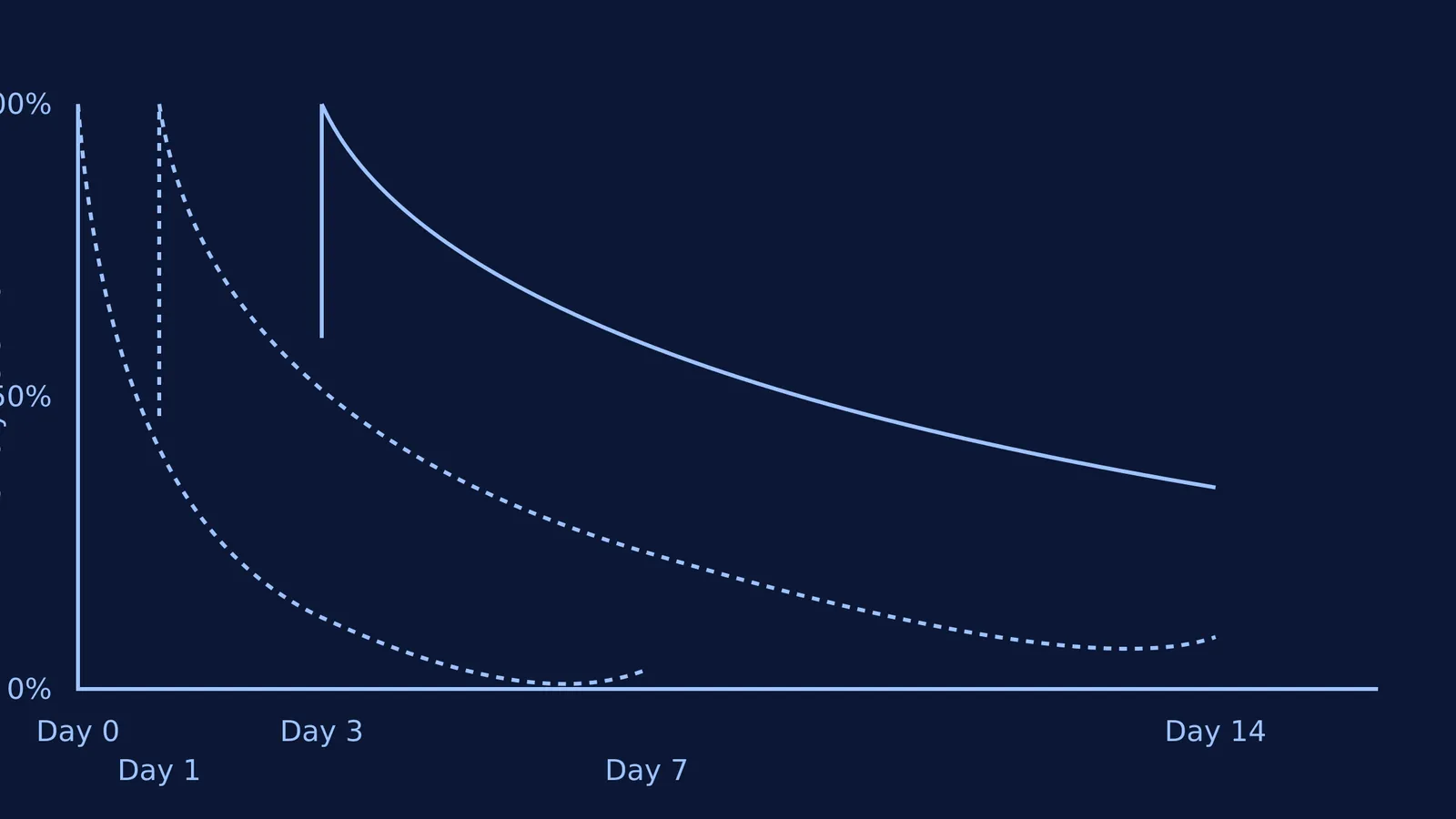
Your brain is incredibly efficient at clearing out information it thinks you no longer need. When you cram a vocabulary list the night before a test, the words sit in your short-term memory. As soon as the test is over, your brain discards them.
This "forgetting curve" is well documented, but it has a known mathematical fix: spaced repetition. Every time you review a word just as you are about to forget it, you force your brain to strengthen that neural pathway. A landmark study published in *Psychological Science* tracked language retention over nine years and found that 13 retraining sessions spaced at 56-day intervals yielded retention comparable to 26 sessions spaced at 14-day intervals (Bahrick et al., 1993). This builds on what we know about the biology of memory, proving that spacing out your practice builds durable memory.
How can you memorise vocabulary so it sticks?
To apply spaced repetition at home, you do not need complex software. You simply need a system that forces active recall over expanding intervals.
Make physical or digital flashcards: Write the French or German word on one side and the English meaning on the other. Include the article (e.g., *le*, *la*, *der*, *die*, *das*) because gender is part of the word's identity.
The Leitner System: Create three boxes. Box 1 is for new words you review every day. Box 2 is for words you review every three days. Box 3 is for words you review once a week.
Active recall: When reviewing, look at the English word and try to produce the foreign word. If you get it right, move the card to the next box. If you get it wrong, it goes all the way back to Box 1.
This forces you to spend your time on the words you find hardest, rather than passively rereading the ones you already know, which is a major reason why students misjudge their own learning. If you are applying these active recall principles to science subjects as well, the Fermi Concept Library contains every concept in physics, chemistry, biology, mathematics and computing, each with its own lesson and its place in the map.
Can extensive listening improve your scores?
School papers always include a reading and a listening comprehension section. Many students lose marks here because they try to translate every single word in their head, running out of time.
The key to comprehension is automaticity—recognising words instantly without needing to translate them. To achieve this, you need "extensive listening". This means listening to large amounts of spoken language that you can mostly understand. According to a widely cited paper by Paul Nation in *The Canadian Modern Language Review*, you need a vocabulary of 6,000 to 7,000 word families to achieve 98% coverage of spoken text (Nation, 2006).
When you hit that 98% threshold, you can guess the remaining 2% from the situation. To build this fluency:
Listen to French or German podcasts designed for learners.
Watch movies you already know well, but change the audio track to your target language.
Do not pause to look up words. Let the audio flow and train your ear to catch the rhythm and the gist of the conversation.
What is a four-step plan for your French or German paper?
To guarantee a strong score in your next language exam, structure your weekly study habits around these four pillars:
Spaced vocabulary: Spend 10 minutes every day reviewing flashcards. Consistency beats duration.
Grammar tables: Do not just read conjugation tables; write them out from memory.
Writing practice: Write a short paragraph twice a week using your new vocabulary. Language production forces you to retrieve the words and apply the grammar simultaneously.
Passive exposure: Swap 15 minutes of your daily music or YouTube consumption for a French or German audio source.
By aligning your study habits with how the brain actually acquires language, you will not just pass your school paper—you will build a skill that lasts for years. And if you are applying these active recall strategies to your STEM subjects, Fermi's AI tutor teaches rather than answers, holding a line of reasoning across a session to help you understand where you are stuck.


