

On this page
If you search for advice on cracking the JEE or NEET, you will inevitably hear the same daunting number: 14 hours. The claim is that to secure a top rank, you must sit at your desk studying for 14 to 16 hours every single day.
It sounds like the ultimate test of dedication. But when you look at the mathematics of a 24-hour day and the biology of how the human brain learns, the 14-hour study day falls apart. It is a myth, and trying to force it often does more harm than good.
What happens during a 14-hour study day?
Let us break down the mathematics of a 24-hour cycle. The United States Centers for Disease Control and Prevention (CDC) recommends that teenagers aged 13 to 18 regularly sleep 8 to 10 hours per 24 hours (https://www.cdc.gov/sleep/about/). This is not a luxury; sleep is the biological process during which your brain consolidates new information into long-term memory.
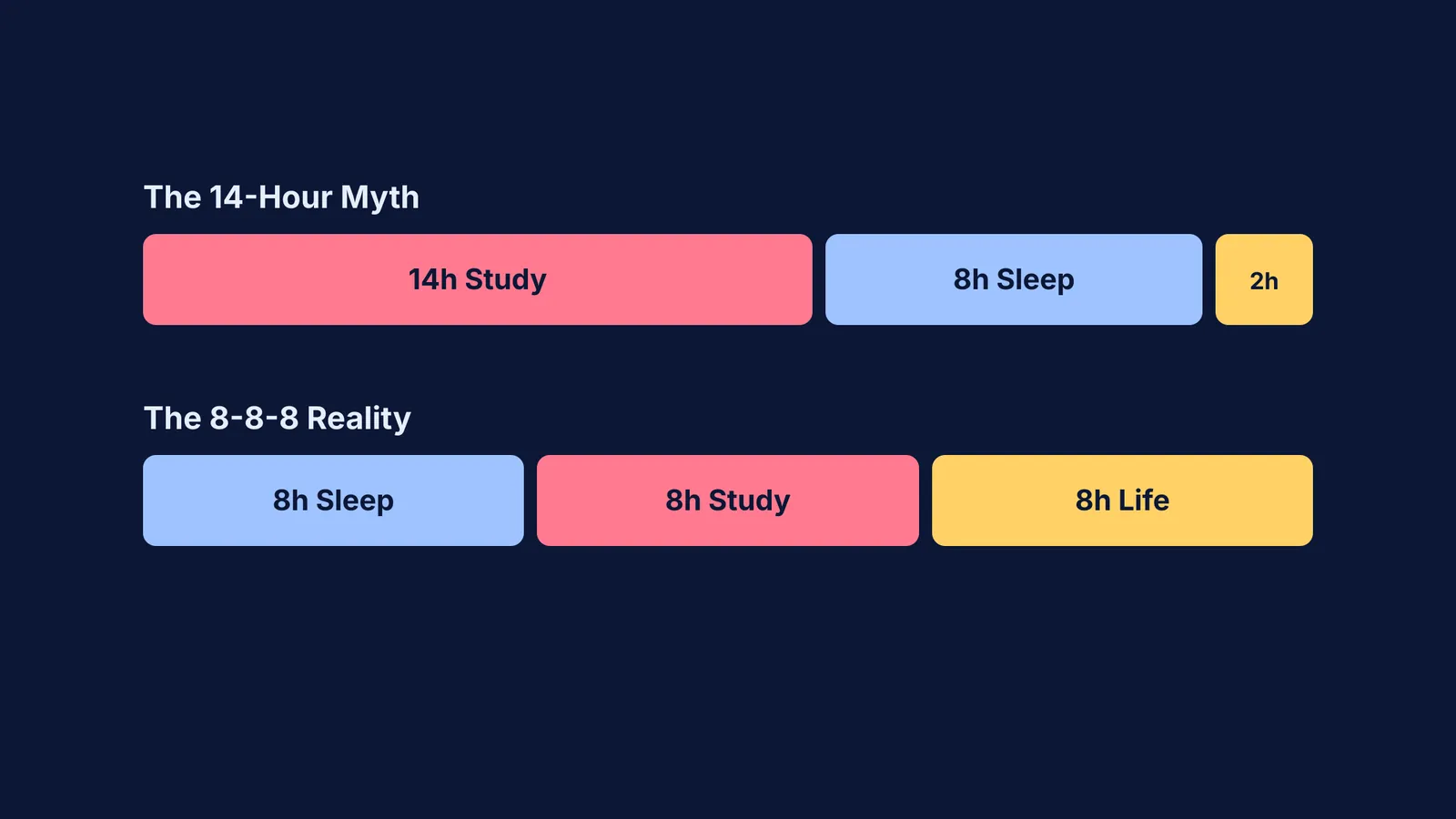
If you take the minimum recommended 8 hours for sleep, you have 16 hours left. If you study for 14 hours, that leaves exactly two hours for everything else. You have just two hours to eat your meals, bathe, get dressed, travel to coaching, and take mental breaks. It is an impossible schedule to sustain over the two-year span of JEE preparation. Students who attempt it end up borrowing from their sleep, which guarantees burnout and makes them forget what they learned.
How many hours of deep work can you actually do?
The core of the myth is the confusion between shallow work and deliberate practice. Shallow work includes re-reading notes, highlighting textbooks, or passively watching video lectures. Deliberate practice is hard, focused work: solving unrecognised problems, recalling formulas from memory, and analysing your mistakes.
Research on expert performance shows that the human brain has a hard limit on this kind of deep focus. In 1993, psychologist K. Anders Ericsson published a landmark study on elite performers in *Psychological Review* (https://doi.org/10.1037/0033-295X.100.3.363). He found that even world-class experts maxed out at 3.5 to 4 hours of intense, deliberate practice a day. Pushing past this limit did not improve performance; it led to exhaustion and a drop in quality.
For a JEE student, this means your brain can only handle about 3.5 to 4 hours of intensely hard problem-solving daily. The remaining hours of a productive study day are best spent on lighter tasks, such as revising familiar concepts or reviewing effective study techniques.
Can you crack the JEE without studying 14 hours a day?
Yes. Consistency beats daily marathons. The students who succeed are not the ones who pull 14-hour days for a month and then burn out; they are the ones who put in a solid, effective shift every single day.
When you are putting in your hours, you need them to count. If you are stuck on a difficult question, staring at a blank page wastes your limited cognitive energy. The Fermi Problem Library has worked problems with a step-by-step solver that explains the reasoning rather than printing an answer. If you need more help, Fermi's AI tutor can work out what you already know and build a plan for the session, so you sit down to a clear next step.
How do you measure effective study time?
Instead of chasing a 14-hour target, aim for the 8-8-8 rule: 8 hours of sleep (https://www.cdc.gov/sleep/about/), 8 hours of study, and 8 hours of life (meals, exercise, hobbies). To ensure those 8 study hours are effective, use a simple checklist:
Count the output, not the clock: Measure your progress by the number of complex problems you solved independently, not by how long you sat in your chair.
Limit deep work to 90-minute blocks: Your brain needs recovery. Study intensely for up to 90 minutes (https://doi.org/10.1037/0033-295X.100.3.363), then take a real break away from your desk to give your working memory a rest.
Use active recall: If you cannot close the book and explain the concept aloud, the hour you spent reading it was passive.
Mix your intensities: Dedicate 4 hours to deep work (new chapters and tough problems) and 4 hours to smart practice (mock tests and solving familiar patterns).
The clock is a poor judge of learning. Focus on the quality of your practice, protect your sleep, and remember that an honest 6-to-8 hour day will take you much further than a fake 14-hour one.


