

On this page
You are on question 14 and the projectile range formula has gone. Stop remembering and start rebuilding: almost every formula hangs off something you know better.
What should you do first when you forget a formula in the exam?
Treat the blank as a crowded memory, not an empty one. In a 2011 study published in Science, Gerardo Ramirez and Sian Beilock found that anxious students who spent 10 minutes writing about their worries just before a high-pressure test did better than those who did not. As the University of Chicago reported, Beilock's work suggests that when worries creep up, the working memory people use to hold and use information for the task becomes overburdened.
You cannot write for ten minutes mid-paper, but you can clear some space:
Mark the question.
Jot in the margin what you do remember: the variables, the rough shape, a related law.
Give the rebuild a budget, roughly what you would give any one question.
If the budget runs out, move on and return in your final pass.
If nerves usually empty your head, read our piece on reappraising test anxiety before the paper.
How can you rebuild a formula from what you remember?
You usually need only one of three routes.
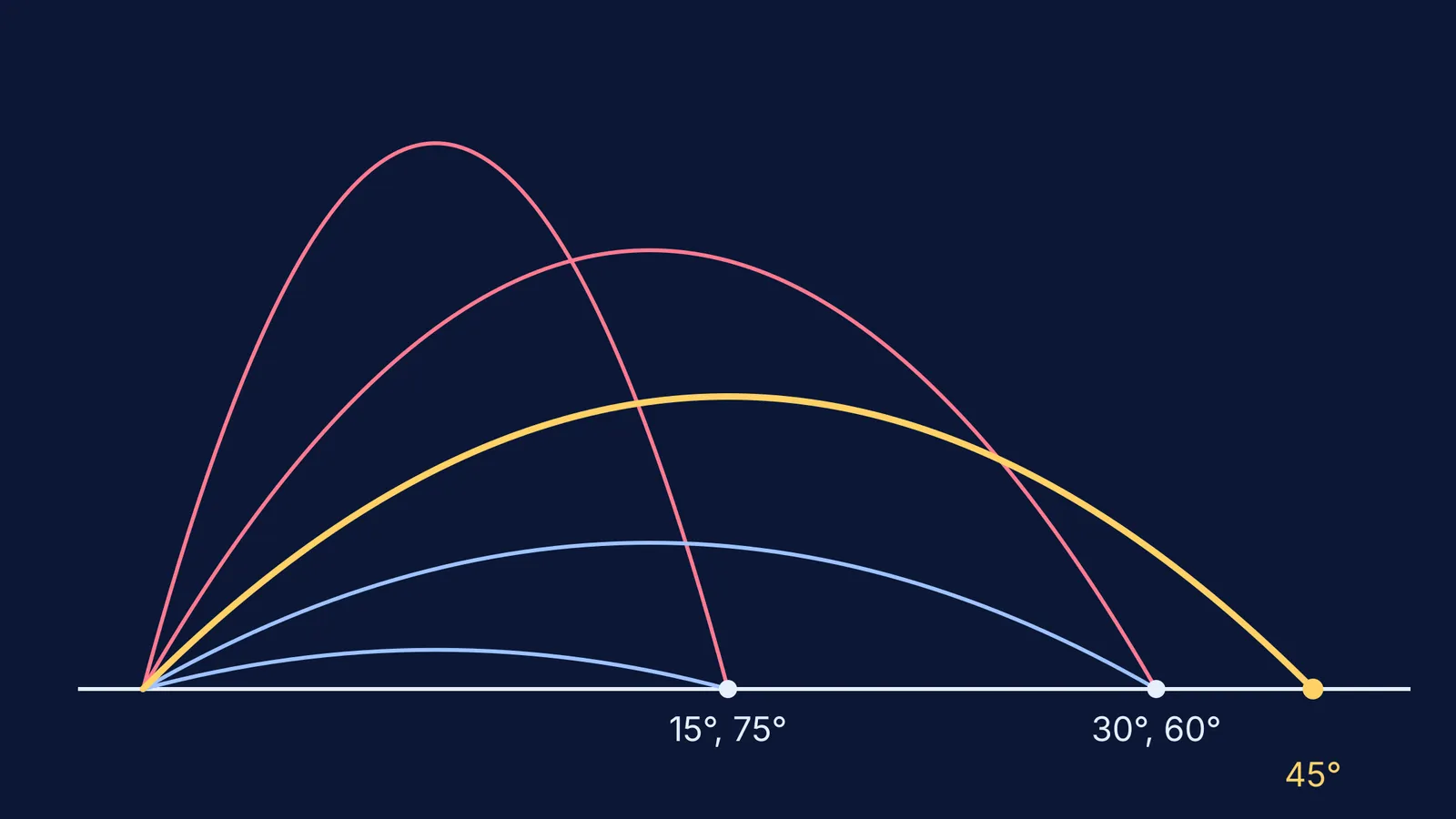
From a related law. Forgot the projectile range? Start from v = u + at for the vertical motion. The vertical velocity goes from u sinθ to −u sinθ, so the time of flight is 2u sinθ / g. Range is horizontal speed times time: u cosθ × 2u sinθ / g, and since 2 sinθ cosθ = sin 2θ, you get R = u² sin 2θ / g.
Chemistry works the same way. If you forget the units of a rate constant, write rate = k[A]ⁿ and solve for k; our guide to units of the rate constant walks through every order.
From a special case. Plug in a value where you already know the answer.
Is 1² + 2² + ... + n² equal to n(n + 1)(2n + 1)/6? Try n = 2: 2 × 3 × 5 / 6 = 5, and 1 + 4 = 5. It holds.
Is cos 2A = 1 − 2 sin²A? Try A = 90°: cos 180° = −1, and 1 − 2 = −1. It holds.
Is the range zero when you fire straight up (θ = 90°)? sin 180° = 0, so yes.
A formula that fails a special case is wrong; one that passes two or three is more likely right, though not proved.
From units. The NCERT Class 11 physics chapter on units and measurement uses dimensions alone to show a pendulum's period goes as √(l / g). Its stated limit: dimensionless constants such as 2π cannot be obtained this way.
How do you use units and the options to check your answer?
According to the NCERT Class 11 physics textbook, an equation that fails the dimensional consistency test is proved wrong, but one that passes is not proved right.
That makes units a filter for options. Say a question asks how high (h) a liquid rises in a capillary tube of radius r, given surface tension T, contact angle θ, density ρ and g:
h = 2T cosθ / (ρ g r)
h = 2T cosθ ρ g / r
h = T cosθ / (2ρ g r)
h = 2T r / (ρ g cosθ)
Surface tension is force per length, [M T⁻²], and ρ g r is [M L⁻³][L T⁻²][L] = [M L⁻¹ T⁻²]. So T / (ρ g r) is [L], a length. Options 1 and 3 pass; options 2 and 4 come out with the wrong dimensions and are gone.
Units cannot choose between 1 and 3, because they differ only by a number. Now use a related law: the surface-tension force around the rim, 2πr T cosθ, holds up the weight of the column, πr² h ρ g. Solve and you get option 1.
For more practice, see how to convert units using dimensions.
When should you move on instead of rebuilding?
Move on when:
you cannot name the law the formula comes from;
the derivation needs more than a few lines you do not trust;
two options survive and the paper has negative marking (check your exam's official information bulletin).
Finish the questions you can do and come back to it in your final pass.
How do you practise this before the exam?
For each chapter, write the parent laws at the top of a page and list the formulas that grow from them. Each week, cover your formula sheet, rebuild five from those laws, and test each on a special case.
When a derivation breaks down halfway, the Fermi Problem Library has worked problems with a step-by-step solver that explains the reasoning rather than printing an answer, so you can see which law the formula came from. If the gap is the idea itself, the Fermi Concept Library gives every concept in physics, chemistry, biology and mathematics its own lesson.
Pick one formula you always forget and rebuild it tonight.


