

On this page
Every year, thousands of Indian students look beyond domestic borders to pursue a medical degree. When government medical seats fill quickly and private college fees feel daunting, universities in Europe, Central Asia, and East Asia seem like an attractive alternative. But a foreign degree does not carry an automatic right to treat patients in India.
Before you or your child unpack bags in an overseas hostel, you need to understand the statutory architecture that determines whether that degree will ever convert into a valid Indian medical licence.
Why does a foreign medical degree require Indian screening?
Medicine is fundamentally local. Disease epidemiology, public health infrastructure, and drug protocols differ drastically across continents. While a medical student in Northern Europe might spend months studying degenerative illnesses common to ageing populations, an Indian physician faces acute viral fevers, malaria, dengue, tuberculosis, and obstetrical emergencies daily.
The National Medical Commission enforces screening examinations to ensure every foreign-trained doctor meets the clinical, diagnostic, and ethical standards expected of an Indian MBBS graduate. The legal gateway starts before departure: under official Ministry of External Affairs advisories, every Indian citizen intending to study medicine abroad must first qualify through standard NEET-UG eligibility rules. That qualifying NEET score remains valid for 3 years for overseas admission. Without it, you are ineligible to appear for Indian licensing examinations upon your return.
What are the NMC rules for studying MBBS abroad?
The statutory landscape shifted decisively when the National Medical Commission notified the Foreign Medical Graduate Licentiate (FMGL) Regulations on November 18, 2021. Any student who enrolled in a foreign medical programme on or after that date must satisfy strict equivalency rules:
Course duration: The medical curriculum must deliver at least 54 months of direct academic and clinical education.
Foreign internship: The student must complete a mandatory 12-month clinical internship at the same institution where they earned their degree.
Medium of instruction: All lectures, examinations, and hospital bedside postings must be conducted entirely in English.
Single institution: The degree cannot be fragmented across different campuses or countries; transferring colleges midway through the course is prohibited.
Host country licence: The graduate must obtain an unconditional licence to practise medicine in the host country, granted on equal terms with local citizens.
Completion timeline: The entire degree and foreign internship must be finished within 10 years of initial enrollment.
This double-internship structure means students spend a minimum of 6.5 years from their first overseas lecture to their final Indian registration.
Why are screening test pass rates historically so low?
The Foreign Medical Graduate Examination (FMGE), administered twice each year by the National Board of Examinations in Medical Sciences, tests whether foreign graduates possess the diagnostic competencies required for safe clinical practice. The exam consists of 300 multiple choice questions divided across two 150-minute sessions. Candidates must secure at least 150 marks out of 300 to pass. There is no negative marking, but there is no score moderation or category reservation.
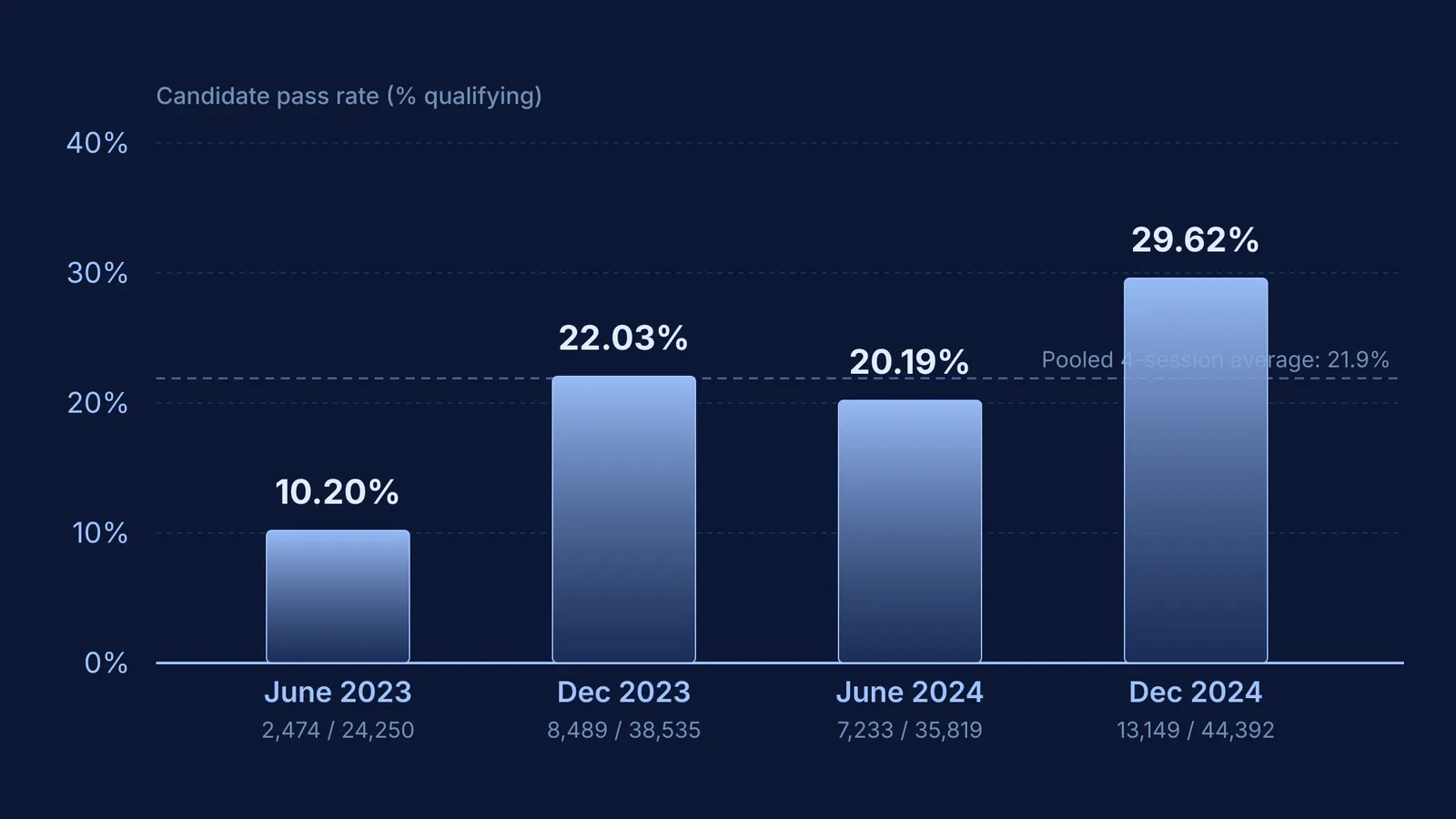
Official records published by the National Board of Examinations in Medical Sciences reveal consistently challenging outcomes:
In the June 2023 session, 2,474 of 24,250 candidates passed, representing a 10.20% pass rate.
In the December 2023 session, 8,489 of 38,535 candidates passed, achieving a 22.03% pass rate.
In the June 2024 session, 7,233 of 35,819 candidates passed, yielding a 20.19% pass rate.
In the December 2024 session, 13,149 of 44,392 candidates passed, reaching a 29.62% pass rate.
These modest pass rates stem from two major bottlenecks: language barriers during foreign hospital postings and gaps in foundational science. In many non-English-speaking countries, foreign students attend English classroom lectures but cannot converse with patients in wards, leading to hollow clinical exposure.
Strengthening foundational physiology and pathology early prevents these deficits. The Fermi Concept Library maps every concept across biology, chemistry, and physics, helping students build deep conceptual understanding rather than relying on memorised question banks. For dynamic processes like hemodynamic flow or membrane potentials, the Fermi Simulation Lab offers interactive simulations designed for ideas that are easier to see than to read.
What questions should you ask before choosing a university?
Before signing an admission agreement or transferring tuition fees, ask these six questions:
Does the degree span 54 continuous months of medical study? Verify that pre-medical foundation courses are not being counted toward the 54-month statutory minimum.
Can foreign citizens legally practise medicine in that country? If local regulations restrict full medical licensure to domestic citizens, the degree will fail NMC Regulation 4(b).
Are clinical rotations conducted in English with genuine patient contact? Ask senior students whether ward rounds involve real patients or merely observing simulation mannequins.
Is the institution recognized globally? Check the university's accreditation on the official World Directory of Medical Schools.
What is the hospital's bed occupancy? A university without an attached multispecialty hospital with high daily patient turnover cannot provide adequate bedside training.
Have you exhausted domestic alternatives? Review all possibilities through NEET UG counselling in India, and explore related STEM career pathways before committing to a costly, seven-year overseas path.


