

On this page
Most first weeks go the same way: new books arrive, the timetable changes twice, and by the time the first unit test is announced, nothing is set up. A little structure now saves catching up later, whether your session starts in April or June, in Class 9 or Class 12.
What should you do in the first week of a new school session?
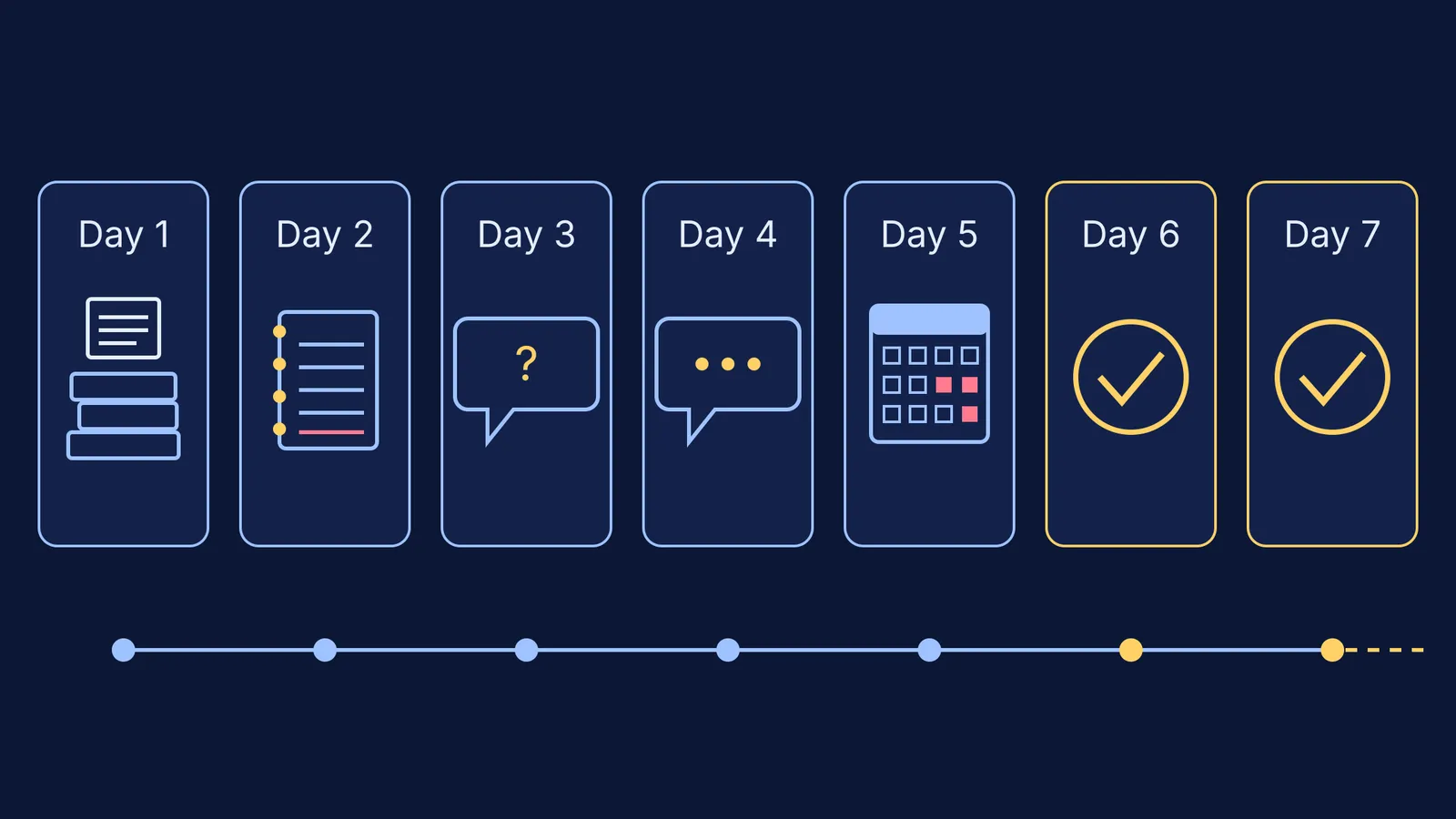
Give each day one job of an hour or less.
Day 1: Collect every textbook and the official syllabus for each subject.
Day 2: Set up one notebook per subject, with a contents page and a mistakes log.
Day 3: Introduce yourself to each subject teacher and ask three questions.
Day 4: Meet the teachers you missed and note how each runs homework and tests.
Day 5: Write every known test and submission date on one calendar.
Day 6: Start your one study habit.
Day 7: Do the habit again, then check what is still missing.
Parents can help most with days 1, 2 and 5, which are about getting organised. The rest work better when the student does them.
How do you set up books, syllabus and notebooks?
Start with the syllabus, not the textbook: it tells you which chapters count and how marks are split. CBSE publishes its curriculum for the 2026-27 session as subject-wise documents for Classes 9 to 12. Other boards and many schools share their own; ask your class teacher if you have not been given one.
Copy each subject's chapter list onto the first page of its notebook, with a column to tick chapters as they are taught and another for the date you last revised them. Then:
Number the pages and keep the first two for contents.
Write the date and topic at the top of every class's notes.
Keep the last four pages as a mistakes log: the question, what you did, the correct idea.
For a note layout that builds self-testing into every page, see our guide to the Cornell note-taking method, with a physics class example.
What should you say to your teachers in the first week?
A short, specific introduction makes you a name rather than a face, which matters later when you need help. Catch the teacher after class or in a free period and keep it under a minute.
If last year left a gap, name it: "I found trigonometry hard in Class 10. Which chapter should I revise before we reach it?" You can also go back over it on your own in the Fermi Concept Library, which has a lesson for every concept in physics, chemistry, biology, mathematics and computing.
How do you make a test calendar that actually helps?
Put every date in one place: unit tests, periodic tests, practical and project deadlines, and coaching tests if you attend coaching. One wall calendar or one phone calendar works; two separate lists do not.
Then work backwards. For each test, write the chapters it covers and mark a revision start date about a week before. When two tests land in the same week, you see it now, not the night before. Our 4-week spaced revision schedule for any chapter sets out the gaps between revision sessions.
Which study habit should you start in week one?
Start with self-testing. At the end of each school day, close your notebooks and write down from memory what you learned in two subjects. Then open them and mark what you missed.
A 2013 review by John Dunlosky and colleagues rated ten common study techniques and gave only two a high utility rating: practice testing and distributed practice. In two experiments by Henry Roediger and Jeffrey Karpicke, students who took recall tests on a passage remembered more of it two days and one week later than students who spent the time restudying, even though restudying made them feel more confident.
Tie the habit to a fixed moment, such as straight after you put your school bag down. In a study of how habits form, 96 volunteers repeated one daily behaviour in the same situation for 12 weeks; among those whose data could be modelled, reaching 95% of their plateau of automaticity took from 18 to 254 days. Missing one opportunity did not materially affect the process, so one skipped evening is no reason to quit. To keep it going, read how to build a study routine that lasts longer than a week.
If you are not sure where to begin in a subject, Fermi's AI tutor can work out what you already know and build a plan for the session, so you sit down to a clear next step.
Tele MANAS, on 14416, is the Ministry of Health and Family Welfare's free, 24x7 mental-health helpline, and you can call it in many Indian languages.


