

On this page
Class 11 can feel like a cliff. Very often the new chapter is not the problem. It quietly assumes a Class 9 or 10 skill, and that old step is where your working breaks. You rarely need to redo Class 10; you need to find the two or three basics that are blocking you and repair them in short sessions.
Why does Class 11 feel so hard after Class 10?
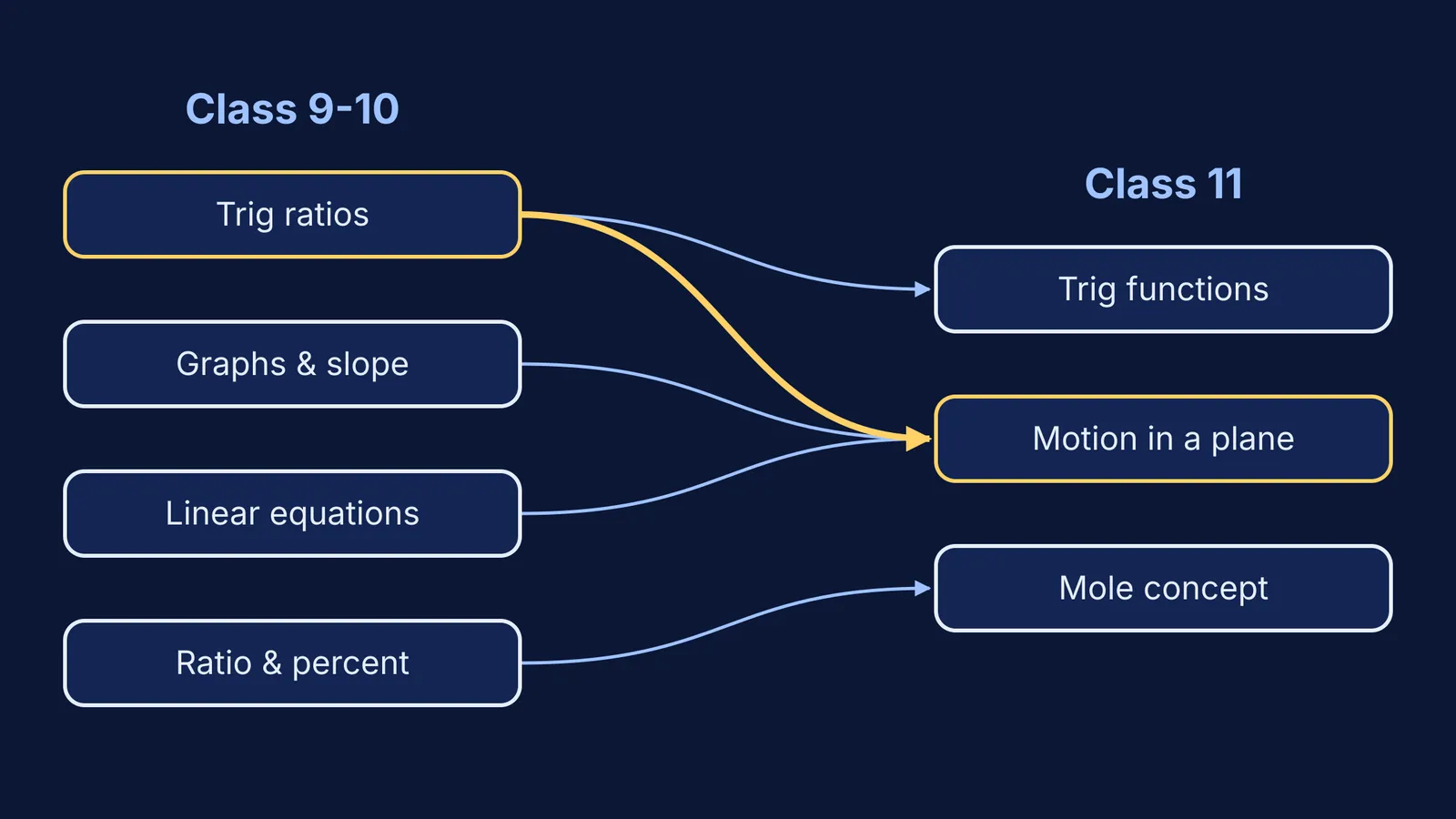
Trigonometric functions assume you are fluent with Class 10 trigonometric ratios. Motion in a plane assumes you can split a vector with sine and cosine and read a speed-time graph. The mole concept assumes ratios and percentages. When the old step is shaky, every new problem fails there.
In the PARAKH Rashtriya Sarvekshan 2024, a national school survey conducted by PARAKH, a body under NCERT, Class 9 students averaged 37% in maths, their lowest subject, as reported by ThePrint. The same report says only 28% of Class 9 students could understand and apply percentages to solve problems.
A large meta-analysis of prior knowledge by Simonsmeier and colleagues pooled 8,776 effect sizes. What students knew before learning correlated strongly with what they knew afterwards (r = .53), so students who start ahead tend to stay ahead. But prior knowledge barely predicted how much students gained (r = -.06), and results varied widely. In plain terms: a gap tends to persist if left alone, but on average it does not limit how much you can gain.
How do you find which Class 9-10 basics are blocking you?
Use a trace-back. Take three Class 11 problems you got wrong this week. For each, find the first line where your working went wrong and ask: is this a Class 11 idea, or an older one?
Common links to check:
Trigonometric functions rest on Class 10 trigonometric ratios and identities.
Sequences and series rest on Class 10 arithmetic progressions.
Straight lines rest on Class 10 coordinate geometry and linear equations.
Motion in a straight line and in a plane rest on Class 9 Motion (graphs, equations of motion) and Class 10 trigonometric ratios.
The mole concept rests on Class 9 Atoms and Molecules, ratios and percentages.
Then run a ten-minute check: five questions on that skill from your Class 10 NCERT exercises, closed-book. Five right means the skill is fine. Three or four means shaky. Two or fewer means you have found a gap.
Use paper, not rereading. In Roediger and Karpicke's study, students who restudied a passage felt more confident, yet students who tested themselves remembered more on tests days later.
If you can't tell which older idea a topic rests on, the Fermi Concept Library gives every concept in physics, chemistry, biology and mathematics its own lesson and its place in the map, so you can see what sits around it.
What does a short targeted session look like?
Keep each session to about 30 minutes and one skill:
Five minutes: write the rule or formula from memory, then check it.
Ten minutes: relearn only the part you got wrong from the Class 10 textbook, using one worked example.
Ten minutes: solve four Class 10 problems, then two Class 11 problems that use the skill.
Five minutes: note the skill and the date, and plan a quick five-question recheck a few days later.
This is a small version of mastery learning: fix the gap before you build on it. A meta-analysis by Kulik, Kulik and Bangert-Drowns of 108 controlled evaluations found mastery programmes had positive effects on exam performance, and the effects appeared stronger for weaker students. It also found they may increase time spent, so run two or three gap sessions a week alongside your current chapters, not instead of them.
What does fixing a gap look like in a real problem?
A ball is thrown at 20 m/s at 30 degrees above the horizontal, and your horizontal velocity keeps coming out wrong. Tracing back, you wrote vx = 20 sin 30. The slip is a Class 10 one: mixing up which side is adjacent to the angle. Say your right-triangle check gives 2 out of 5, so it is a gap. After one session, you redo it: vx = 20 cos 30 = 17.3 m/s and vy = 20 sin 30 = 10 m/s.
If you would rather not plan this alone, Fermi's AI tutor can work out what you already know and build a plan for the session, so you sit down to a clear next step.
How can parents help without adding pressure?
Ask about the trace-back, not the marks. "Which old topic did today's mistake go back to?" invites a useful answer; "Why are you weak in maths?" shuts the conversation down. Offer to read out the check questions and notice when a recheck goes well. If worry about studies starts affecting sleep or mood for weeks, talk to a school counsellor or call Tele MANAS on 14416.
For next steps, see why students misjudge their own learning, how to tackle a chapter you've never understood, and a triage plan for a chapter backlog.


