

On this page
When JoSAA counselling begins, many students and parents see "female supernumerary seats" on the seat matrix and wonder how they affect the competition. Introduced by the Ministry of Education in 2018, this policy was designed to fix the historically low representation of women in Indian Institutes of Technology (IITs).
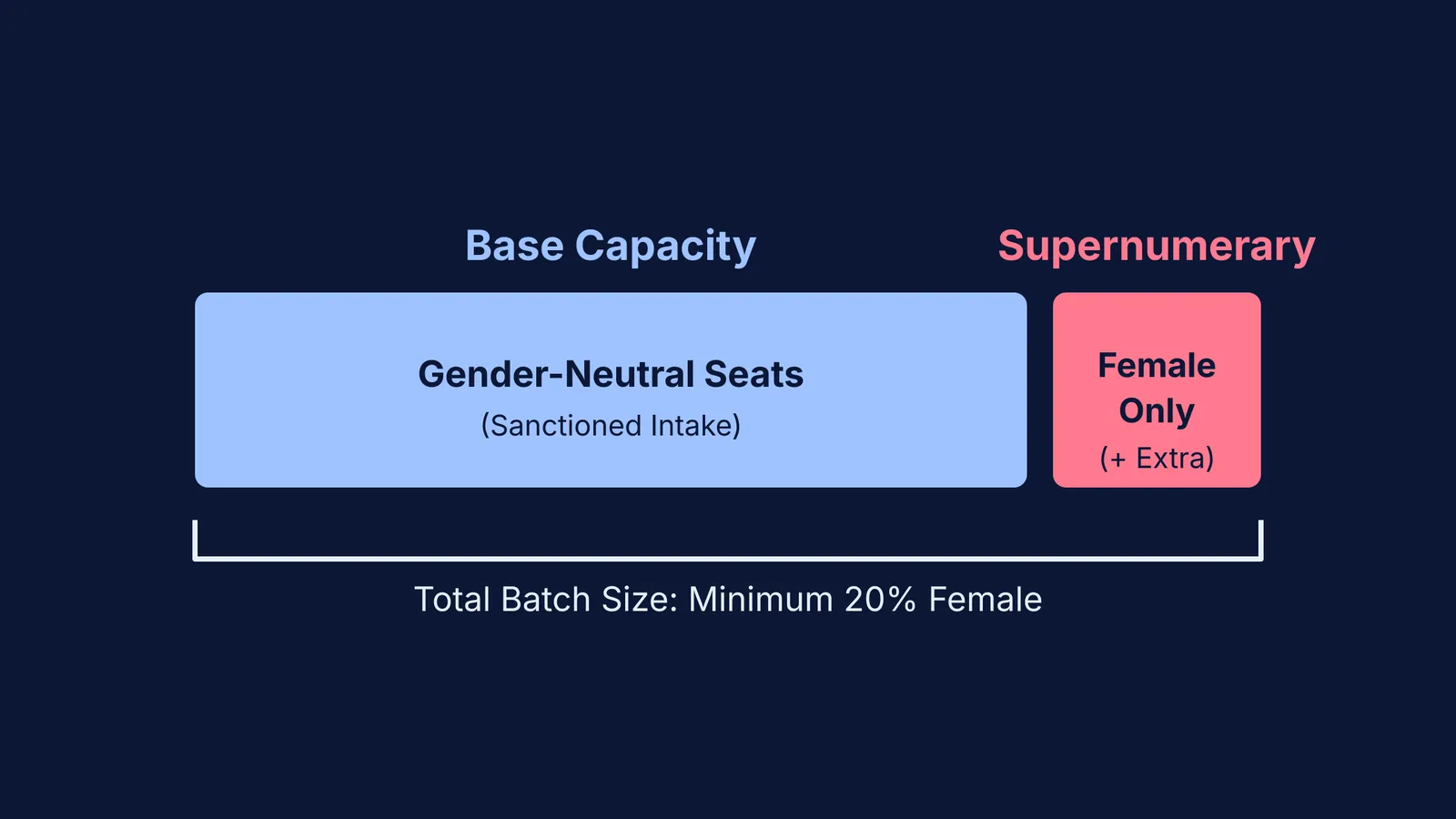
The goal is simple: ensure that at least 20% of the students in every IIT batch are female. In 2024, there were 3,566 female supernumerary seats created across a total IIT capacity of 17,740 seats. This targeted intervention has successfully raised female enrollment from around 8% in 2017 to the 20% threshold today.
Why was the supernumerary policy introduced?
Before 2018, the representation of women in IITs was remarkably low, hovering around 8%. A committee constituted by the Joint Admission Board (JAB) analysed the admission data and found a noticeable trend. While many female candidates qualified in the JEE Advanced, they were often less likely to join an IIT compared to their male counterparts.
The committee identified several factors behind this drop-off. Societal norms sometimes made families reluctant to send their daughters to distant campuses. Additionally, female candidates often preferred specific, highly competitive branches; if they did not secure those branches, they would choose local colleges instead. The supernumerary policy was created as a direct response to these findings. By expanding the total capacity with female-only seats, the IITs aimed to provide qualifying women with better branch options and greater incentive to enroll, all without altering the existing opportunities for male candidates.
What does "supernumerary" actually mean?
The word supernumerary means "extra" or "in addition to the regular number". This is the most crucial part of the policy: these seats are added on top of the existing sanctioned intake.
If a particular branch historically had 100 seats (open to all genders), it still has 100 seats. To achieve 20% female representation, the IIT adds approximately 25 extra seats reserved exclusively for women, making the new total batch size 125. Because these seats are strictly additional, the number of seats available to male candidates is not reduced.
How are female supernumerary seats allotted?
During the JoSAA counselling process, seats are divided into two distinct pools:
Gender-Neutral Pool: Open to all qualifying candidates, regardless of gender.
Female-Only Pool: The supernumerary seats, reserved exclusively for female candidates.
When a female candidate applies, the algorithm first checks if her rank is high enough to secure a seat from the Gender-Neutral pool. If she does not qualify there, she is immediately considered for a seat in the Female-Only pool for that same branch.
This means a female candidate effectively gets two chances to secure her preferred branch during the allocation process.
Do female supernumerary seats have lower cutoffs?
Yes. Because the Female-Only pool is a smaller, separate competition, its closing ranks are typically more relaxed than those of the Gender-Neutral pool.
This difference in cutoffs allows female students to enter highly sought-after branches, such as Computer Science or Electrical Engineering, with a rank that might not have been sufficient in the open pool. However, clearing the JEE Advanced to qualify for these ranks still requires deep conceptual clarity. When students struggle to build that clarity, the Fermi Problem Library has worked problems with a step-by-step solver that explains the reasoning rather than printing an answer.
How should you fill your choices?
When filling your JoSAA choices, you do not need to guess which pool you will be selected from. The system handles the dual-pool logic automatically.
List every branch and institute you want in your true order of preference.
Do not try to game the algorithm based on last year's Gender-Neutral or Female-Only cutoffs.
Keep your focus on your preparation. If you are just starting out, understanding how JEE Main and JEE Advanced differ is a critical step in the first year of JEE preparation.
The female supernumerary policy simply runs in the background, ensuring that if you have the merit, you get the best possible outcome across both available pools.


