

On this page
You sit down meaning to do chemistry. Two hours later you have solved twelve rotational motion problems, you feel great, and the chemistry book is still closed. You are not lazy, and a time log plus one rule can fix it.
Why do students spend too much time on their favourite subject?
Interest seems to pull study time towards itself. Psychologist Janet Metcalfe, reviewing Son and Metcalfe's 2000 experiments, noted that in each of their three experiments there was a positive correlation between how interesting people judged material to be and how much study time they gave it. That is a correlation, not proof that interest caused the extra time. The same paper describes how, under heavy time pressure with long passages, people chose to study the easier material.
Your favourite subject is often both the most interesting and the easiest for you, so it can win evening after evening.
In a later set of experiments, Metcalfe and Nate Kornell found steep early learning on easy items followed by little further gain, and the best performance came when most time went to medium-difficulty items. These were lab tasks, not whole subjects, but by analogy an extra hour on chapters you already handle well is likely to buy less than an hour on ones you only half know.
And because you are working hard, it never feels like avoidance, just as students often misjudge how well they know something.
How do you spot it in your time log?
Writing progress down seems to help. A meta-analysis of 138 studies with 19,951 participants found that interventions that increased progress monitoring also improved goal attainment, and the effect was larger when the information was physically recorded.
Run a one-week log:
Keep a sheet or notebook page on your desk for seven days.
Each time you start or stop, write the subject and the clock time. Round to 15 minutes.
Count only real study: solving, writing, revising. Leave out the time spent "getting ready".
On day seven, add up the hours per subject and turn each into a percentage of your total.
From your last two mock tests or unit tests, add up the marks you lost in each subject and turn those into percentages too.
Now put the two columns side by side. The trap shows up as a mismatch: your favourite subject takes the biggest share of hours but a small share of lost marks.
Other signs to check:
You start every session with the same subject.
Your weakest subject only gets the last, tired hour of the day.
You re-solve problem types you already get right.
A worked example: one JEE week
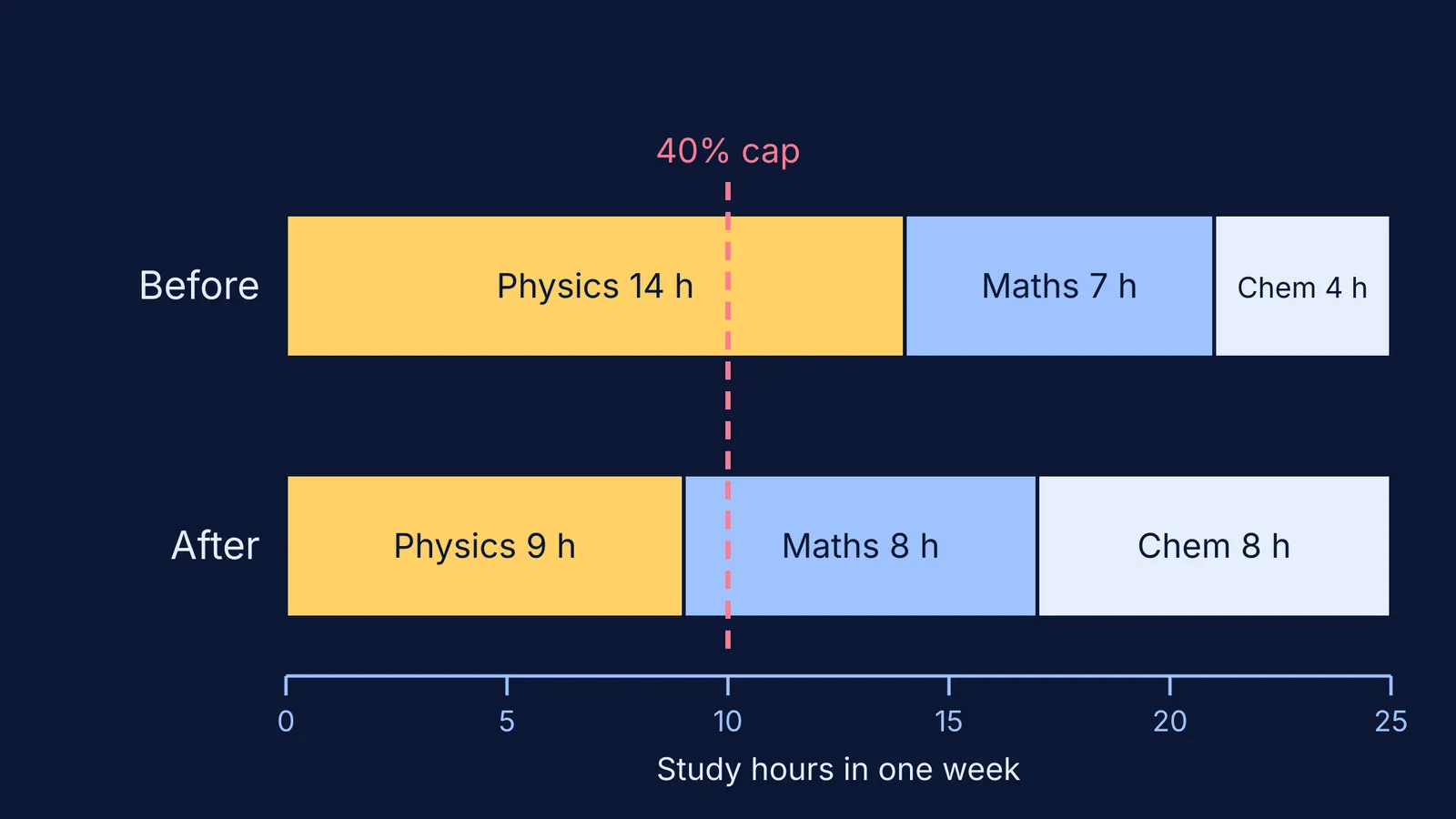
Take an imaginary Class 12 student who logs 25 hours in a week: physics 14 hours, maths 7 and chemistry 4. That is 56% physics, 28% maths and 16% chemistry. In their last two mocks, about half of the marks they lost were in chemistry and only a fifth in physics.
The log says physics is getting the most time and costing the fewest marks. The plan for next week: physics 9 hours, maths 8, chemistry 8. Physics still gets the most, so the fun stays, but chemistry doubles.
How do you cap it without losing the joy?
You do not want to kill the interest. Researchers Suzanne Hidi and K. Ann Renninger describe interest developing in four phases, from triggered situational interest to well-developed individual interest.
So cap the hours, not the feeling:
Weak first, favourite second. Put a chemistry block before a physics block, so physics becomes the reward.
Keep a curiosity slot. One fixed slot a week for the favourite with no syllabus attached: an olympiad problem, a simulation, a long derivation.
Use a timer. When it rings, the favourite block ends, even mid-problem.
Borrow the joy. If you love physics, start chemistry with its most physics-like chapters, such as thermodynamics or electrochemistry.
If the weaker subject feels like a blank wall, the Fermi Concept Library covers every concept in physics, chemistry, biology and mathematics, each with its own lesson, so you can start from the idea you are missing. Fermi's AI tutor can also work out what you already know and build a plan for the session, so the weaker block starts with a clear next step.
To fit the new hours around school and coaching, try weekly time blocking for students. If you keep dodging the subject you dislike, procrastination is about feelings, not laziness.
What can parents say?
Criticising the favourite subject can easily backfire. Try this instead:
"I love how much you enjoy physics. Can we look at your week together? Let's see where the hours went and where the marks went, and you decide what to change."
Let your child set the cap. A rule they help choose is one they are more likely to stick with.


