

On this page
If you write fast or large, running out of pages is a real worry. The fix: a page budget, and knowing what to do when you need more paper. This guide covers CBSE; ICSE, ISC and state boards set their own rules, so check with your school.
Should you take supplementary answer sheets in board exams?
Yes, if you have truly filled the main answer book and still have answers to write. CBSE's Guidelines for Centre Superintendents for the 2023-24 board exams tell invigilators that a supplementary answer book "is not to be given to a student until the main answer book given to him is completely used." So you cannot get one early, just in case, and the invigilator may ask you to fill your last pages first.
Don't write longer to look thorough. Marks come from the points an answer makes, which is how CBSE marking schemes are built; repetition only costs time.
How many pages do you get in a CBSE board exam?
The same CBSE 2023-24 centre guidelines list the answer books the Board supplies:
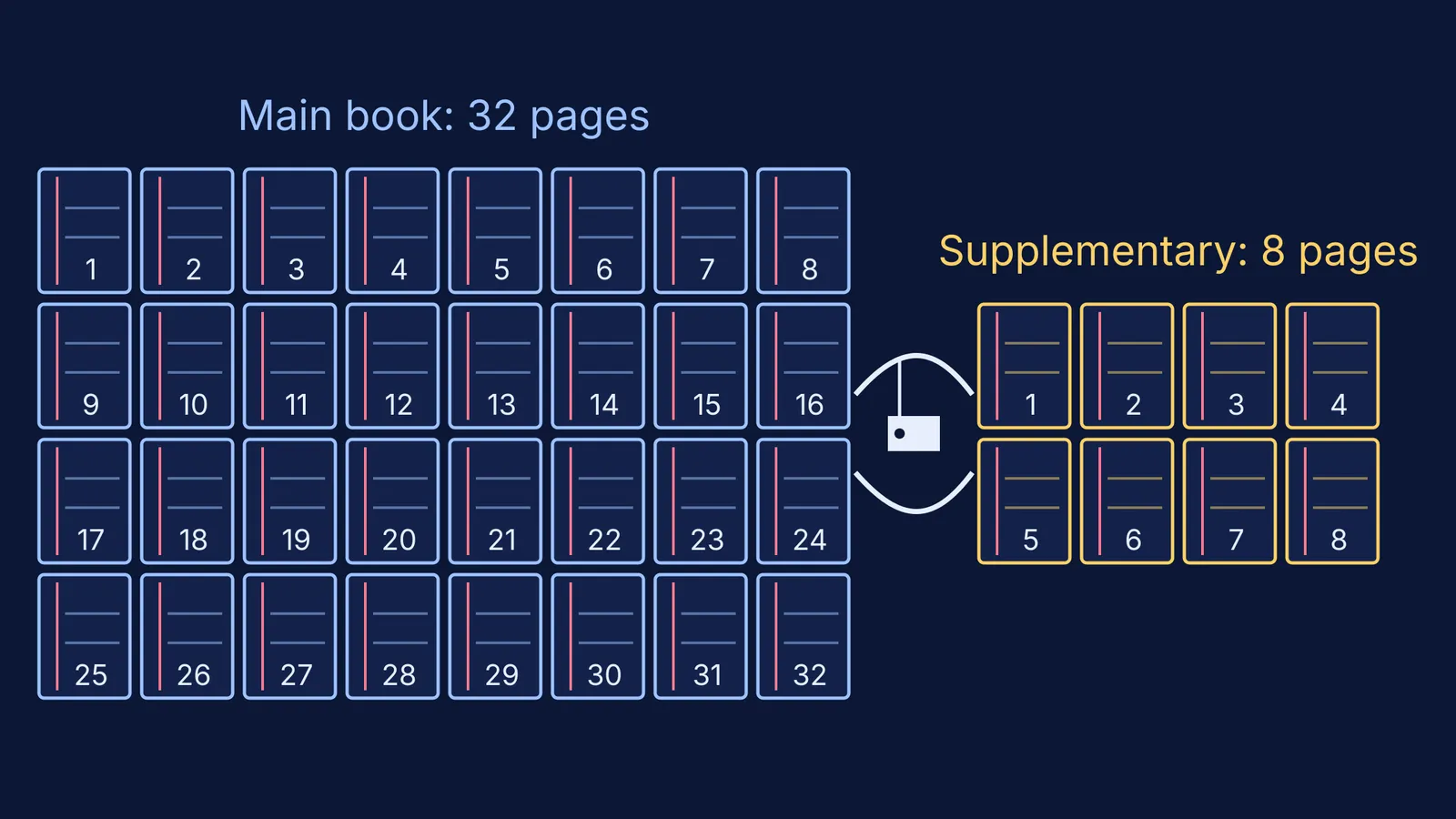
32-page answer books for subjects with more than 50 theory marks
20-page answer books for subjects with 50 theory marks or fewer
48-page answer books with graph paper for Mathematics
8-page supplementary answer books for all subjects
These are the 2023-24 formats, and CBSE can change them. The guidelines also tell you to check the page count and report any missing page at once.
How do you plan answer length so you don't run out of pages?
Turn pages into a budget per mark. CBSE's Class 10 Science sample paper for 2025-26 carries 80 marks across 39 questions in 3 hours. With a 32-page main book, that works out to 0.4 pages per mark, or 2.5 marks per page.
A worked budget for that paper:
1-mark question: a line or two
2-mark question: under a page
3-mark question: about a page
5-mark question: about two pages, including any diagram
One-mark answers use far less than their share, so the slack is room for clear diagrams, not padding. Add a halfway check: after about 40 marks, you should have used no more than about 16 pages. If you are well past page 16, tighten the remaining answers. On time, the same paper gives you 180 minutes for 80 marks, about 2.25 minutes per mark. For the minutes side of this, see how to plan your time inside the exam hall.
Habits that save space without losing marks:
Leave two or three lines between answers rather than starting a fresh page each time.
Skip copying the question; go straight to the point.
For numericals, write the formula, the substitution and the answer with its unit.
Draw diagrams large enough to label clearly, not across a whole page.
Cut a mistake with one neat line instead of rewriting the whole answer.
If your numericals sprawl because you are unsure which steps matter, practise with the Fermi Problem Library. Its step-by-step solver explains the reasoning, so you can see which lines carry the method and which you can drop.
When should you ask for an extra sheet?
Raise your hand on the last two or three pages if you still have more than a page to write. The invigilator has to bring the book, and the CBSE guidelines ask you to write its serial number on the attendance sheet, so it is not instant. A simple script: "Sir or Ma'am, my main answer book is nearly full. May I have a supplementary answer book, please?" Keep writing on your remaining pages while you wait; the book is handed over once the main one is used up.
How do you tie and number supplementary answer books properly?
The CBSE 2023-24 centre guidelines set out these steps:
Write your roll number on the supplementary answer book, and do not write your name or any identifying mark inside it.
Fill in the slip on the supplementary book, and write the question paper code on the main book's title sheet.
Write its serial number on the attendance sheet.
Tie it securely to the main answer book with the white tag or twine supplied at the centre; coloured ones are not allowed.
Enter the number of supplementary answer books used on the OMR cover of the main book.
Do not write your roll number on graph paper or maps.
Never tear out a page, and write on both sides of each page.
Two habits, not written rules, help the examiner follow you: if an answer runs into the supplementary, write the question number again with "contd." in the margin, and end the main book's last page with "continued in supplementary".
Pair this with our guide to checking answers in the last few minutes, and practise your page budget on one full mock this week.


