

On this page
Most students enter science essay contests with the wrong model in mind. They treat entries like textbook summaries, packing pages with known definitions and broad predictions about the future. When evaluators review hundreds of submissions, purely descriptive essays blur together.
Judges look for scientific thinking: picking a contestable question, marshalling empirical evidence, and following a causal chain. Whether you enter an international competition like the John Locke Institute essay prize or a national initiative like the CSIR Innovation Award for School Children, which accepts proposals under 5,000 words in a problem-solution format, your entry succeeds on the sharpness of its argument.
Why do generic science essays lose competitions?
The most common error in student science writing is substituting description for an argument. If an essay merely explains how CRISPR-Cas9 works or lists the benefits of solar energy, it is a report, not an essay. A report relays settled facts; an essay evaluates a dispute, a trade-off, or an unsolved constraint.
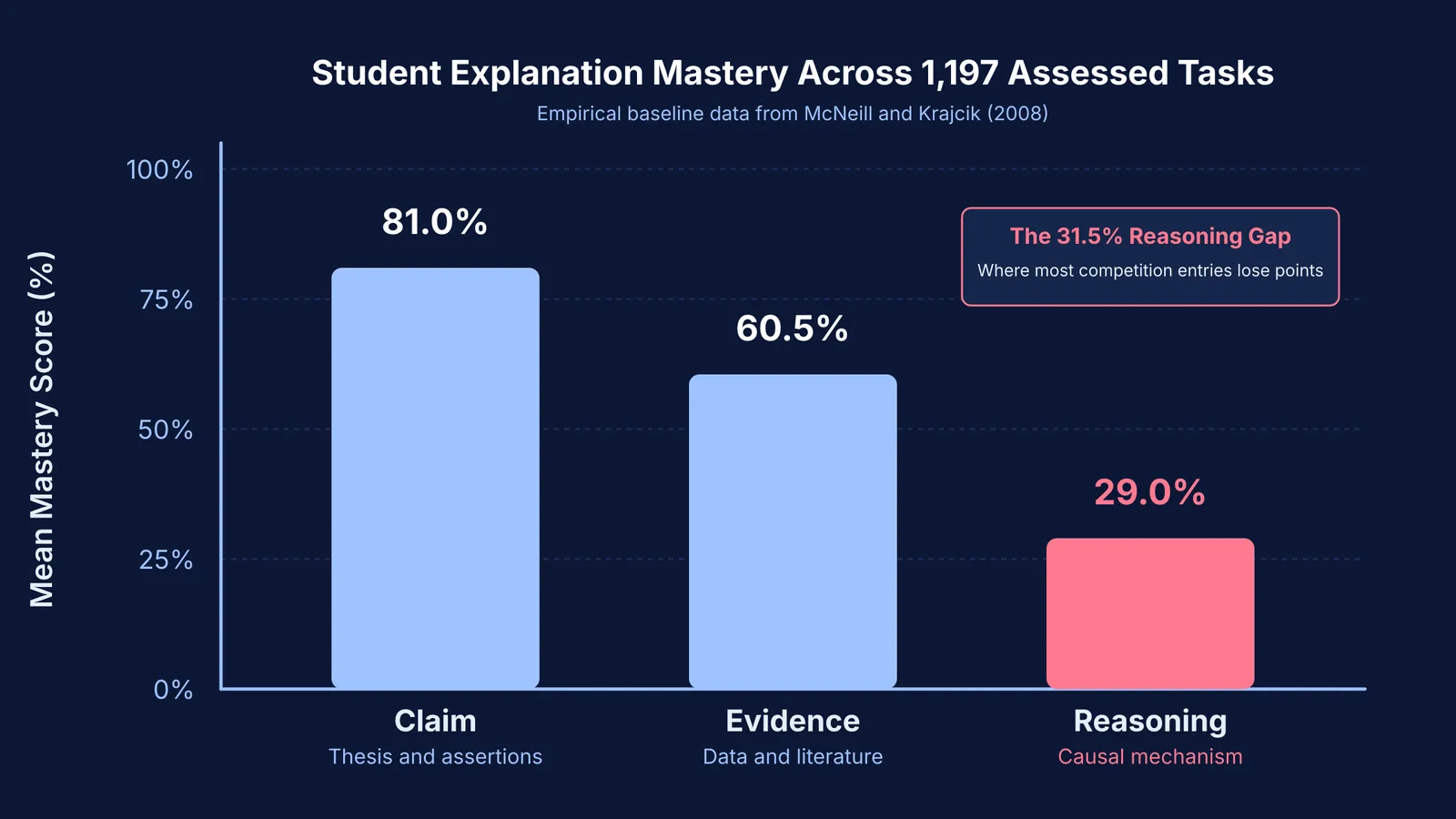
In a study published in the *Journal of Research in Science Teaching*, researchers Katherine L. McNeill and Joseph Krajcik examined how 1,197 middle school students constructed scientific explanations (McNeill & Krajcik, 2008). Students achieved mean scores of 81% on stating a claim and 60.5% on gathering evidence, but only 29% on scientific reasoning. Most could state a claim and point to data, but struggled to explain the underlying principles connecting them.
This reasoning gap is where competition entries lose marks. Weak submissions present isolated facts without demonstrating why those facts support the central thesis.
How do you choose a sharp angle for a broad prompt?
Contest prompts are deliberately wide, asking questions like "How will biotechnology reshape medicine?" Answering the entire prompt produces a superficial survey.
To find a winning angle, narrow the prompt to an unresolved trade-off:
Move from topic to tension: instead of writing broadly about mRNA vaccines, examine thermal stability constraints in lipid nanoparticles and their effect on distributed storage.
Focus on mechanisms: rather than claiming machine learning improves diagnostics, evaluate how neural networks handle domain shifts between clinical scanners.
Set clear boundaries: specify exactly what your essay examines and what lies outside its scope.
This discipline mirrors framing an investigative question for laboratory research or preparing an entry for the IRIS National Fair.
How does the Claim-Evidence-Reasoning framework structure your essay?
Organize each analytical section using the Claim-Evidence-Reasoning (CER) framework:
Claim: a direct, testable assertion that answers a specific facet of your prompt.
Evidence: concrete data from peer-reviewed studies, government databases, or field trials.
Reasoning: the explicit explanation of how and why the evidence supports the claim, grounded in established scientific principles.
Consider how this distinction sharpens a draft:
Descriptive draft: "Ex-vivo gene editing holds promise for treating sickle cell anaemia because Cas9 cuts mutated DNA accurately."
Argumentative draft: "While ex-vivo gene editing achieves high efficacy for sickle cell anaemia, its reliance on busulfan conditioning produces severe toxicities. Clinical trials report prolonged neutropenia, restricting patient access to tertiary hospital centers with dedicated isolation units."
When tracing laws connecting observations to claims, browsing the Fermi Concept Library helps locate where each principle fits within the broader subject map. Exploring interactive models in the Fermi Simulation Lab clarifies dynamic mechanisms before writing.
How should you find and cite primary scientific sources?
Judges quickly spot superficial research. Relying on blog summaries weakens an entry; competitive submissions build on peer-reviewed research papers, review journals, and official publications.
To build an authoritative bibliography:
Read methodology sections: check sample sizes, control groups, and stated limitations. Our guide on how to read a scientific paper explains how to extract findings efficiently.
Trace claims to source papers: when secondary reports cite high catalyst performance, check the original DOI for operating temperatures and pressures.
Follow contest formatting rules: in the ASHG DNA Day Essay Contest, judges evaluate submissions on a 20-point rubric where references account for up to 3 points, scientific accuracy carries 6 points, and evidence carries 6 points, within a 750-word ceiling. Use consistent APA or MLA citations throughout.
What does a judge look for before selecting a winner?
Top marks reward writers who demonstrate intellectual honesty by addressing counterarguments and acknowledging scientific limits.
Before submitting, review your draft against five criteria:
Is the thesis falsifiable? Could a knowledgeable scientist argue an opposing position using published data?
Does every paragraph include reasoning? Verify that you explained the causal mechanism rather than merely citing a number.
Is technical vocabulary necessary? Replace inflated terminology with clear, direct explanations.
Are limitations acknowledged? Noting where a method fails demonstrates mature scientific judgment.
Are format rules respected? Submissions exceeding length limits or revealing student identities in blind judging rounds face immediate disqualification.
When choosing between competing arguments or outlining an essay, Fermi's AI tutor can work out what you already know and build a plan for the session, helping you test each step in your logical chain. Clear science writing is a systematic habit of mind that treats every sentence as an accountable piece of reasoning.


