

On this page
Medical education in India often divides between competitive government college seats and private institutions charging tuition beyond reach for salaried families. For children of formal-sector workers covered by social security, the Insured Persons (IP) Quota provides an accessible route to an MBBS degree. Administered jointly by the Employees' State Insurance Corporation and the Directorate General of Health Services, this quota reserves medical seats at heavily subsidized annual fees. Understanding eligibility rules, contribution audits, and document requirements prevents costly disqualifications.
What is the ESIC quota in MBBS admissions?
The ESIC quota is a dedicated reservation category for undergraduate medical (MBBS) and dental (BDS) seats in institutions run by or affiliated with the Employees' State Insurance Corporation. Under the Employees' State Insurance Act, 1948, these colleges set aside seats specifically for dependent children of insured workers.
In ESIC medical colleges, 15% of seats go to the All India Quota, while state quotas serve domicile candidates. The remaining seats—frequently 20% to 35% of intake—form the Insured Persons quota. Nationwide, over 460 MBBS seats—expanding up to 695 seats in recent admission sessions—are allotted under this quota each year, as reported by the Press Information Bureau. Rather than holding a separate entrance exam, the quota allocates seats directly through NEET-UG merit.
Who qualifies as a ward of an insured person?
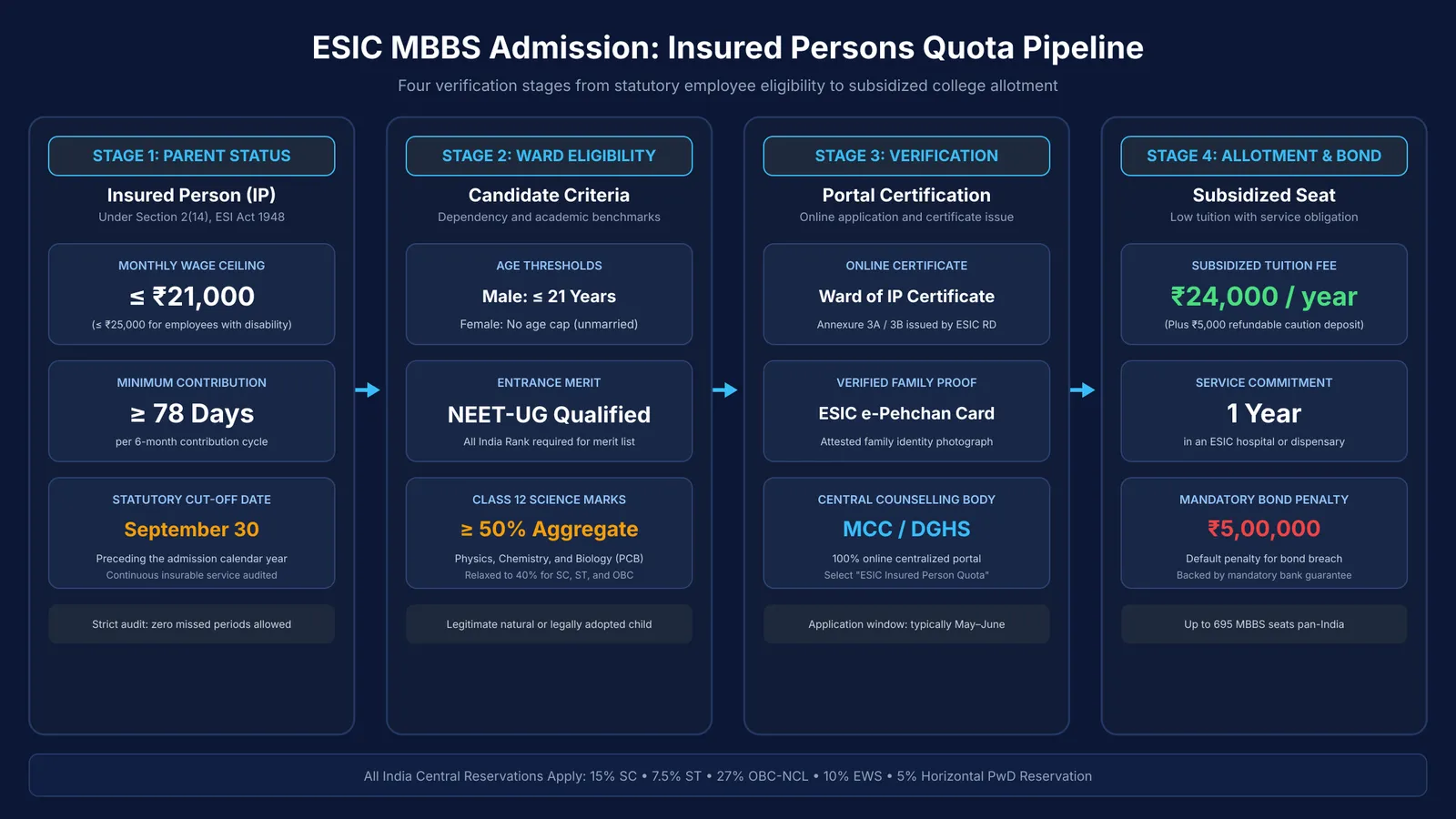
Qualifying requires meeting criteria under both social security law and medical admission rules. Under Section 2(14) of the ESI Act, 1948, an Insured Person is a worker registered with the ESI Scheme whose monthly wages do not exceed ₹21,000 (₹25,000 for employees with disabilities), per statutory rules from the Employees' State Insurance Corporation. The parent must be in continuous insurable employment before the cut-off date, set on September 30 of the calendar year preceding the admission session.
The contribution threshold is strictly enforced:
The parent must have paid or payable contributions for at least 78 days in each six-month period (April 1–September 30 and October 1–March 31).
A single missed contribution period disqualifies the candidate, regardless of cumulative service length.
Candidates must also satisfy family dependency rules:
Male wards must not exceed 21 years of age on the last date of NEET-UG application submission.
Female wards face no upper age limit, provided they remain unmarried and wholly dependent on the parent.
Candidates must qualify in NEET-UG and satisfy standard NEET UG eligibility rules, including 50% aggregate in Class 12 Physics, Chemistry, and Biology (40% for SC, ST, and OBC candidates).
Building quantitative confidence across physics and physical chemistry problem-solving requires mastering underlying methods. The Fermi Problem Library offers worked problems with a step-by-step solver that explains the reasoning rather than printing an answer.
What documents are required for ESIC quota verification?
Documentation follows a strict verification process. Before counselling begins, candidates apply through the ESIC admissions portal to secure a 'Ward of Insured Person Certificate'. Original documents required during college reporting include:
Ward of IP Certificate: Issued online by the ESIC Regional Director (Annexure 3A for standard wards, Annexure 3B for disability beneficiaries).
ESIC e-Pehchan Card: Family identity card displaying the student's photograph, attested by the employer or ESI branch manager.
NEET-UG Documents: Official admit card and scorecard displaying All India Rank.
Academic and Age Proof: Class 10 certificate for date of birth and Class 12 marksheet confirming qualifying science marks.
Category Certificate: Central format certificate for SC, ST, OBC-NCL, or EWS candidates.
Affidavit for Female Wards: Notarized declaration confirming unmarried, dependent status.
How does the MCC counselling and seat allotment work?
Admissions are conducted centrally by the Medical Counselling Committee under the Directorate General of Health Services without offline walk-in rounds. Eligible candidates select the 'ESIC Insured Person Quota' during online registration, with seats allotted by merit-cum-preference on NEET All India Rank. Standard central reservations apply: 15% SC, 7.5% ST, 27% OBC-NCL, 10% EWS, and 5% horizontal PwD quota. For choice-filling mechanics, consult our guide to NEET UG counselling for parents. Managing application stress also requires learning how to help children learn without adding pressure.
Strengthening underlying science fundamentals also helps candidates make informed academic decisions during medical training. The Fermi Concept Library covers every concept in physics, chemistry, biology, mathematics and computing, each with its own lesson and its place in the map.
What are the fees and mandatory service bond conditions?
The primary benefit of the ESIC quota is affordability. Tuition fees for MBBS students under the IP quota are capped at ₹24,000 per year, alongside a refundable security deposit of ₹5,000, as documented by the Employees' State Insurance Corporation. This contrasts sharply with private medical college fees that often exceed ₹10 lakh annually.
In exchange for this subsidy, students execute a mandatory service bond:
Admitted candidates sign an undertaking agreeing to serve in an ESIC hospital, dispensary, or affiliated facility for one year upon completing their MBBS.
The bond carries a financial penalty of ₹5,00,000 (₹5 lakh) if a candidate fails to fulfill the service commitment.


