

On this page
In Class 12 science, physics, chemistry and maths take most of your week, and English and the fifth subject get the leftovers. That is sensible, but leaving those two papers to chance is risky: they count towards the percentage that colleges and JoSAA look at.
Do English and the fifth subject count for IIT and NIT admission?
Yes. The JoSAA 2026 business rules say that candidates seeking IIT seats must pass Class 12 with at least five subjects and either score at least 75% aggregate (65% for SC, ST and PwD candidates) or be in the top 20 percentile of their board. The aggregate uses five subjects: physics, chemistry, maths, a language (the higher-scoring one if you took two) and the highest-scoring other subject. The NIT+ system, including NITs and IIITs, uses the same 75% or top 20 percentile test.
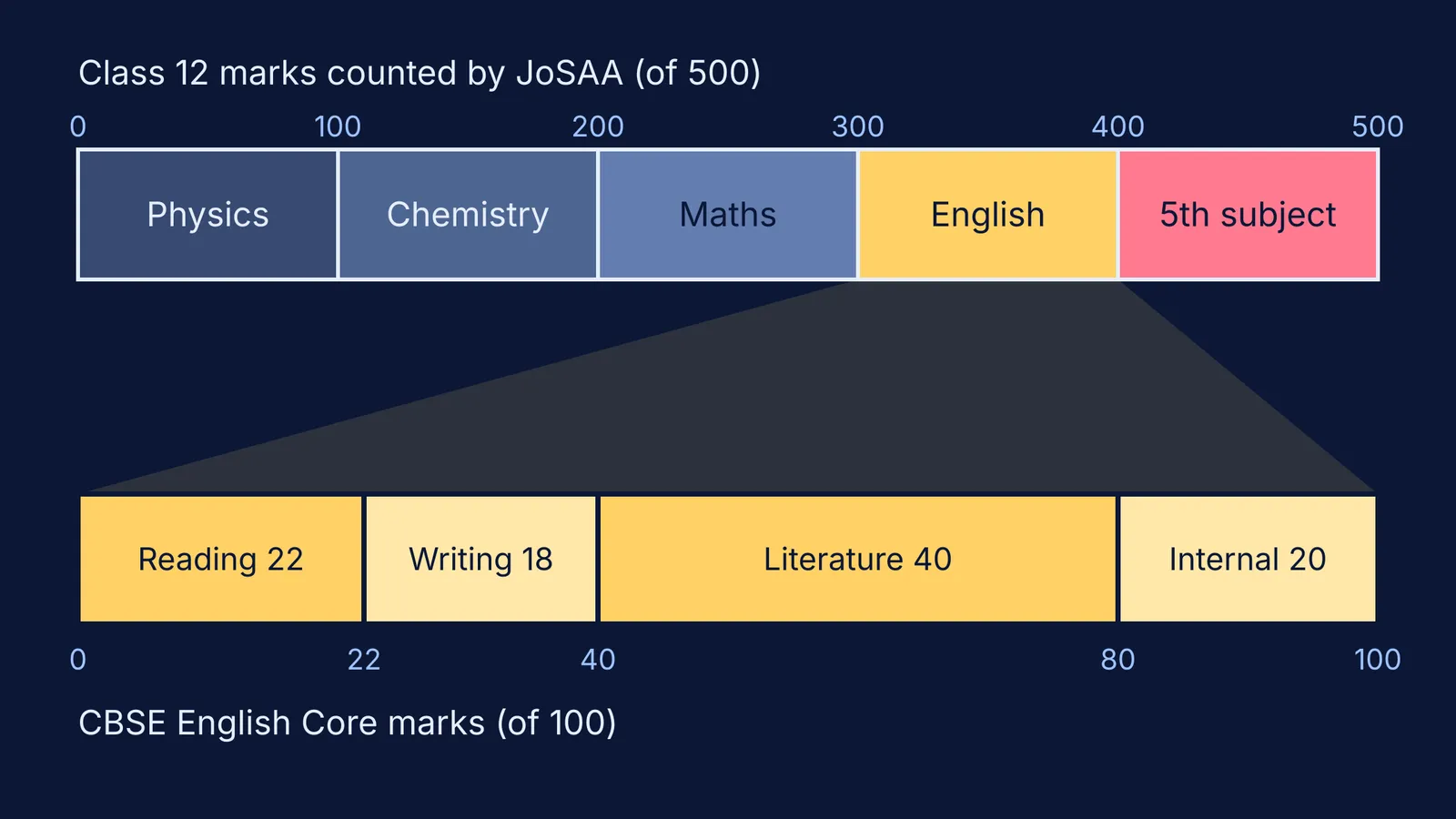
If English is your only language, English and your fifth subject make up 200 of the 500 marks JoSAA counts, or 40% of the aggregate.
CBSE itself does not print a percentage. Its 2026-27 senior secondary curriculum says the board gives marks subject by subject, and the percentage is calculated according to the norms of the college or institution.
How is the CBSE Class 12 English Core paper marked?
The CBSE English Core curriculum for 2026-27 sets 80 marks of theory plus 20 marks of internal assessment: 5 for listening, 5 for speaking and 10 for a project with a viva. The 80 theory marks are split into three sections:
Reading, 22 marks: two unseen passages of 700-750 words combined, one of them a case-based factual passage with data or charts.
Creative writing, 18 marks: a notice, an invitation or reply, a letter, and an article or report.
Literature, 40 marks: extracts, short answers and long answers from Flamingo and Vistas.
Writing is where marks are easiest to protect. Each of the four writing tasks carries 1 mark for format and 1 mark for accuracy of spelling and grammar, so 8 of the 18 writing marks reward correct layout and clean sentences rather than clever ideas.
How to prepare English for board exams as a science student?
This plan uses two 40-minute English sessions a week, matched to the CBSE question paper design.
Writing session: write one task against a timer, then mark yourself against the format, content and accuracy split above. Our guide to using CBSE marking schemes to write answers that earn the marks shows how to read the official answer key.
Literature session: choose one chapter or poem, close the book, and write its theme, main characters and three key moments from memory before you check.
Every other week, add one unseen passage. The case-based passage uses charts and figures, which you already handle in physics; our guide to answering competency-based and case-based questions covers the method.
Why recall rather than rereading? In a 2006 study by Henry Roediger and Jeffrey Karpicke, students who practised recalling prose passages remembered more two days and one week later than students who reread them, though rereading won on a test after five minutes.
Do not leave the 20 internal marks for the end: the curriculum suggests planning the project by November-December and submitting the final portfolio by December-January.
What about the fifth subject?
The CBSE subject list shows that Physical Education, Computer Science and Informatics Practices each have 70 theory marks and 30 practical marks.
Take Physical Education as an example. The 2026-27 Physical Education curriculum splits the 30 practical marks between a fitness test (6), one sport (7), yogic practices (7), a record file (5) and a viva (5). In the theory paper, Biomechanics and Sports is the heaviest unit at 10 marks, and Training in Sports carries 9.
The rule for any fifth subject: finish the practical file early, then give your time to the heaviest units and the latest CBSE sample paper.
How much time should these two papers get?
About two hours a week: 80 minutes of English and 40 minutes of the fifth subject. Over 12 weeks:
Weeks 1-4: one writing task and one literature chapter a week; finish the fifth-subject record file or project.
Weeks 5-8: keep both English sessions, add an unseen passage every other week, and cover the two heaviest fifth-subject units.
Weeks 9-12: alternate a full timed English paper with a full fifth-subject sample paper, and fix the section that lost the most marks.
For your PCM hours, Fermi's AI tutor can work out what you already know and build a plan for the session, so a stuck chapter does not eat the hours you set aside for English.
Start this week with one notice and one poem from Flamingo.


