

On this page
If you sit down to study and immediately start reorganising your desk, checking tomorrow's minor homework, or replying to group chats, you are not alone. It is easy to spend a whole evening feeling busy without ever touching the physics chapter that actually matters for your upcoming JEE or NEET exam. If you are looking for an Eisenhower matrix for students study planning, this guide explains how sorting your tasks can help you focus on what actually improves your results.
What is the Eisenhower Matrix?
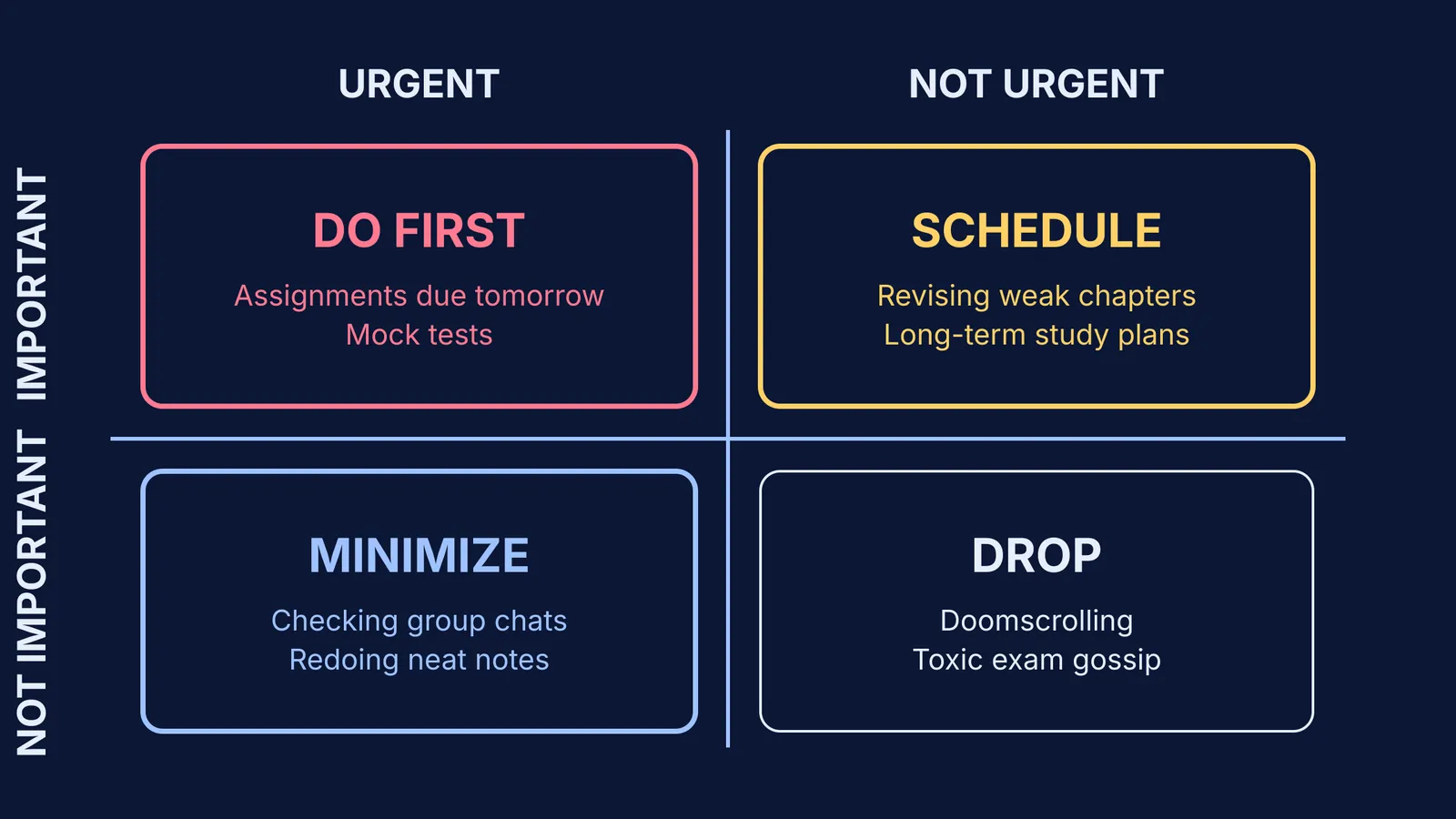
The Eisenhower Matrix is a grid that splits your tasks into four boxes. It forces you to look at every item on your to-do list and ask two questions: is this urgent (does it have a ticking clock?), and is it important (does it help me reach my long-term goals?).
Do First (Urgent and Important): Things with strict deadlines that carry serious consequences, like an assignment due tomorrow morning or a coaching test on Sunday.
Schedule (Not Urgent but Important): Activities that build your long-term success but have no immediate deadline. This includes revising old chapters, practising numericals, and resting.
Minimize (Urgent but Not Important): Interruptions that demand your attention right now but do not help your goals, like a friend calling to complain about a test or an alert on your phone.
Drop (Not Urgent and Not Important): Time-wasting activities that offer zero value, such as mindlessly scrolling social media or worrying about other students' scores.
Why do students choose urgent over important tasks?
We tend to gravitate towards the "Minimize" box because a looming deadline feels impossible to ignore. A 2018 study in the *Journal of Consumer Research* spanning five experiments found that people naturally prioritize urgent tasks over important ones, even when the important tasks offer larger outcomes (Zhu, Yang, & Hsee, 2018).
The researchers called this the "mere urgency effect." When you feel overwhelmed, a ticking clock captures your attention and crowds out your long-term goals. Your brain seeks the quick satisfaction of crossing something off a list. That is why sticking to time blocking for students juggling school and coaching can feel so difficult: the urgent always wants to replace the planned.
How to decide if a task is important or just urgent?
The hardest part of using the matrix is telling the difference between importance and urgency. Urgency is strictly about time. If a task has a strict deadline—like an assignment due at 8:00 AM tomorrow—it is urgent. Importance is about results. If a task helps you secure a good rank, master a tough physics concept, or keep your mind and body healthy, it is important.
When you sit down at your desk, list every task in your head. Ask yourself:
"Does this matter for my final exam or my health?" If yes, it is Important.
"Will something terrible happen if I do not do this today?" If yes, it is Urgent.
If the answer to both is yes, it is a "Do First" task. If the answer to the first is yes, but the second is no, it belongs in the "Schedule" box. This means you do not have to study it today, but you must write down exactly when you will study it later this week.
How does the Eisenhower matrix for students study planning work?
When you create a study plan, you map your current workload directly onto the four quadrants. The goal is to spend most of your time in the "Schedule" box so that fewer tasks spill over into the "Do First" box.
For example, imagine you are a NEET aspirant who needs to master genetics. If the exam is months away, studying genetics belongs in the "Schedule" box. You can block out two hours on Sunday afternoon to sit down and learn the concepts calmly. If you get stuck on the mechanics of DNA replication and are unsure how to proceed, Fermi's AI tutor works out what you already know, builds a plan for the session, and teaches through it, removing the friction that often pushes students to procrastinate.
If you ignore genetics until the week before the exam, it becomes a "Do First" crisis. You will end up cramming, sleeping less, and stressing more. If you are already in this position, you need a triage plan to clear your JEE or NEET backlog so you can get back to scheduling. When working through backlog problems under time pressure, the Fermi Problem Library helps by providing worked problems with a step-by-step solver that explains the reasoning rather than printing an answer, preventing you from wasting hours on a single question.
What should a student put in the "Drop" box?
The "Drop" box is the hardest to accept because it requires you to actively stop doing things that feel comfortable. When you are writing a school holiday study plan, you must be ruthless about what to exclude.
You should drop:
Redoing notes: Copying out your rough class notes just to make them look neat in coloured pens. This feels productive but is a classic "Not Urgent and Not Important" trap.
Toxic exam gossip: Spending an hour on Reddit or group chats arguing about whether the upcoming JEE shift will be harder than the last one.
Endless resource collecting: Downloading gigabytes of PDF study materials and test papers that you will never actually open.
By dropping the tasks that do not matter and minimizing the interruptions, you free up the hours you need for the important work. Start by sketching out a simple 2x2 grid on a piece of paper today, and sort your tasks before you sit down to study.


