

On this page
As technology becomes increasingly integrated into our physical world, the boundary between hardware and software is dissolving. Electronics and Computer Engineering (ECE) has emerged as a hybrid branch designed for students who want to build the physical systems that run complex software. This field goes beyond traditional computer science by ensuring you understand the microscopic silicon structures beneath the code.
What is Electronics and Computer Engineering?
While computer science focuses primarily on algorithms, data structures, and software architecture, this hybrid branch explores how that software interacts with the physical world. It is not just about writing an application for a smartphone; it is about designing the embedded systems, robotics, and Internet of Things (IoT) devices that power modern life.
In this branch, you learn to write code that directly controls hardware. This means understanding both the physics of how electricity flows through a circuit and the logic of how data is processed by a microchip. Engineers in this field build the architecture that allows a self-driving car's sensors to talk to its decision-making algorithms, or a smartwatch to measure a heartbeat and send that data to the cloud.
What do you study in Electronics and Computer Engineering?
The curriculum is structured to provide a deep foundation in both parent disciplines. According to the All India Council for Technical Education (AICTE), the model curriculum for undergraduate engineering programmes typically prescribes 160 to 163 credits over four years.
Students in this branch take a demanding mix of subjects that bridge the two fields:
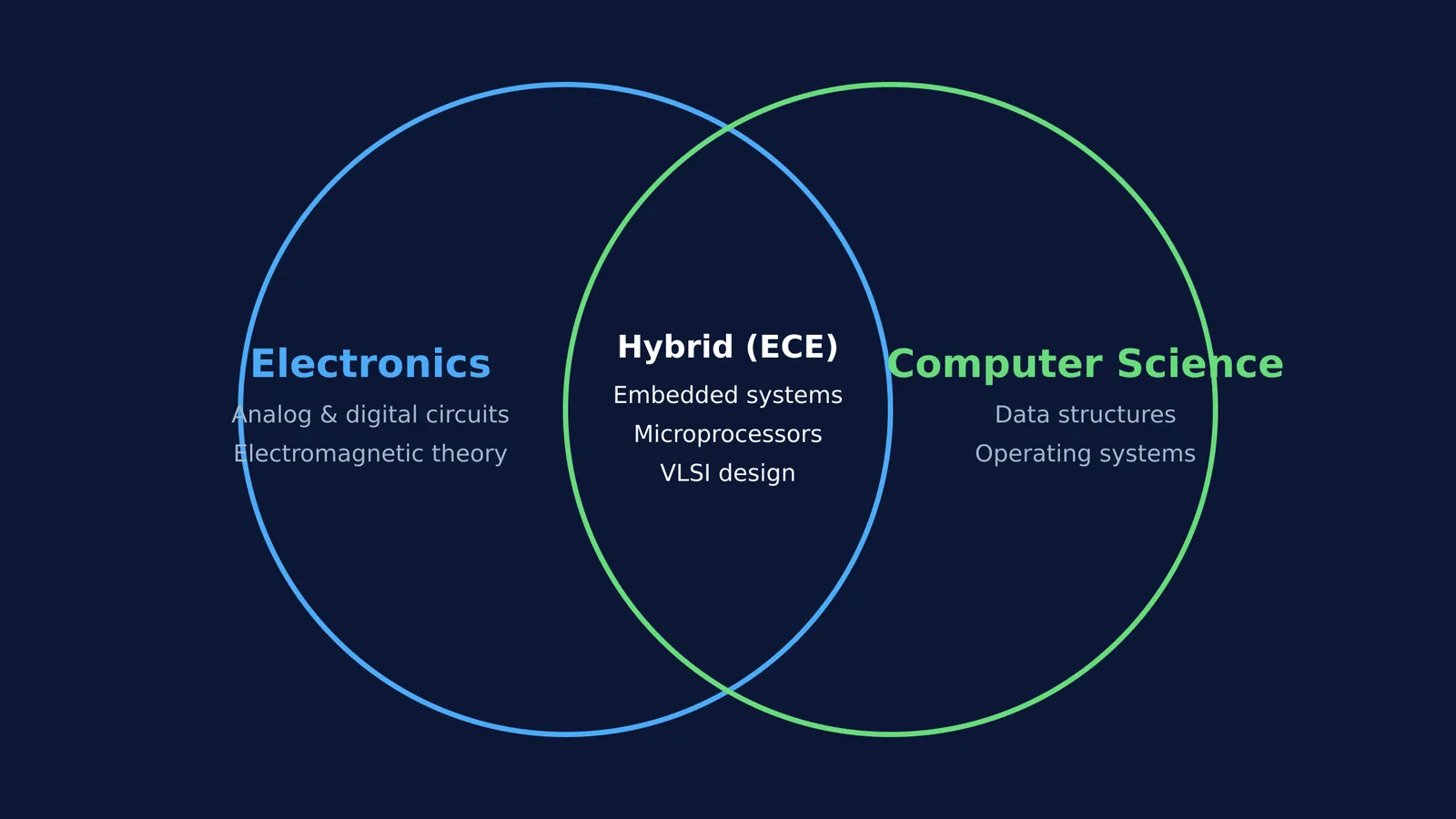
Core Electronics: You study analog and digital circuits, semiconductor devices, electromagnetic theory, and signals and systems.
Core Computer Science: You cover fundamental programming, data structures, algorithms, operating systems, and computer networks.
The Bridge (Hybrid): The unique value of this branch comes from subjects where the two disciplines meet, such as microprocessors, embedded systems, VLSI design (making integrated circuits), and digital signal processing.
The AICTE model curriculum also mandates practical exposure, requiring a 3-week induction programme at the start of the course and 6 to 8 weeks of industry internships before graduation. For those seeking to specialise further, students can often take 18 to 20 additional credits to earn an Honours degree in areas such as artificial intelligence or cybersecurity.
When tackling the demanding physics and mathematics in these early semesters, Fermi's AI tutor can work out what you already know and build a plan for the session, guiding you step by step through difficult topics. If you are struggling with the abstract concepts of how charge carriers move in n-type and p-type semiconductors, the Fermi Simulation Lab provides interactive models to make the physics easier to see. And for tackling tough numerical problems—like solving circuits by assigning voltages—the Fermi Problem Library has a step-by-step solver that explains the reasoning rather than just printing an answer.
What are the career options and salary statistics?
Graduates of this hybrid branch are uniquely positioned for roles that require a deep understanding of both silicon and software. They are heavily recruited for careers in semiconductor design, aerospace, automotive engineering, and artificial intelligence hardware development.
In the United States, these skills command a significant premium in the job market. The US Bureau of Labor Statistics reports a median annual wage of $161,740 for computer hardware engineers in 2025. The same report projects a 9% job growth in this field over the next decade, driven by the expanding need for AI-capable hardware and domestic semiconductor manufacturing.
In India, the engineering landscape is rapidly shifting from traditional IT services to high-value Engineering Research and Development (ER&D). This has created a surge in demand for VLSI engineers and embedded systems developers who can bridge the gap between global hardware standards and efficient software deployment.
Decision Checklist: Is the hybrid branch right for you?
Choosing your engineering major is a significant commitment. Use this framework to decide if the hybrid branch aligns with your long-term goals:
Choose pure Computer Science if: You want to focus exclusively on algorithms, web development, or cloud architecture, and you have little interest in physics or how the underlying processor works.
Choose pure Electronics and Communication if: You are fascinated by telecommunications, antenna design, and signal processing, and you prefer the physics of waveforms over writing complex software systems.
Choose the Hybrid branch if: You want to build tangible products like robotics, autonomous vehicles, or IoT devices. This is for students who want to write the low-level code that makes physical hardware move, sense, and react.
By mastering both the hardware that powers our world and the software that runs it, graduates of this branch step into the workforce ready to build the next generation of smart devices.


