

On this page
Applying to universities in the Netherlands from India involves two steps: registering on a national portal called Studielink and then completing the application on the university's own system.
Whether you are looking at engineering, economics or psychology, the Dutch system evaluates Indian applicants on their Class 12 board marks and English proficiency. Here is how the system works and what you need to prepare.
Which type of Dutch university is right for me?
The Netherlands has two main types of higher education institutions, and your Class 12 results determine which one you can enter.
Research Universities (WO), such as TU Delft or the University of Amsterdam, are highly academic and focus on theoretical models and independent study. For Indian students, the secondary school diploma (such as CBSE or CISCE) must be equivalent to the Dutch pre-university (VWO) level (Study in NL). Leading institutions set specific grade thresholds: for example, TU Delft requires CBSE applicants to achieve at least grade B1 in five academic subjects, while CISCE candidates need a minimum score of 75% in each subject (TU Delft). State board certificates are typically evaluated by Nuffic as equivalent to the senior general secondary (HAVO) level rather than VWO, meaning state board applicants generally need to complete a one-year university foundation programme or a year of undergraduate study in India first (Nuffic).
Universities of Applied Sciences (HBO), such as Fontys or Saxion, focus on practical and profession-oriented training, often incorporating mandatory internships. Admission is generally more flexible. An Indian Standard XII diploma with passing marks across five academic subjects is typically evaluated as equivalent to the Dutch HAVO level, granting direct entry to these programmes (Study in NL).
If your Class 12 scores are borderline for a Research University, you need a strong final push in your board exams. Fermi's AI tutor can work out what you already know and build a plan for the session, so you sit down to a clear next step instead of a blank page.
What are the English and academic requirements?
Most Dutch universities teach their international bachelor's programmes in English. Indian applicants must demonstrate English language proficiency through recognised standardised tests. Research universities, such as TU Delft, require an IELTS Academic overall band score of at least 6.5, or a TOEFL iBT score of at least 90 (TU Delft). Language test certificates must not be older than two years at the time of application.
For STEM degrees such as aerospace engineering or computer science, strong final grades in Class 12 Mathematics and Physics are mandatory. If a syllabus lacks sufficient calculus or mechanics coverage, universities may require applicants to clear the Online Mathematics Placement Test (OMPT) or Dutch VWO deficiency examinations prior to final enrolment (Study in NL).
If you are stuck on difficult numericals while preparing for your Class 12 or entrance exams, the Fermi Problem Library has worked problems with a step-by-step solver that explains the reasoning rather than just printing an answer.
How does the application system work?
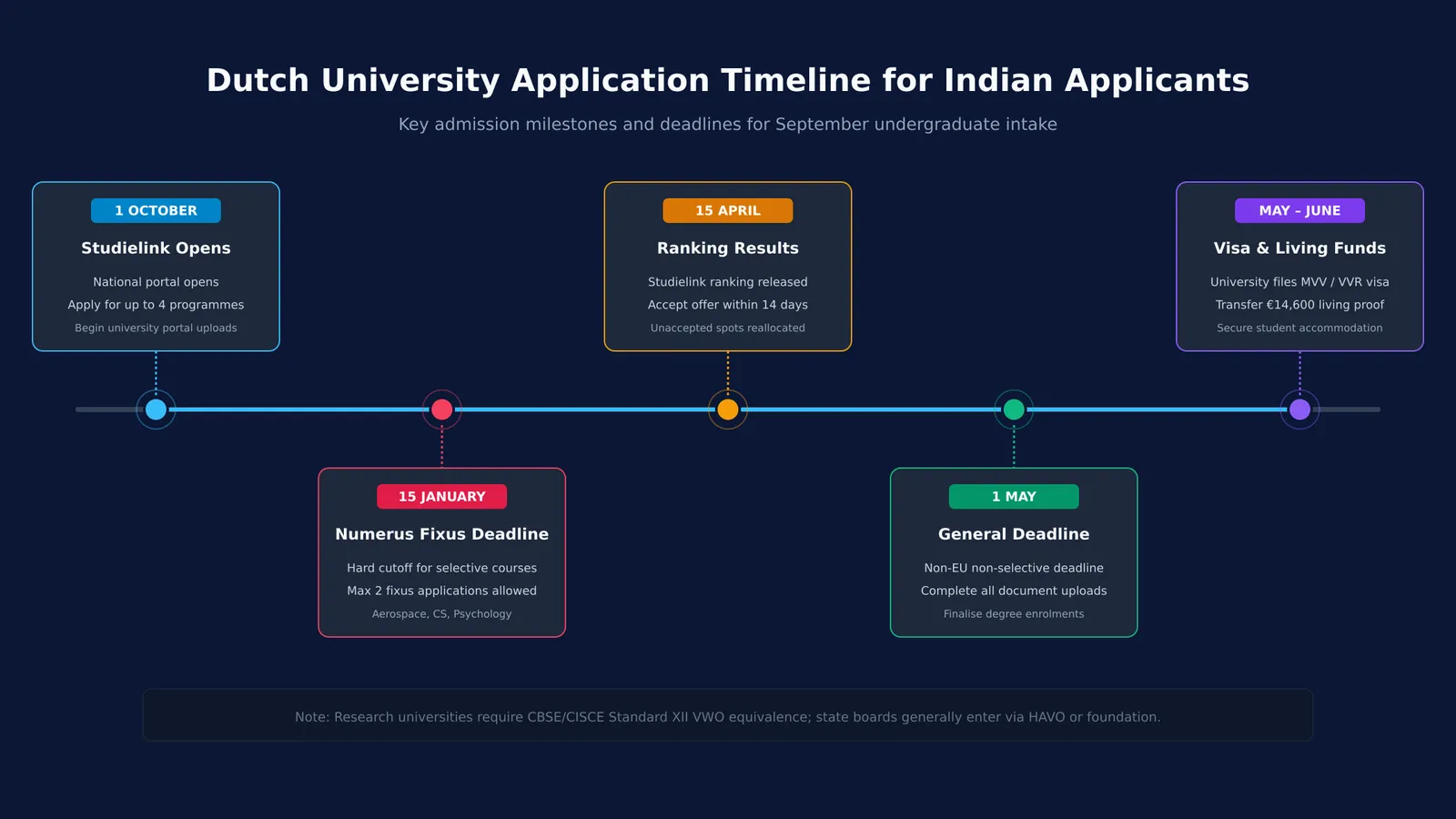
The application cycle for the September intake opens on 1 October of the preceding year (Study in NL).
Applicants submit their initial registration through Studielink, the central national application portal. You can submit up to four active applications at one time (Study in NL). Once registered in Studielink, each chosen university provides access to its own portal where you upload your academic transcripts, English scores, CV, and motivation letter.
Special attention is required for "Numerus Fixus" programmes, which have capped enrolment quotas for competitive courses like Computer Science, Psychology, and Aerospace Engineering. The national deadline for Numerus Fixus programmes is strictly 15 January, and applicants can select at most two fixus programmes per year (Study in NL). Ranking numbers are released via Studielink on 15 April; successful applicants have exactly 14 days to accept their placement offer. For non-selective bachelor's programmes, the general application deadline for non-EU students is usually 1 May (Study in NL).
Here is a timeline to plan your application:
October to November: Register on Studielink and upload required documents to the university application portals.
15 January: Final deadline to submit applications for Numerus Fixus programmes.
15 April: Receive ranking numbers in Studielink for Numerus Fixus courses (offers must be accepted within 14 days).
1 May: General application deadline for non-EU students applying to non-selective bachelor's programmes.
May to June: The university initiates your student visa (MVV) and residence permit (VVR) applications.
How much does tuition cost for Indian students?
Tuition fees for non-EU/EEA students are set at institutional rates that vary by institution and subject. For bachelor's programmes, international tuition fees typically range from €6,000 to €15,000 per year, though specialized engineering degrees may exceed this range (Study in NL).
To secure a student residence permit, the Dutch Immigration and Naturalisation Service (IND) requires international students to prove sufficient financial resources for living expenses, set at €1,216.62 per month, which totals approximately €14,600 per year, excluding tuition fees (Study in NL). Dutch universities generally require applicants to transfer this living expense amount into a university bank account before lodging the visa application, subsequently disbursing the money back to the student in monthly instalments upon arrival.
To help offset expenses, non-EEA students can apply for the NL Scholarship (formerly the Holland Scholarship), which awards a one-off grant of €5,000 during the first year of undergraduate study (Study in NL). Students can also explore our guide on scholarships for science students in India.
For families planning early, balancing international university application requirements with board examination prep requires steady pacing. A structured holiday study plan helps students make consistent progress across both tracks. Parents can also explore guidance on talking about STEM careers to help evaluate multidisciplinary degree tracks in Europe.


