

On this page
A Drug Inspector acts as the primary regulatory authority under the Drugs and Cosmetics Act, 1940 (CDSCO). They are Central Government Gazetted Officers responsible for ensuring that all medicines, cosmetics, and medical devices sold in the country are safe and effective. Their daily work involves inspecting pharmaceutical manufacturing units for Good Manufacturing Practices (GMP) and checking retail pharmacies to verify licenses, storage conditions, and proper record-keeping.
When a batch of medicine is suspected to be "Not of Standard Quality" (NSQ), inspectors take samples from the market or the factory and send them to a government analyst at a Central Drugs Laboratory. Under Section 22 of the Act, they have the power to search premises, seize illegal or adulterated stocks, and launch prosecutions in court against violators (CDSCO). Because they are deemed public servants, obstructing their duty is a criminal offence.
What are the eligibility criteria?
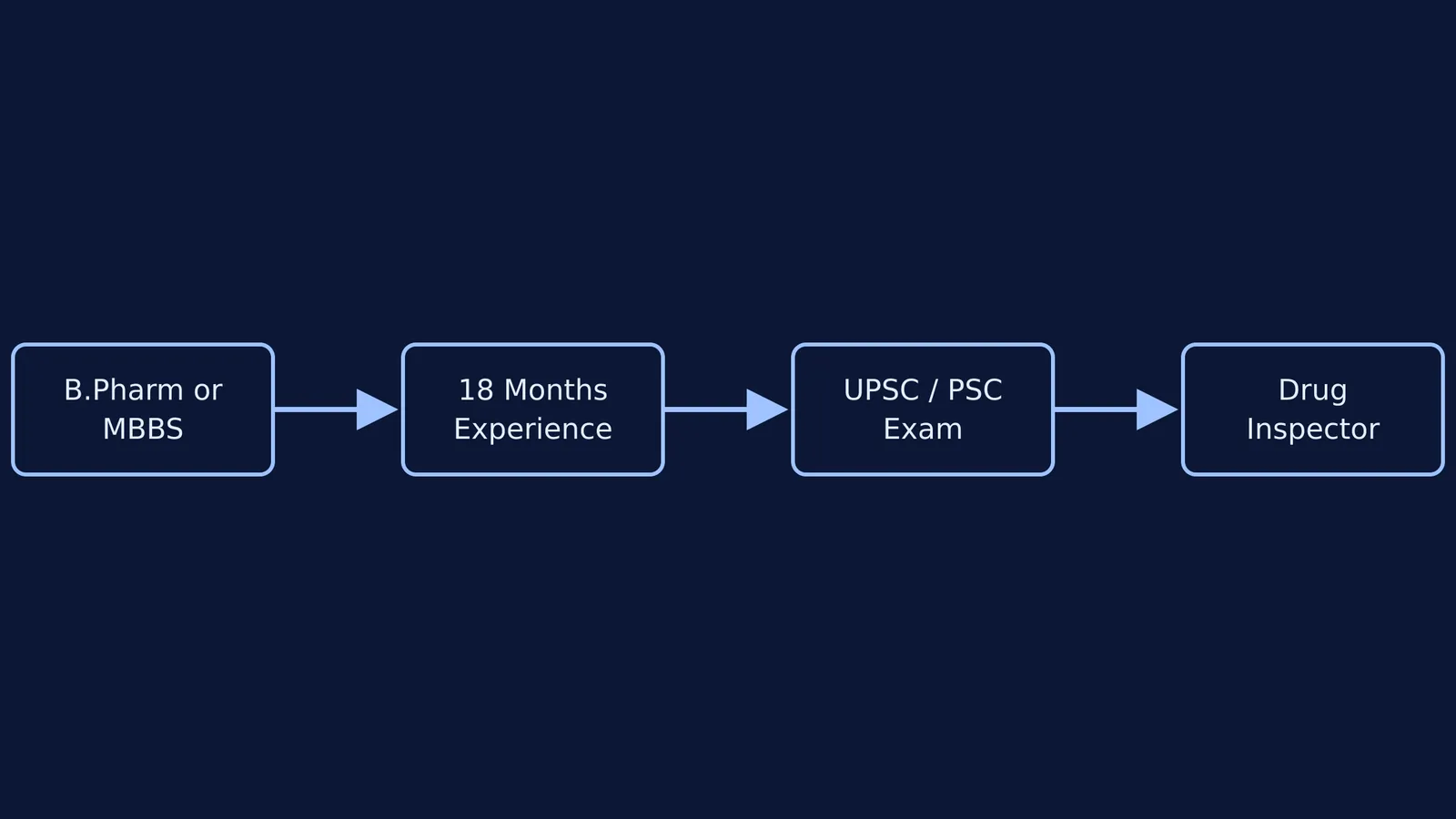
To apply for a central role with the Central Drugs Standard Control Organization (CDSCO), candidates must meet specific educational requirements. According to the Union Public Service Commission (UPSC), you must hold either a Bachelor’s Degree in Pharmacy (B.Pharm) or Pharmaceutical Sciences, or a Degree in Medicine (MBBS) with a specialization in Clinical Pharmacology or Microbiology (UPSC).
While fresh graduates can apply for general recruitment, specific roles come with experience mandates. To inspect the manufacture of Schedule C and C1 substances—such as biological products, antibiotics, and vaccines—an inspector must have at least 18 months of experience in manufacturing or testing these substances, or 3 years of experience inspecting such firms (CDSCO).
The maximum age limit for general category applicants is 30 years (UPSC). The government provides standard relaxations, including a 3-year relaxation for OBC candidates and a 5-year relaxation for SC/ST candidates.
How to become a Drug Inspector in India?
Recruitment for central Drug Inspector posts is conducted by the UPSC, while state-level roles are managed by respective State Public Service Commissions (PSCs). The selection process is highly competitive. For example, the UPSC recently announced 186 vacancies under Advertisement No. 07/2026 (UPSC Online).
The recruitment process generally involves two stages:
Recruitment Test (RT): An offline written exam that tests your knowledge of pharmacy, pharmacology, forensic pharmacy, and drug laws. Understanding industrial processes, such as recombinant insulin production, and biological topics like opioids, cannabinoids and coca alkaloids, is crucial for the technical sections.
Interview: Candidates who clear the written test are called for a personal interview. This stage evaluates the candidate's character, regulatory knowledge, and suitability for a high-stakes enforcement role.
Central Drug Inspectors are placed at Level-8 of the 7th CPC Pay Matrix, drawing a starting salary of approximately ₹70,000 to ₹85,000 per month, inclusive of standard allowances (UPSC).
Career progression and hierarchy
A career as a Drug Inspector offers significant room for growth within the regulatory framework. After several years of service, a Drug Inspector can be promoted to Assistant Drugs Controller, moving up to Pay Level 11 (CDSCO).
Subsequent promotions lead to roles as Deputy Drugs Controller, Joint Drugs Controller, and eventually Additional Drugs Controller. The apex position in this hierarchy is the Drugs Controller General of India (DCGI), who heads the CDSCO and oversees the approval of new drugs and clinical trials nationwide.
If you are building your foundation in science, the Fermi Concept Library maps out every concept in physics, chemistry, biology, mathematics and computing, each with its own lesson and its place in the map. For subjects requiring complex calculations, the Fermi Problem Library offers worked problems with a step-by-step solver that explains the reasoning rather than printing an answer.
A checklist for aspiring inspectors
If you are planning a career in pharmaceutical regulation, follow this pathway:
Complete your degree: Secure a B.Pharm from an institution recognized by the Pharmacy Council of India, or complete your MBBS with the required specialization.
Gain relevant experience: Work for at least 18 months in a pharmaceutical manufacturing or testing unit to ensure you qualify for Schedule C inspections (CDSCO).
Monitor notifications: Regularly check the UPSC online portal and state PSC websites for recruitment advertisements, as these exams are not held every year.
Study the law: Master the Drugs and Cosmetics Act, 1940, and the associated rules, alongside your core pharmacy subjects.
Prepare for the interview: Build a strong understanding of current regulatory affairs, Good Manufacturing Practices, and public health policies in India.


