

On this page
In JEE Main, all three subjects count the same. So the useful question is where your next hour of study will earn the most marks. Here is a split to start from, a worked week, and a monthly rule for changing it.
Does JEE Main give physics, chemistry and maths equal marks?
Yes. NTA's JEE (Main) 2027 Information Bulletin describes Paper 1 (B.E./B.Tech.) as having "equal weightage to Mathematics, Physics and Chemistry".
In the same bulletin, each subject has 20 multiple-choice questions in Section A and 5 numerical-answer questions in Section B, worth 100 marks. That makes 75 questions and 300 marks in a 3-hour paper. A correct answer earns +4 and a wrong one costs −1 in both sections.
If two candidates have the same total NTA score, the bulletin breaks the tie on the maths score first, then physics, then chemistry. That is a good reason not to let maths become the subject you avoid.
How should you split study time between physics, chemistry and maths?
Equal marks mean you start from an equal split. Then you tilt it towards the subject where you lose the most marks. A simple rule is 40-35-25:
Weakest subject (the lowest average across your last two or three full mocks): about 40% of your weekly self-study hours.
Middle subject: about 35%.
Strongest subject: about 25%, and never below 20%.
A 2013 review of ten study techniques by John Dunlosky and colleagues rated practice testing and distributed practice (spreading study out over time) as "high utility". Studying each subject on most days, instead of giving each one a whole day, is a simple way to build distributed practice into your week.
In a randomised trial with 787 Grade 7 students in 54 maths classes, students given interleaved (mixed) practice scored 61% on an unannounced test, compared with 38% after blocked practice (IES study summary; Rohrer and colleagues, 2020). The trial tested maths only, but mixing chapters is easy to try in all three subjects: build each problem set from several chapters instead of one.
You might know a subject is weak but not which chapter to start with. Fermi's AI tutor works out what you already know and builds a plan for the session, so you sit down to a clear next step.
What does a daily and weekly PCM timetable look like?
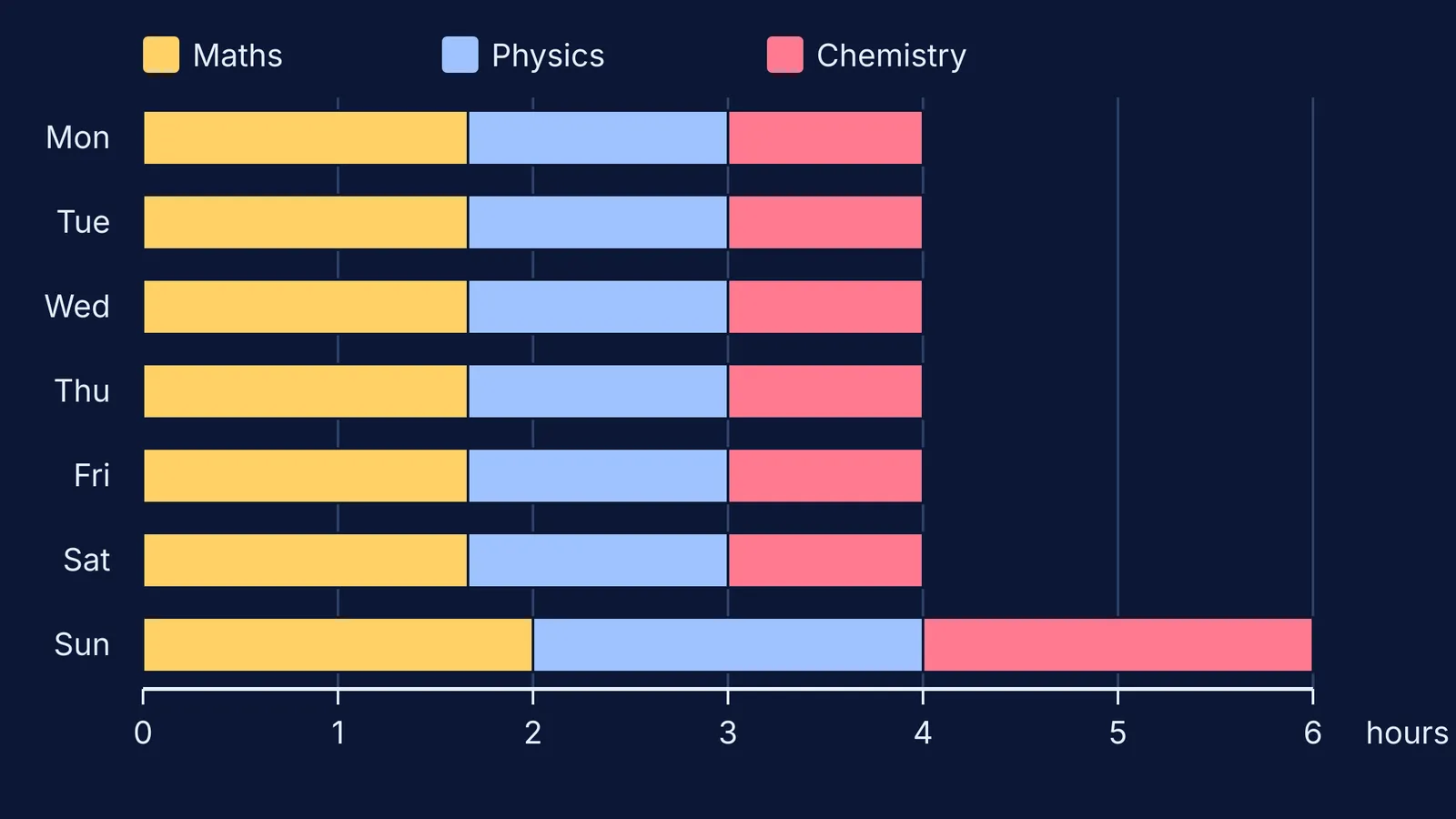
Say you have 4 hours of self-study from Monday to Saturday and 6 hours on Sunday, which adds up to 30 hours a week. Your last three mocks averaged 38 in maths, 52 in physics and 64 in chemistry, out of 100 each. Maths is your weakest subject and chemistry your strongest.
Monday to Saturday (4 hours):
Maths, 100 minutes: one new topic, then a mixed set of problems from older chapters.
Physics, 80 minutes: theory for one topic, then numericals from at least two chapters.
Chemistry, 60 minutes: one short topic, plus quick recall of reactions or formulas from earlier weeks.
Sunday (6 hours):
A full mock in 3 hours, timed like the real paper.
Three hours of review, one hour per subject, sorting every lost mark into a concept gap, a method error or a careless slip.
Counting the mock as one hour per subject, that comes to 12 hours of maths (40%), 10 of physics (33%) and 8 of chemistry (27%) a week, close to 40-35-25. To turn these minutes into fixed blocks on a calendar, use our guide to weekly time blocking for students.
How do you adjust the split every month?
Once a month, take 20 minutes to review:
Average each subject's score from your last two or three full mocks. Our guide on how to analyse a mock test shows how to sort the errors.
If the gap between your highest and lowest subject is 10 marks or more, apply 40-35-25 again to the new ranking.
If the gap is under 10 marks, move back to an even split: 10 hours each in a 30-hour week.
Within each subject, give the first slots of next month to the two chapters that lost the most marks.
Keep older chapters in rotation with a spaced revision schedule.
For example, say the next month's mocks average 51 in maths, 49 in physics and 60 in chemistry. The gap is 11 marks, and physics is now the weakest subject. Physics moves up to 12 hours, maths drops to 10.5 and chemistry stays at 7.5.
When a lost mark comes from a concept gap rather than a slip, the Fermi Concept Library has a lesson for every concept in physics, chemistry and mathematics.
Parents can help with one question at the monthly review: "Which subject gets more hours next month, and why?" Start with this week's split, and check it again after your next three mocks.


