

On this page
Biology carries the most NEET-UG questions, but that does not mean it should get most of your hours from day one. The right split changes as you move from learning chapters to practising questions to sitting mocks.
How is the NEET paper split between subjects?
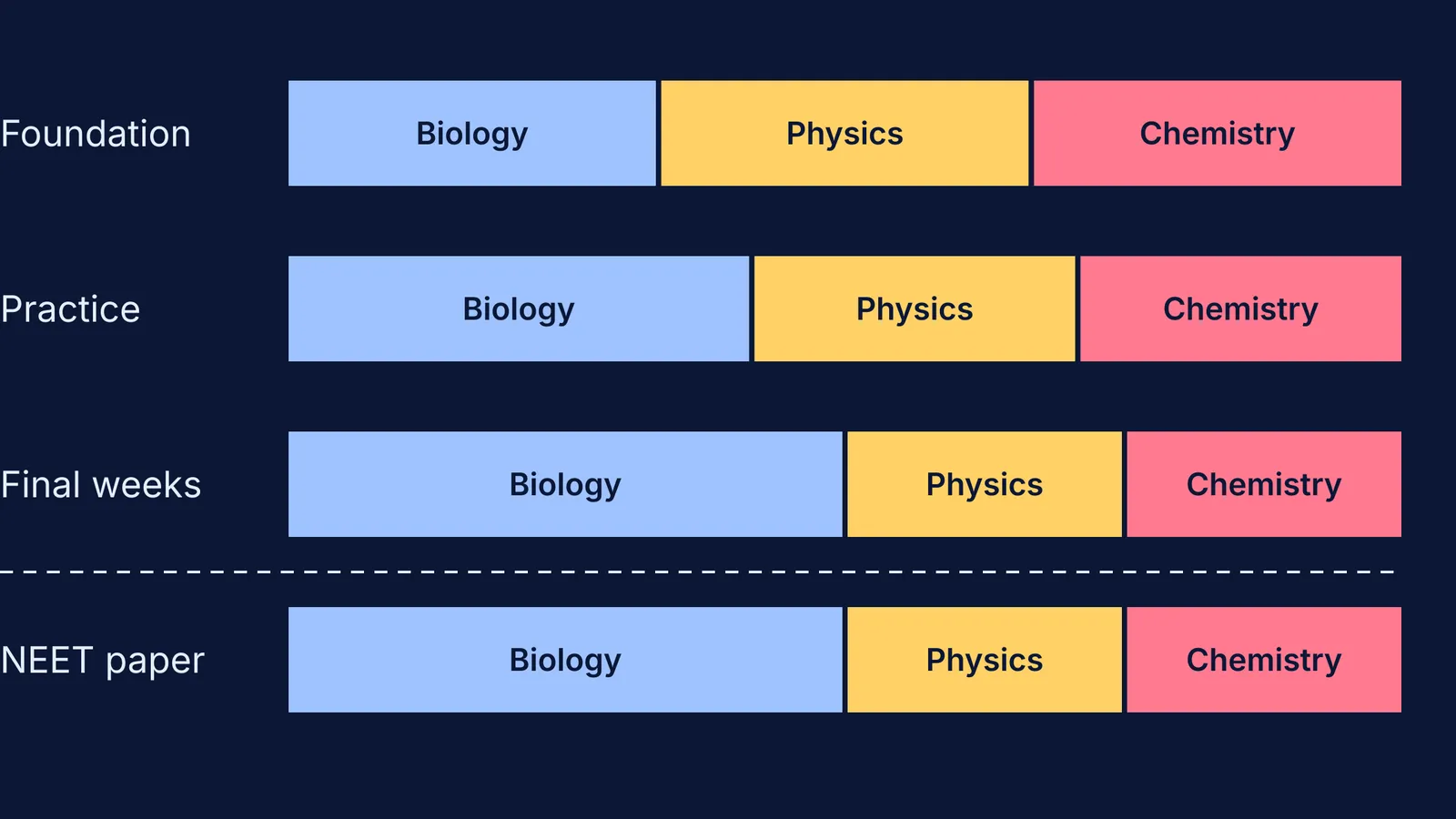
The National Testing Agency's January 2025 notice on the NEET (UG) paper pattern set 180 compulsory questions: 45 in physics, 45 in chemistry and 90 in biology. The same notice fixed the duration at 180 minutes and removed optional questions. Biology is half the paper; physics and chemistry are a quarter each.
Patterns can change, so check the current information bulletin on the official NEET portal before you plan your year. Our explainer on the NEET-UG paper pattern has more detail.
How should you divide time between biology, physics and chemistry for NEET?
Question count shows where the marks are, not how long each subject takes to learn. Many biology questions test facts you can learn by reading and recalling. A physics or physical chemistry question usually needs a method you have practised on many problems. That is why we suggest giving physics and chemistry more than a quarter of your time early on, and letting biology's share grow as the exam gets closer.
Two findings from learning research shape the plan. A 2013 review of ten study techniques by John Dunlosky and colleagues in Psychological Science in the Public Interest rated practice testing and distributed practice (spreading study out over time) as high utility, and rereading and highlighting as low utility. So every subject appears every day, and every block ends with recall rather than rereading.
What should the split look like at each stage?
These are our suggested starting points for six hours of self-study a day, outside school or coaching. Scale them to your own hours.
Foundation (still learning new chapters): biology 2 hours, physics 2 hours, chemistry 2 hours. That gives physics and chemistry more than their quarter-share of the paper, to build problem-solving methods.
Practice (most chapters done, working through question banks): biology 2.5 hours, physics 1.75 hours, chemistry 1.75 hours.
Final weeks (full mocks and revision): biology 3 hours, physics 1.5 hours, chemistry 1.5 hours. That is 50:25:25, the same weighting as the 90, 45 and 45 questions in NTA's paper pattern notice. On mock days, the mock and its review replace the subject blocks.
What does a day look like if one subject is weak?
Use these in the practice stage. Put the weak subject first, when you are freshest, and end each block with a short closed-book recall: write down what you just learnt, then check it against the book. Biology keeps at least 2 hours in every template because it is half of the NEET question paper.
Weak in physics: physics 2.5 hours (one concept, then a set of mixed problems), biology 2 hours, chemistry 1.5 hours.
Weak in chemistry: chemistry 2.5 hours (split between physical numericals and organic or inorganic), biology 2 hours, physics 1.5 hours.
Weak in biology: biology 3 hours (NCERT reading, then answering questions from memory), physics 1.5 hours, chemistry 1.5 hours.
If physics is the weak link and you are strong in biology, our guide to NEET physics for students who are strong in biology goes further. When the problem is a wrong method rather than a missing idea, the Fermi Problem Library has worked problems with a step-by-step solver that explains the reasoning rather than printing an answer.
How do you use mock results to change the split?
Here is a worked example using the 45 physics, 45 chemistry and 90 biology questions in NTA's pattern. Say that over your last three mocks you averaged 23 of 45 right in physics, 30 of 45 in chemistry and 75 of 90 in biology. Count the questions you did not get right: 22 in physics, 15 in chemistry and 15 in biology. Physics accounts for 22 of your 52 misses, more than either other subject, even though it has half as many questions as biology. So switch to the weak-in-physics template for two weeks, then check again against your next three mocks.
Look for a pattern, not one bad paper. Our 60-minute mock test review routine sorts errors into concept gaps, method slips and time pressure, which tells you how to spend the extra hours.
If you are not sure where to begin, Fermi's AI tutor can work out what you already know and build a plan for the session, so you sit down to a clear next step.
What if the timetable stops working?
A plan you can keep most days beats a perfect one you drop after a week. If you keep missing blocks, cut your total hours before you cut a subject. Parents help most by asking which block felt hardest this week, not how many hours were done.
If stress, low mood or poor sleep go on for more than a couple of weeks, talk to someone you trust or a doctor. Tele MANAS, the Health Ministry's free, 24x7 mental-health helpline, answers on 14416 or 1800-891-4416.


