

On this page
Schools such as the Rhode Island School of Design (RISD) in the US and University of the Arts London (UAL) ask design applicants for a portfolio: a small set of your own work that shows how you see, think and make. Here is what their official guidance asks for, and a plan for 12 to 15 pieces.
Some Indian B.Des routes are decided mainly by an entrance exam (see our guide to the UCEED design entrance pattern and marking). Indian institutes set their own requirements, so check each current brochure.
What do design schools look for in a portfolio?
Less polish than you might expect. UAL's portfolio advice says it is not just looking for polished, finished work but for your potential and the journey you've been on, including experiments and mistakes. Your portfolio should also show how you research, develop and plan ideas.
RISD lists the values it looks for in its first-year application tips: exploration, process, discovery, conceptual thought, creative problem-solving and skill. In RISD's words: “We like to see developed concepts and evocative ideas, not just technical exercises.”
RISD recommends some drawing from direct observation: real people, objects and places in front of you. It wants every piece to be your own creation, and discourages drawing from photographs and videos, master copies, fan art and anime.
How many pieces should a design portfolio have?
It depends on the school, so read each brief first. RISD asks first-year applicants for 12 to 20 images of their strongest and most recent work, and says it values quality over quantity (RISD application tips). UAL suggests including work from 3 to 5 projects to show a range of ideas and skills, and tells you to check each course page for its own requirements (UAL portfolio advice).
We suggest 12 to 15 strong pieces: enough for range and RISD's minimum, few enough that nothing is filler. Where a school counts images, as RISD does, count each slide. Put every candidate through four questions:
Is the idea mine, not a copy?
Is it recent?
Does it show a medium, skill or idea that no other piece shows?
Can I say in two sentences why I made it?
Drop anything that fails two of them, however long it took.
How do you document your design process?
UAL advises organising the portfolio by project and telling each project's story, from research and process to outcome (UAL). For one project, that can be three pages:
Research: photos of the problem, observational sketches, notes from talking to people who face it.
Process: thumbnail sketches, rejected ideas, a rough cardboard model and a note on what failed.
Outcome: the finished piece, plus one detail shot.
Keep words short. UAL says annotations should be short, clear and concise, at least 12 point, and, where relevant, give the materials, size and date; for group work, say what your role was. RISD prefers the opposite on slides: it does not recommend text descriptions in slides and says process images are unnecessary for standard drawings or paintings (RISD). So follow each school's format rather than one template.
If a project starts from how something works, such as why bicycle gears make a slope easier, the Fermi Simulation Lab has interactive simulations for ideas that are easier to see than to read.
How should you photograph and present the work?
From RISD's tips (RISD):
Light the work well and keep the background free of distractions; ask whether one front-facing shot or added detail shots show it best.
If you combine images on one slide, use no more than four.
Use JPEG, PNG, GIF, MP4 or MOV files; RISD does not recommend Google Drive links, zip files or multi-page PDFs.
UAL adds that a landscape format is best, that white space helps, and that you should start and end with your strongest work (UAL).
A 14-piece plan you can copy
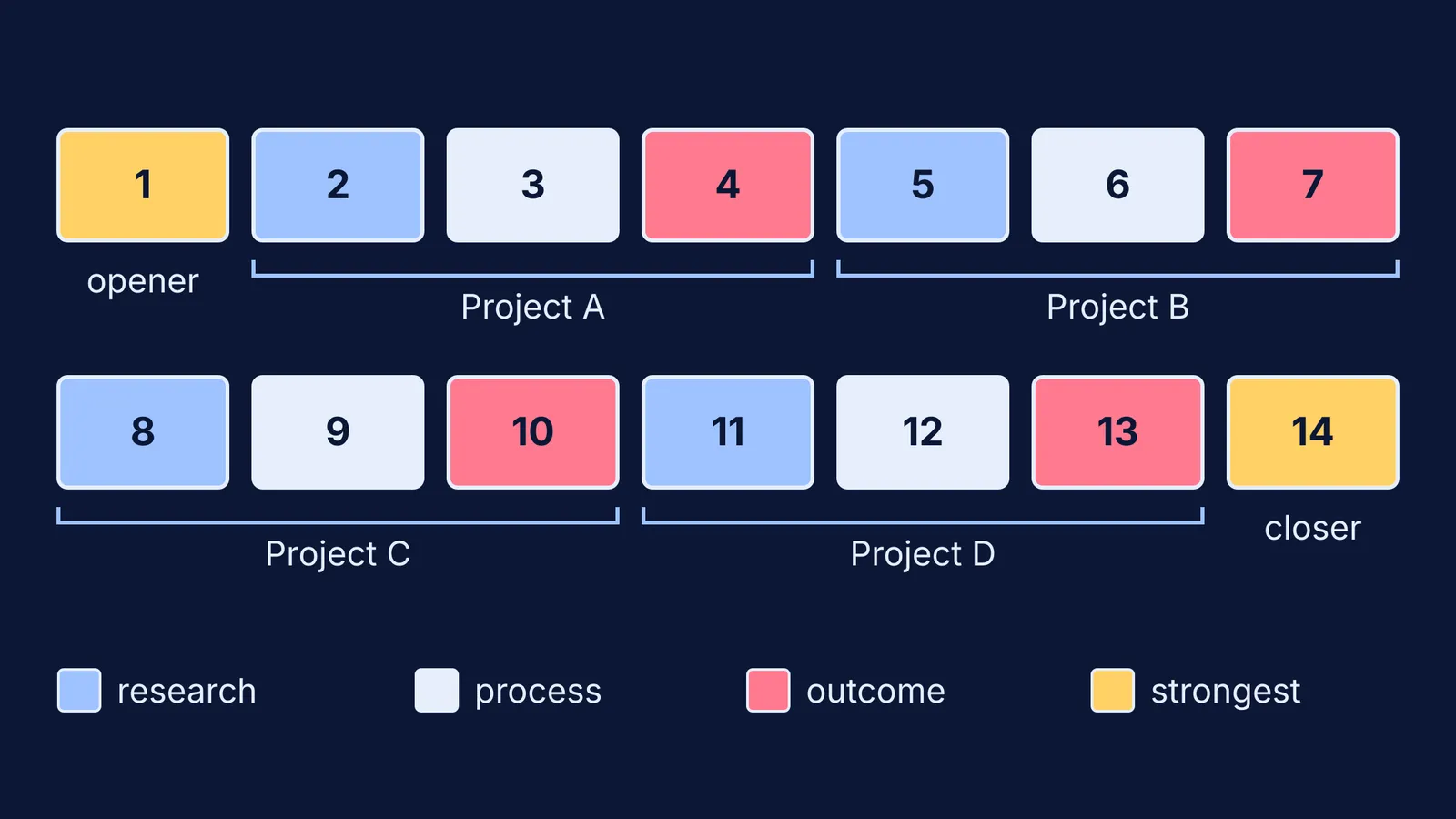
One worked example for a Class 11 or 12 student: four projects of three pieces, plus a strong opener and closer, as UAL advises.
Piece 1, opener: your strongest finished work.
Pieces 2 to 4, observation: sketches at a local sabzi market, studies of hands and crates, then one large finished drawing.
Pieces 5 to 7, problem-solving: a better school tiffin carrier, from classmates' complaints to cardboard mock-ups to a final model.
Pieces 8 to 10, communication: posters on saving water for your housing society, from thumbnails and type tests to the final set.
Pieces 11 to 13, materials: tests with clay, cloth or scrap, the failures, then the piece that worked.
Piece 14, closer: another of your strongest finished pieces.
If design is a new direction for your family, our piece on when your child's career choice differs from yours may help. If architecture is also on the list, read how the IIT B.Arch drawing test after JEE Advanced works.
Start this week with one project: pick a problem near you and photograph every step.


