

On this page
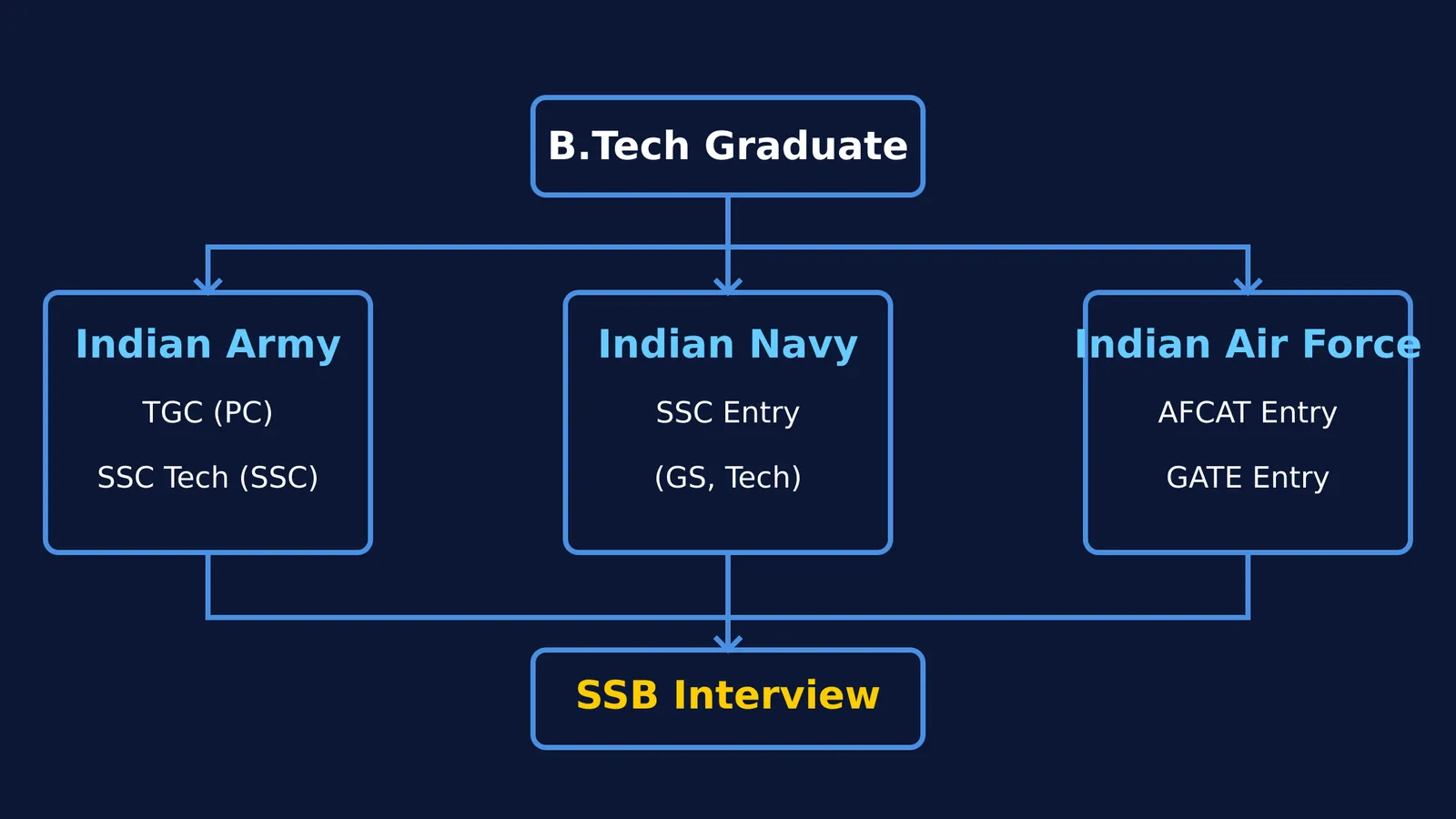
In short Engineering graduates can join the Indian Armed Forces through direct technical entries or exams like the CDS and AFCAT. The Army's TGC, Navy's SSC Tech and Air Force's AFCAT routes recruit B.Tech holders based on their degree marks and a five-day SSB interview 1.
If you are finishing your B.Tech and looking for a career that goes beyond a standard desk job, the Indian Armed Forces offer several direct pathways for engineers. The Army, Navy and Air Force rely heavily on technical graduates to maintain their equipment, manage communications and lead technical units.
Rather than going through the standard National Defence Academy (NDA) route meant for school leavers, engineering graduates apply through specific technical entries. These routes often skip the initial written exam, shortlisting you directly for the Services Selection Board (SSB) interview based on your university marks.
How to join the Indian Army after B.Tech?
The Indian Army recruits engineering graduates primarily through two direct entry schemes, managed via its official portal, joinindianarmy.nic.in.
For a lifelong career, male engineers can apply for the Technical Graduate Course (TGC). This grants a Permanent Commission, and the age limit is 20 to 27 years at the time the course begins 1. Candidates are shortlisted based on their cumulative B.Tech percentage. Those who meet the cut-off are called for a direct SSB interview, followed by 49 weeks of training at the Indian Military Academy (IMA) in Dehradun 1.
If you are looking for a shorter tenure, the Short Service Commission (Technical) or SSC Tech is open to both men and women. The age limit is also 20 to 27 years, and the selection process is identical to the TGC 1. However, the training lasts 49 weeks at the Officers Training Academy (OTA) in Chennai 1. This is the primary technical entry route for women engineers joining the Army.
If you do not meet the technical cut-offs or wish to join non-technical arms like the Infantry, you can take the Combined Defence Services (CDS) examination. Conducted twice a year by the UPSC, the CDS exam tests your English, general knowledge and elementary mathematics 1.
How to join the Indian Navy after B.Tech?
The Indian Navy regularly calls for engineers to manage its ships, submarines and air traffic control. The most common route is the SSC Officer Entry, which you can apply for at joinindiannavy.gov.in.
The Navy requires a minimum of 60% aggregate marks in your B.Tech degree 2. The age limit is generally 19.5 to 25 years, though this can vary slightly depending on the specific branch you apply for, such as General Service, Naval Armament Inspectorate or the Electrical Branch 2.
Like the Army's direct entries, the Navy shortlists candidates based on their degree marks and calls them for an SSB interview.
If you find yourself stuck while preparing for written entrance exams like the CDS, a structured approach helps. Fermi's AI tutor works out what you already know and builds a plan for the session, so you sit down to a clear next step.
How to join the Indian Air Force after B.Tech?
Engineers join the Air Force primarily through the Air Force Common Admission Test (AFCAT), with applications hosted at afcat.cdac.in.
The AFCAT is conducted twice a year 3. B.Tech graduates with a minimum of 60% marks can apply for the Ground Duty (Technical) branch, which has an age limit of 20 to 26 years 3. To qualify for the Flying Branch, you must also have scored at least 50% in Physics and Mathematics at the 10+2 level, and the age limit is stricter at 20 to 24 years 3.
Recently, the Air Force has also introduced a direct entry based on GATE scores, allowing you to bypass the written AFCAT exam and proceed straight to the AFSB interview. If you need to refresh your core engineering concepts for these technical interviews, such as converting PV, PT and VT graphs of ideal gas processes, the Fermi Concept Library contains every concept in physics, chemistry, biology, mathematics and computing, each with its own lesson and its place in the map.
The SSB Interview
Regardless of the force or the entry scheme, the final hurdle is the Services Selection Board (SSB) interview. This is a rigorous five-day process that tests your intelligence, psychology and group dynamics 1.
It begins with a screening test on the first day, comprising intelligence tests and a Picture Perception and Discussion Test (PPDT) 1. Only those who pass this stage stay for the remaining four days, which involve psychological tests, group tasks and a personal interview 1.
To prepare, focus on your physical fitness, stay updated with current affairs, and practice your core engineering subjects. For brushing up on mathematical problem-solving skills, you can review topics such as odds in favour and odds against: converting them to probability to tackle common aptitude questions.


