

On this page
If you prepare for JEE Main, JEE Advanced or NEET-UG at a coaching centre, one day a week has no classes. It is tempting to sleep till noon or to attack every backlog chapter at once. Here is a simple shape for the day: rest, chores, one light review block and a short plan for the week.
Why does coaching give you a weekly off?
The day off is part of the design, not a reward. The Ministry of Education's Guidelines for Regulation of Coaching Center say coaching centres "shall ensure weekly off for students as well as tutors" and that there shall be no assessment test on the day after it. They also say classes should not run more than 5 hours a day, with timetables spaced out so students can "relax and recuperate". These are model guidelines for states; a 2026 Rajya Sabha reply lists the state rules that followed, so check what applies where you study.
So the day exists for recovery, and you do not need to cram.
What should you do on your day off from coaching?
Sabine Sonnentag and Charlotte Fritz identified four recovery experiences: psychological detachment, relaxation, mastery and control. They studied working adults, not students, so treat this as a checklist rather than proof. A good day off has some of each:
Detachment: most of the day has no formulas, test analysis or rank lists.
Relaxation: a long meal, a walk, music, a nap.
Mastery: getting better at something off the syllabus, such as cooking, football or the guitar.
Control: you choose the order of the day.
Sleep comes first. The American Academy of Sleep Medicine recommends that teenagers aged 13 to 18 sleep 8 to 10 hours per 24 hours on a regular basis. If the week left you short, a slightly longer night is reasonable, but waking hours later than usual may make it harder to fall asleep before Monday's early class. Our guide on how much sleep teenagers need explains why.
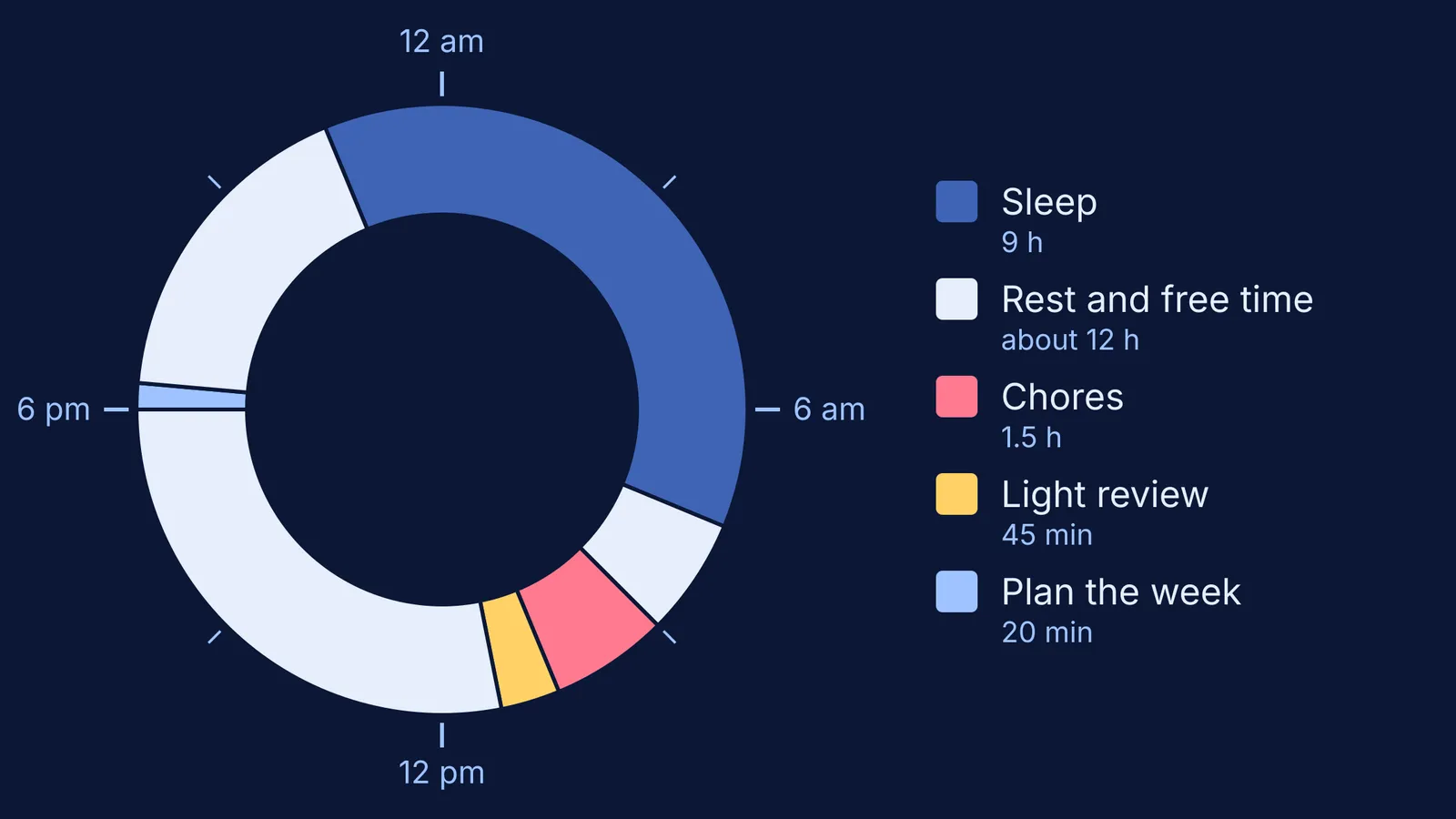
A sample day off, hour by hour
This assumes a Sunday holiday; shift the times to fit your batch.
Until 7:30 am: sleep in a little, not until noon.
7:30 to 9:00 am: slow breakfast and a call home.
9:00 to 10:30 am: chores. Laundry, clear the desk, restock stationery and snacks, top up your bus pass.
10:30 to 11:15 am: the light review block.
11:15 am to 6:00 pm: yours. Friends, sport, a film, a hobby, time outdoors.
6:00 to 6:20 pm: plan the week.
Evening: early dinner, bag packed for Monday, lights out by about 10:30 pm.
How much should you study on a coaching holiday?
One short block is enough, and it should be recall, not rereading. Henry Roediger and Jeffrey Karpicke had students either restudy prose passages or practise recalling them. On tests 2 days and 1 week later, the recall group remembered substantially more, even though restudying made students more confident.
In your 45 minutes:
On a blank page, write everything you remember from the week's main topics: definitions, formulas, one diagram (15 minutes).
Check your notes and mark what you missed in another colour (5 minutes).
Redo three to five problems you got wrong or guessed this week, before looking at the solution (25 minutes).
If a problem still makes no sense on the second try, the Fermi Problem Library has a step-by-step solver that explains the reasoning rather than printing an answer. Add what you missed to your 4-week spaced revision schedule so it comes back at the right time.
How do you plan the week ahead in 20 minutes?
Use if-then plans. Peter Gollwitzer and Paschal Sheeran pooled 94 independent tests of "implementation intentions", plans of the form "if situation X, then I do Y", and found a medium-to-large effect on reaching goals (d = 0.65).
Read the week's coaching timetable and test dates (3 minutes).
Pick the two weakest topics from your review block (2 minutes).
Write one if-then plan for each: "If I'm back from class by 7 pm on Tuesday, then I do ten rotation problems before dinner" (10 minutes).
Block the time on paper or your phone, and leave one evening empty as a buffer (5 minutes).
Our guide to time blocking for students juggling school and coaching shows how to lay out the week. If a weak chapter feels too big to start, Fermi's AI tutor can work out what you already know and build a plan for the session, so Monday begins with a clear next step.
What can parents say on the day off?
Protect the day rather than filling it with extra tuition. Three lines that help:
"What do you want to do today that isn't study?"
"Do you need anything for the week?"
"How did the week feel, not just the test?"
If your child seems low for weeks, cannot sleep, or dreads every holiday ending, speak to the centre's counsellor or a doctor. Tele MANAS, the government's mental health helpline, is free and open 24x7 on 14416.


