

On this page
Allied healthcare professionals form the backbone of modern clinical medicine, from diagnostic analysis to operating complex radiotherapy equipment. Unlike undergraduate MBBS admissions where the Medical Counselling Committee coordinates 15% All India Quota seats alongside state authorities, paramedical admissions across India follow a decentralized structure. Admission depends on either specialized entrance tests or Class 12 aggregate marks in Physics, Chemistry, and Biology.
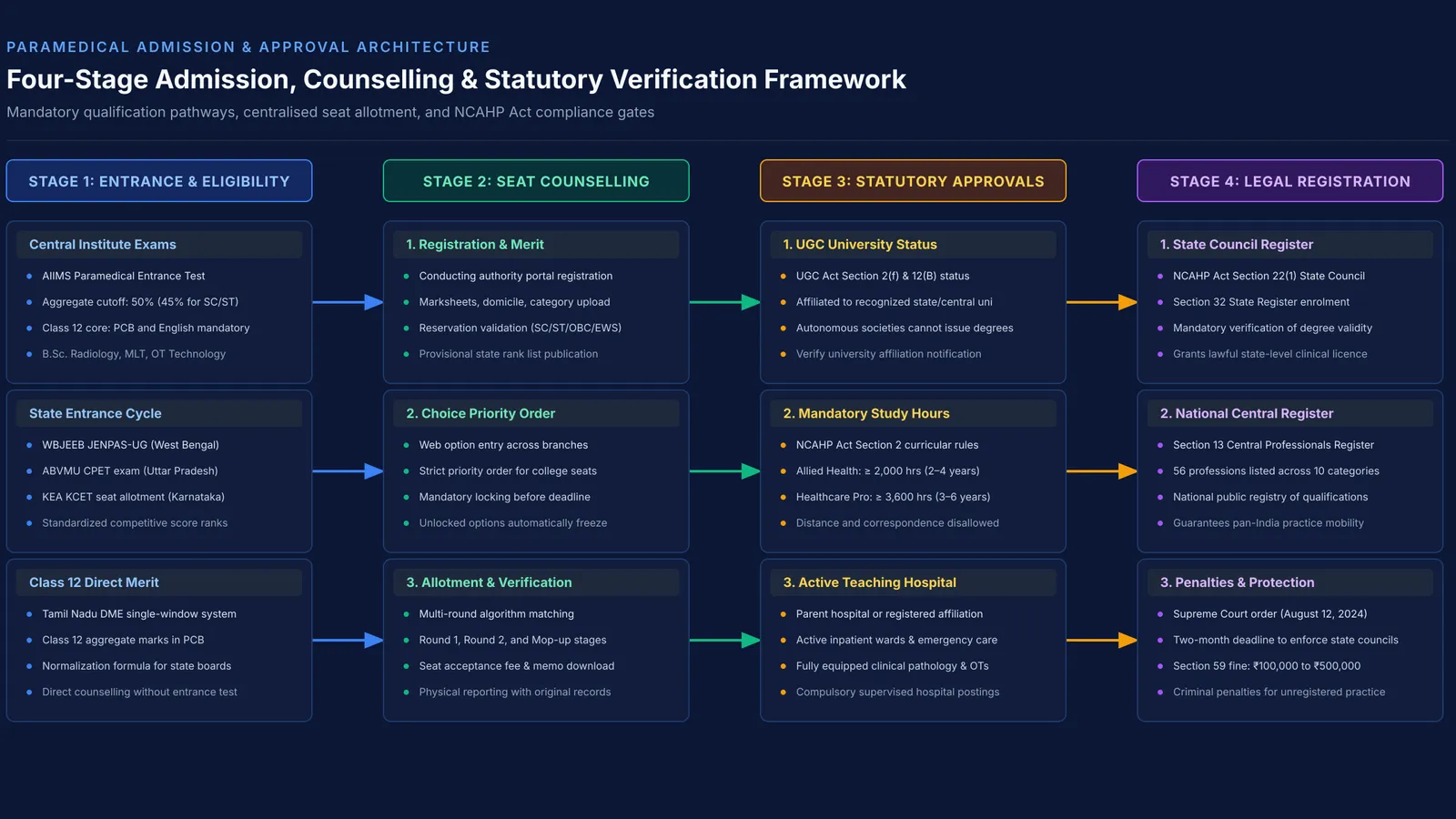
Regardless of the testing route, the paramedical courses admission counselling process follows a consistent sequence:
Online portal registration: Submit personal details, qualifying marks, reservation categories, and domicile documents on the conducting authority portal.
Merit list publication: The authority releases a provisional rank list based on entrance scores or board marks.
Web choice filling: Select preferred course and college combinations in strict priority order.
Multi-round seat allotment: Algorithms allocate seats across Round 1, Round 2, and mop-up phases based on merit, seat matrices, and locked preferences.
Document verification and reporting: Allotted candidates download their allotment memo, pay the seat acceptance fee, and present original documents at the institute.
This sequential workflow mirrors the seat allocation steps in the NEET UG counselling process, requiring applicants to track deadlines and choice locking carefully.
Central or state: which counselling authority conducts your admission?
Paramedical admissions branch into three main pathways depending on the governing body:
First, central institutes run dedicated entrance tests. The All India Institute of Medical Sciences conducts entrance tests and online counselling via AIIMS Exams for degrees like Medical Radiology and Laboratory Technology. Eligibility requires Class 12 with Physics, Chemistry, Biology, and English, with at least 50% aggregate marks (45% for reserved categories).
Second, state examination boards conduct unified entrance and allotment cycles. In West Bengal, the West Bengal Joint Entrance Examinations Board organizes WBJEEB JENPAS-UG for courses including Physiotherapy, Medical Laboratory Technology, and Critical Care Technology. In Uttar Pradesh, Atal Bihari Vajpayee Medical University oversees the Common Paramedical Entrance Test (CPET). In Karnataka, the Karnataka Examinations Authority manages seat allotment using an option entry and seat allotment workflow.
Third, several states allocate seats directly through board merit. In Tamil Nadu, the Directorate of Medical Education conducts single-window counselling using Class 12 science marks without a separate entrance exam.
How do you verify if a paramedical college and course are approved?
Statutory oversight for allied health education is defined by the National Commission for Allied and Healthcare Professions Act, 2021 (Act No. 14 of 2021). As recorded by PRS Legislative Research, the Act recognizes 56 professions grouped across 10 categories, establishing mandatory standards for training and practice.
The law sets clear minimum curricular hours. Section 2(d) defines an Allied Health Professional as requiring a diploma or degree of not less than 2,000 hours over two to four years. Section 2(j) defines a Healthcare Professional as completing a degree of not less than 3,600 hours over three to six years.
Enforcement has strict judicial backing. On August 12, 2024, a Supreme Court bench comprising Chief Justice D. Y. Chandrachud, Justice J. B. Pardiwala, and Justice Manoj Misra addressed unregulated colleges in *Joint Forum of Medical Technologists of India v. Union of India*, reported by LiveLaw. The bench set a two-month deadline for all states to constitute State Allied and Healthcare Councils under Section 22(1). Under Section 59, contravening statutory rules or provisions carries fines ranging from ₹100,000 to ₹500,000 alongside potential imprisonment of one to three years, reinforcing Section 32 and Section 13 mandates that forbid practice without state or central registration.
What is the 5-point verification checklist before locking your choices?
Before locking choices or paying seat deposits, verify your shortlisted colleges against five criteria:
University affiliation: Verify the college is affiliated with a university recognized under Section 2(f) and 12(B) of the University Grants Commission Act. Autonomous societies cannot confer degrees.
Council recognition: Confirm the programme has approval from the State Directorate of Medical Education or State Allied and Healthcare Council. Avoid private societies claiming national council authority.
Attached hospital beds: Practical training requires an active clinical environment. Verify whether the institution owns a teaching hospital or maintains formal clinical affiliations providing fully operational diagnostic laboratories, operation theatres, and dedicated inpatient wards.
Curricular hours: Confirm the curriculum provides the statutory 2,000 to 3,600 hours of academic instruction and hospital postings under the NCAHP Act provisions, excluding distance learning models.
Licensure eligibility: Ensure graduates are eligible for registration in the State Allied and Healthcare Professionals' Register.
How should students prepare for allied health study demands?
Paramedical degrees demand a rigorous mix of anatomy, physiology, and bioinstrumentation. Many students find the shift from high school textbooks to hospital-based clinical duties challenging during their first semester of college.
Building clear fundamentals before classes begin makes this transition smoother. The Fermi Concept Library offers lessons across biology, chemistry, and physics, helping you review organ systems and cell biology. For mastering calculations in radiation physics, solution chemistry, or biomedical measurements, the Fermi Problem Library provides worked problems with a step-by-step solver that explains the reasoning rather than printing an answer.


