

On this page
You can repeat the textbook line on "dynamic equilibrium", yet a slightly unfamiliar question still throws you. That is normal: the idea is stored as words, not as something you can recognise in a new situation. One fix has decades of research behind it: pair every abstract idea with two concrete examples that look different, then write down what they share.
Why are abstract ideas in physics and chemistry hard to understand?
Beginners notice what a problem looks like, not the principle underneath. In a classic study of how experts and novices categorise physics problems, Chi, Feltovich and Glaser (1981) found that experts started from the physics principles involved, while novices went by the problem's literal features. A single example makes this worse: with one case, you cannot tell which details matter and which are scenery.
What does the research say about learning from two examples?
In Gick and Holyoak's 1983 experiments on analogical transfer90002-6), one solved story, even with a stated principle or a diagram, did little to help people solve a new problem. With two analogous stories, they often worked out the general idea while describing the similarities, and how well they did so strongly predicted transfer.
In a study of people learning negotiation strategies, Gentner, Loewenstein and Thompson (2003) found a marked advantage for comparing two cases over studying the same two cases separately.
A meta-analysis by Alfieri, Nokes-Malach and Schunn (2013) pooled 336 tests from 57 experiments and found that case comparisons commonly led to more learning than other ways of studying cases or traditional instruction, with an average effect size of d = 0.50. Finding similarities and being given the principle after the comparison were both linked with more learning.
Examples help on their own too: in three experiments by Rawson, Thomas and Jacoby (2015), students who studied definitions plus examples beat those who only re-studied definitions on a classification test. A review by Weinstein, Madan and Sumeracki (2018) lists concrete examples among six well-supported learning strategies.
How do you use two examples to understand an abstract concept?
Write the idea in one line, in the textbook's words.
Choose example A from one setting and example B from a setting that looks different.
List at least two things both examples share. Start each line with "In both...".
Write the principle in your own words from that list, then check it against the textbook.
Test it on a third case, and on a non-example that looks similar but does not fit.
Compare first, read the principle second: in the case-comparison meta-analysis, giving the principle after the comparison was linked with more learning.
How does the card work for centripetal force?
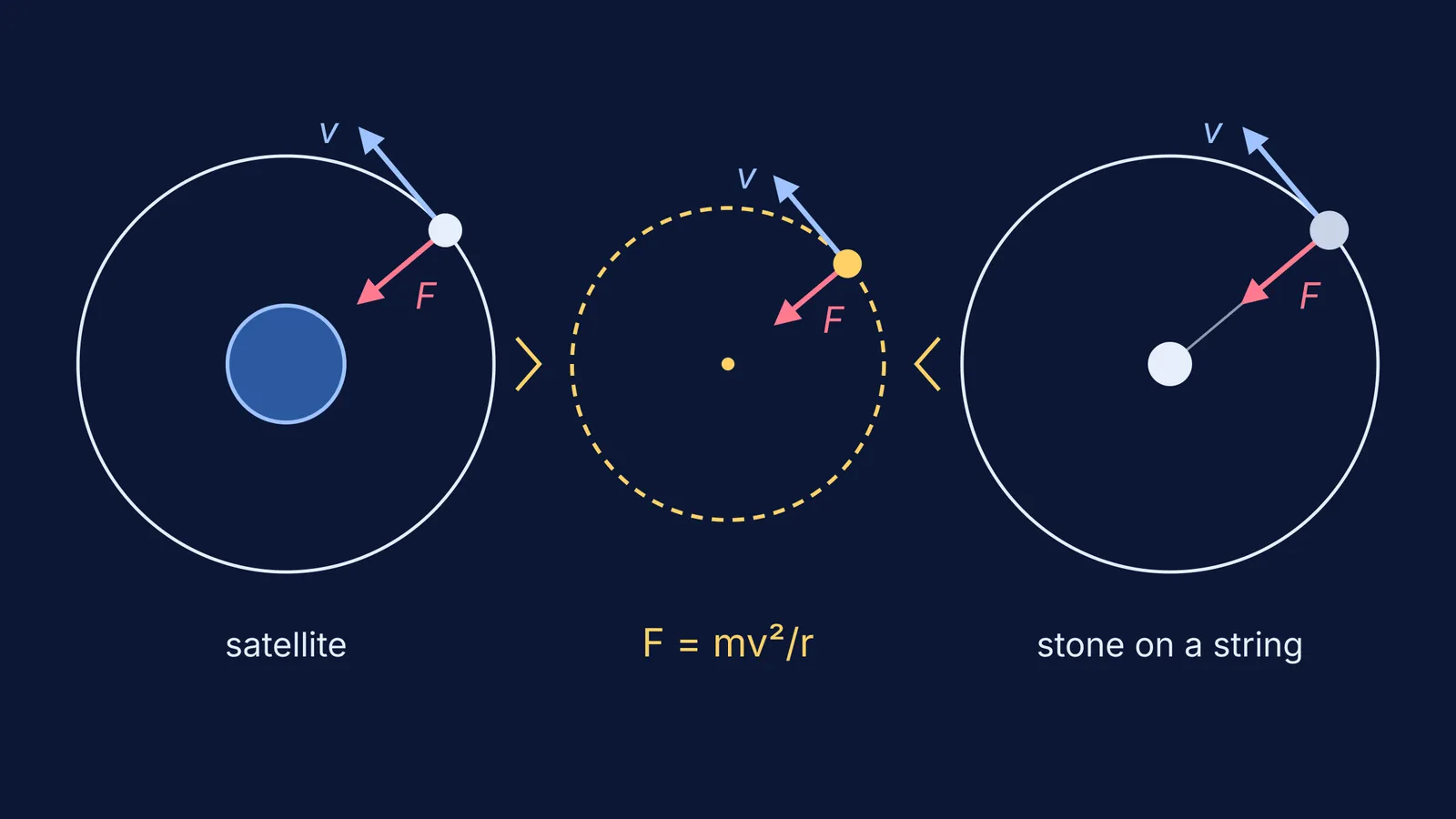
Example A: a satellite circling Earth.
Example B: a stone whirled on a string.
In both, the speed stays the same but the direction keeps changing. In both, a real force points to the centre: gravity for the satellite, tension for the stone. In both, removing that force would stop the curving, and the object would fly off along the tangent.
Principle: centripetal is not an extra force; it is the job some real force is doing.
Third case: a car on a flat curve, where friction does the job. Non-example: a car moving straight at constant speed, which needs no net force.
This card catches a common mistake: drawing "centripetal force" as an extra arrow on a free-body diagram.
How does the card work for dynamic equilibrium?
Example A: water in a sealed bottle, with vapour above it.
Example B: a sealed tube of brown NO2 and colourless N2O4 whose colour has stopped changing.
In both, the system is closed. In both, two opposite processes keep going (evaporation and condensation; NO2 joining into N2O4 and splitting back) at equal rates, so nothing you can measure changes.
Principle: equilibrium is a balance of rates, not a stop.
Third case: a saturated salt solution with undissolved crystals at the bottom. Non-example: a book resting on a table, which is balanced but has nothing happening.
The card pairs well with asking "why is this true?" while you study and with sketching both examples side by side, as in dual coding for science notes.
What if you cannot think of a second example?
That tells you the idea has not landed yet. Look in a different chapter, in the kitchen or on the road, or ask your teacher. Each concept in the Fermi Concept Library has its own lesson and its place in the map, which can point you to a second setting. For ideas that are easier to see than to read, the Fermi Simulation Lab has interactive simulations.
Tonight, pick the one idea from this week's chapter you can define but not use, and fill in a two-example card for it.


