

On this page
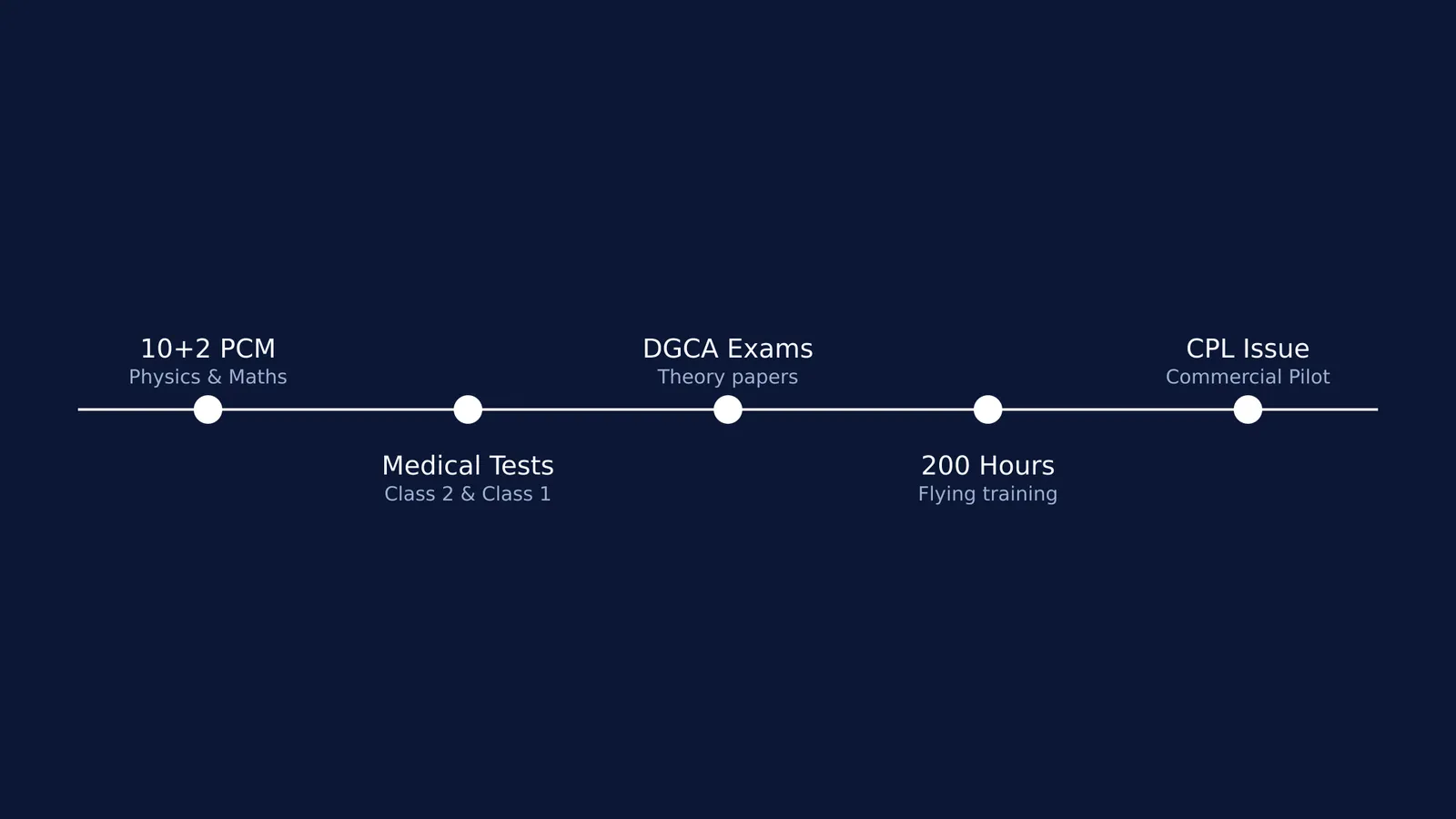
Many students dream of flying. In India, civil aviation is regulated by the Directorate General of Civil Aviation, setting strict educational, medical and training standards for a Commercial Pilot License (CPL). Here is what the journey looks like after the 12th board exams.
What are the physics and maths requirements for a pilot?
To start flight training, you must have passed 10+2 board exams with Physics and Mathematics. The Directorate General of Civil Aviation mandates these subjects as the baseline for any candidate.
If you did not take these in Class 12, you can appear for single-subject exams through the National Institute of Open Schooling (NIOS) or another open board.
If you are catching up on these subjects through open schooling and find the syllabus challenging, the Concept Library has every concept in physics, chemistry, biology, mathematics and computing, each with its own lesson and its place in the map.
What are the DGCA medical requirements?
Before you spend money on training, you must prove you are medically fit. The Directorate General of Civil Aviation mandates two levels of clearance:
Class 2 Medical: Required to start training. It includes tests for eyesight, hearing, colour vision, and blood work. Your vision must be 6/6, correctable with glasses.
Class 1 Medical: Mandatory for your CPL and airline jobs. It involves an electrocardiogram and treadmill test at specific civil centres or Indian Air Force boarding centres.
Securing your Class 1 assessment before flight school ensures you will not be disqualified later.
What does commercial pilot training cost in India?
Flight training is a significant financial investment. At an approved Flying Training Organisation, the budget covers classroom theory, single and multi-engine aircraft rental, fuel, and licensing fees.
If you wish to fly commercial jets, you will also need a Type Rating for aircraft like the Airbus A320 or Boeing 737, which adds considerably to the cost. Major airlines offer Cadet Pilot Programs that include a conditional job offer, though these are often the most expensive route.
What does the 200 hours of flight training involve?
To earn your CPL, you must log a minimum of 200 hours of flying time within a five-year period, according to the Directorate General of Civil Aviation. This includes:
100 hours as Pilot-in-Command (PIC).
20 hours of cross-country flying, including a 300-nautical-mile flight with full-stop landings at two aerodromes.
10 hours of instrument flying (up to 5 hours on an approved simulator).
5 hours of night flying, including 10 take-offs and 10 landings as PIC.
You must also pass written theory examinations:
Air Regulations: The laws of the air.
Air Navigation: Calculating headings and fuel.
Aviation Meteorology: Understanding weather patterns.
Technical General: Aircraft systems and engines.
Technical Specific: Deep knowledge of your training aircraft.
You must also pass a Radio Telephony exam to communicate with Air Traffic Control.
How do you start the process step by step?
If you are ready, follow this order. It can be helpful to discuss this when your child chooses a different career path than expected:
Register on eGCA: Get your unique computer number.
Clear the medicals: Pass Class 2, then Class 1.
Pass the theory exams: Clear DGCA papers and the Radio Telephony exam.
Join a flying school: Choose an approved organisation.
Log the flying hours: Complete your required hours and pass your check ride.


