

On this page
Undergraduate expenses often outpace family allowances, leading students to consider part-time work. Commuting to off-campus jobs frequently disrupts study routines and drains energy. On-campus roles offer a structured alternative where academic departments hire enrolled students to assist daily operations while keeping them closely connected to faculty.
What campus assistantships are available for undergraduates?
Higher education institutions in India provide several categories of on-campus positions designed to fit around lecture schedules:
Laboratory assistants: Science and engineering departments hire undergraduates to prepare apparatus, calibrate equipment, and assist lab technicians during practical sessions.
Library student aides: University libraries recruit students for cataloging, shelving, managing digital journal databases, and staffing circulation desks.
Departmental office and IT aides: Administrative cells and computer centres engage students to maintain lab workstations, manage portal data entry, and format departmental notices.
Research project assistants: Faculty members running funded grants hire undergraduates for data entry, literature searches, and basic bench tasks. Under the UGC Guidelines for Internship and Research Internship for Undergraduate Students, students must complete an internship of 60 to 120 hours carrying 2 to 4 credits after their 4th semester, connecting coursework with active lab practice.
How much do college assistantships pay in India?
Stipends for undergraduate campus roles depend on whether the position is part of a university student employment scheme or an institute-funded fellowship.
For semester work, several Indian universities operate formal student employment programs. Under the University of Delhi's Vice Chancellor Internship Scheme (VCIS), regular undergraduate interns work 8 to 10 flexible hours per week during term time and receive a monthly stipend of ₹5,000, which includes a 5% annual increment. During summer breaks, the scheme expands to 15 to 20 hours per week for 8 weeks with a monthly stipend of ₹10,500. Other colleges run local 'Earn While You Learn' initiatives through their student welfare boards, capping weekly shifts to prevent academic conflict.
Competitive summer research fellowships at premier institutes offer dedicated project stipends. The IIT Roorkee SPARK fellowship awards selected undergraduate interns ₹3,000 per week to conduct research under faculty mentorship. Similarly, the 8-week IIT Kanpur SURGE program provides participants with mentorship and an institute stipend of ₹12,500 for funded positions. If you are exploring government or corporate funding options, our guide to scholarships for science students in India details national eligibility rules.
How does working during college affect your grades?
Many families worry that taking on paid campus work will distract from coursework and lower exam scores. Yet higher education research consistently reveals an unexpected pattern: moderate on-campus employment often improves academic outcomes compared to not working at all.
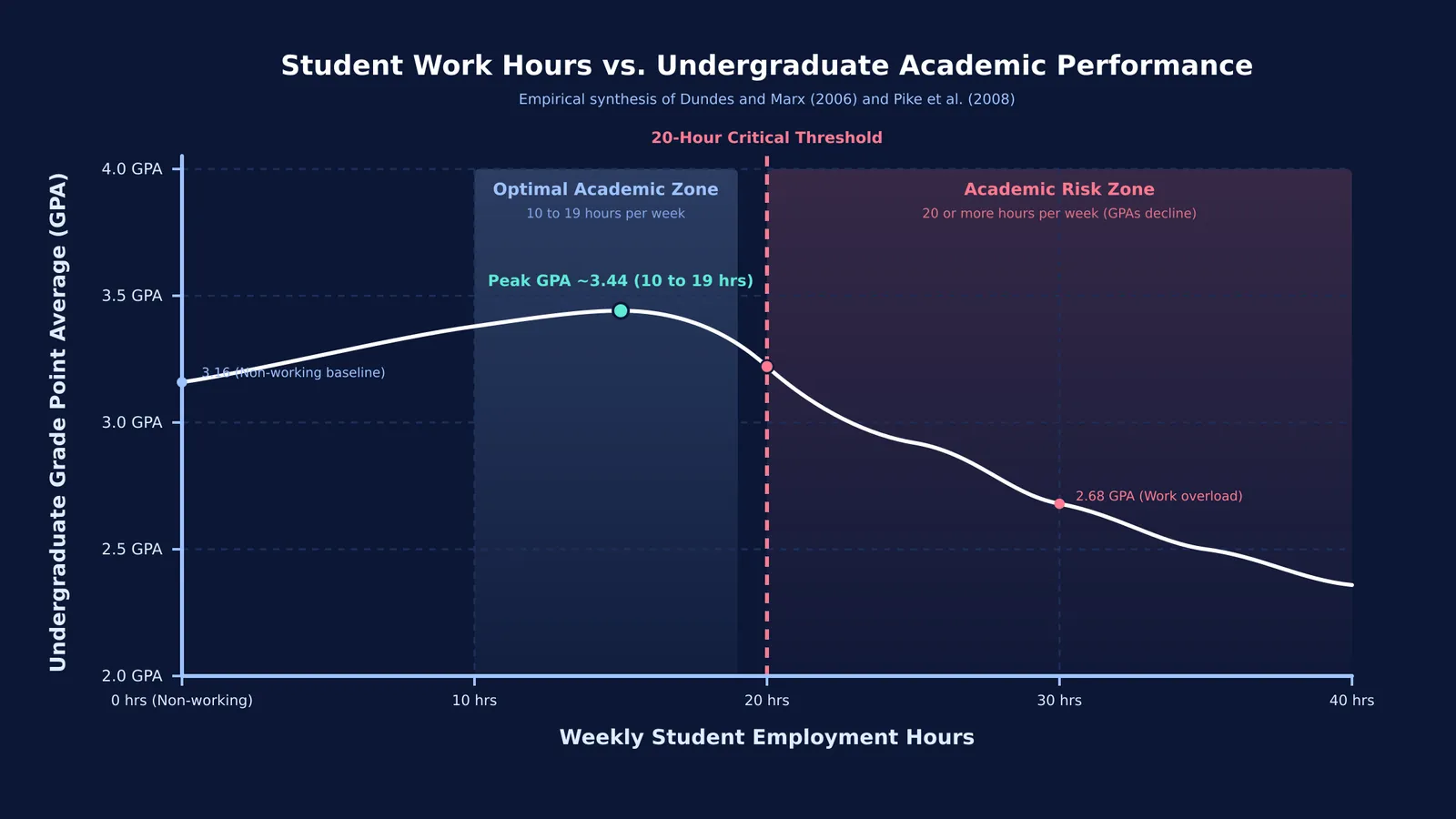
According to data compiled by the National Center for Education Statistics (NCES), roughly 40% of full-time undergraduate students work while enrolled, with 10% of full-time students working 35 or more hours per week. NCES reports that students who work moderate hours—specifically between 10 and 19 hours per week—often achieve higher grades than peers who work excessive hours.
This phenomenon was examined closely in a landmark study published by Lauren Dundes and Jeff Marx in the Journal of College Student Retention. Investigating undergraduate work patterns, Dundes and Marx found that students working 10 to 19 hours per week earned higher GPAs than both non-working students and those working over 20 hours. The authors noted that a moderate work commitment forces students to structure their days and develop stricter time-management routines. However, working 20 or more hours per week triggered sharp performance penalties: students exceeding 20 hours were twice as likely to fall into the lower 2.0 to 2.9 GPA band.
Supporting this finding, a study by Gary R. Pike, George D. Kuh, and Ryan C. Massa-McKinley in the NASPA Journal showed that working 20 hours or less per week on campus was positively related to grades. On-campus roles foster closer faculty interaction and peer connections without the draining commute of off-campus jobs.
When you balance a 10-hour weekly assistantship with demanding STEM coursework, every study hour must count. If you get stuck on a difficult numerical problem after your lab shift, the Fermi Problem Library provides worked problems with a step-by-step solver that explains the underlying reasoning rather than just printing a final number. For broader revision across physics, mathematics, and computing, the Fermi Concept Library offers dedicated lessons for every core concept, making it easier to reinforce theoretical foundations and improve your CGPA throughout the semester.
How do you apply for an on-campus assistantship?
Campus roles are rarely advertised on commercial portals. Instead, departments fill positions through internal notice boards, faculty announcements, and direct student outreach.
To secure an assistantship, follow this four-step plan:
Visit your Dean of Student Welfare (DSW): Inquire whether your university runs a formal 'Earn While You Learn' roster or departmental assistant scheme at the start of term.
Contact campus facilities: Introduce yourself to head librarians, computing facility managers, or lab superintendents during the second week of classes once schedules settle.
Email faculty researchers directly: Reach out to professors whose courses you excelled in, citing your grades and availability.
Protect your academic calendar: Use structured weekly time blocking to reserve study slots before agreeing to work shifts.
Here is an email template to contact a professor or lab coordinator:
Subject: Undergraduate Assistantship Inquiry — [Your Name]
Dear Professor [Last Name],
I am a [2nd/3rd]-year undergraduate in [Your Major] (Current CGPA: [X.XX]). I enjoyed your course on [Course Name] last semester, particularly our practical work on [Specific Experiment].
I am writing to inquire about openings for an undergraduate laboratory or research assistant this semester. I can commit 8 to 10 hours weekly, primarily on [Tuesday afternoons] and [Saturday mornings], with no timetable conflicts. I am eager to help with apparatus preparation, data logging, or literature compilation.
My resume and transcript are attached. Thank you for your time and consideration.
Sincerely, [Your Name] (Roll No: [XXXXXX]) Department of [Your Department]


