

On this page
Why does campus location matter beyond academic rank?
When comparing colleges, cut-off ranks, national league tables, and placement packages dominate family discussions. Yet an institution's physical surroundings shape daily student life far more directly than its brochure suggests. A college might boast advanced laboratories, but if stepping outside the boundary gate after dark feels unsafe, independence quickly evaporates.
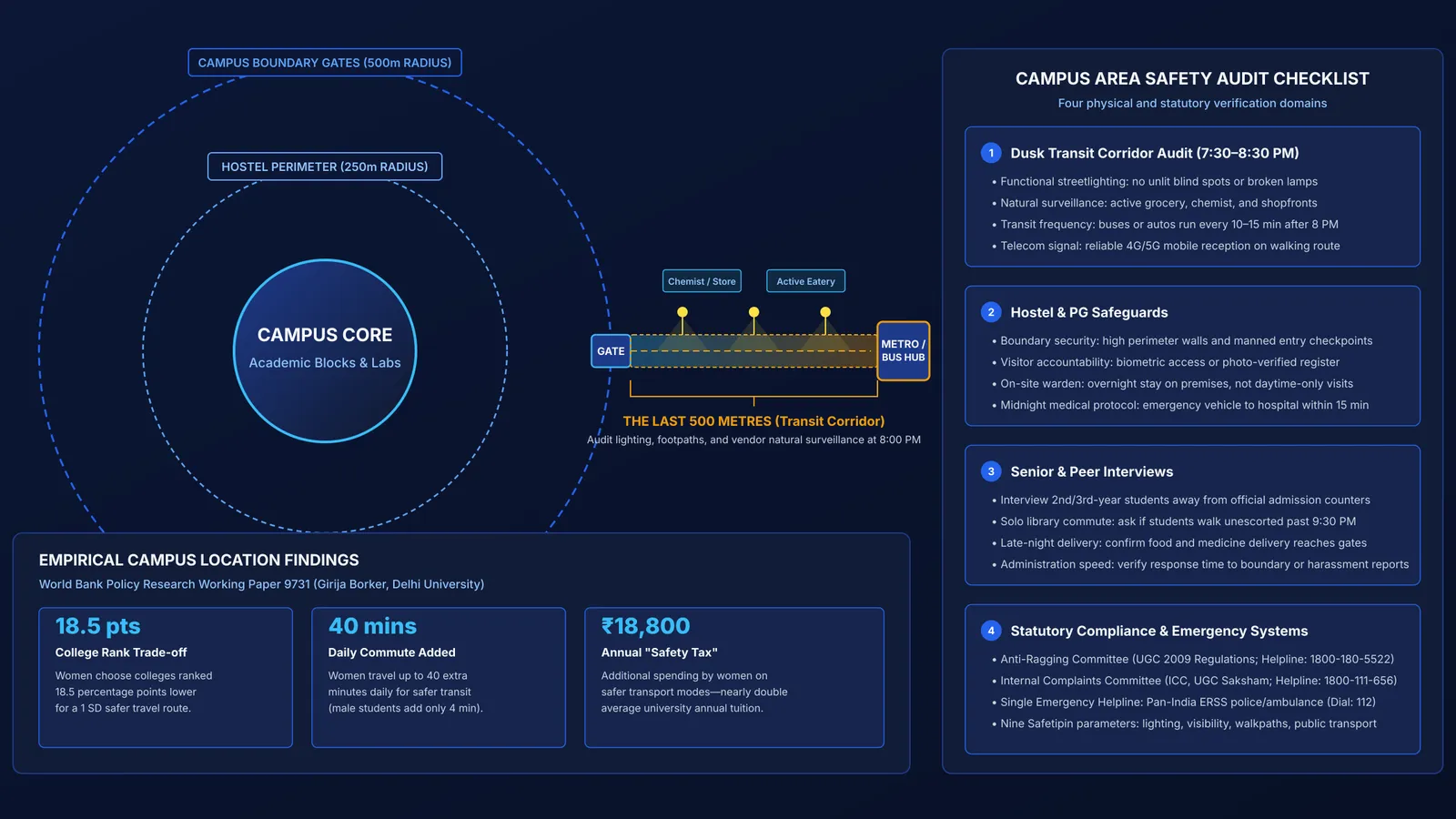
This trade-off is documented in empirical economics. In a study on college choice and street safety, economist Girija Borker surveyed approximately 4,000 students at the University of Delhi (World Bank Policy Research Working Paper 9731). Borker found that women students were willing to attend a college ranked 18.5 percentage points lower in the quality distribution—or travel an additional 40 minutes daily—simply to secure a commute perceived as one standard deviation safer, whereas male students were willing to add only 4 minutes for the same safety gain. For families navigating the transition of studying away from home, overlooking the physical setting converts an exciting admission into a daily compromise.
Urban safety organizations such as Safetipin evaluate neighbourhoods through nine parameters: lighting, openness, visibility, crowd density, security, walkpaths, public transport, gender diversity, and perceived safety. Before paying admission deposits or signing leases, families can adapt these exact principles into a practical audit.
How do you audit transit routes and the "last 500 metres"?
The most vulnerable portion of a student's commute is rarely the main highway or metro; it is the final 500 metres connecting the transit stop to the college gate or private hostel cluster—the "last-mile corridor."
Avoid visiting solely at midday on counseling day. Instead, conduct a dusk inspection between 7:30 PM and 8:30 PM. Look for "eyes on the street"—natural surveillance provided by active, open grocery shops, chemist outlets, and residential frontages. Blank perimeter walls, unlit vacant plots, or deserted stretches leave pedestrians isolated if trouble arises.
Check public transit reliability:
Does the local bus or metro feeder run at 10-to-15 minute intervals after 8:00 PM, or do frequencies collapse?
Are auto-rickshaw stands active and metered, or do drivers refuse trips toward student sectors after dark?
Does your mobile phone maintain strong 4G or 5G reception along the entire walking path?
What should you inspect in campus and off-campus hostels?
Accommodation varies between campus hostels and rented paying-guest (PG) rooms. When establishing a setup for studying in a hostel or PG, examine four physical safeguards:
Boundary integrity: Ensure perimeter walls have adequate height and that entry gates maintain manned security with regular guard shifts and female personnel for women's wings.
Visitor logging: Check whether the residence enforces digital biometric logs or signed registers with photo identity verification.
Resident warden presence: Confirm where the warden stays overnight. An off-campus warden who only visits during daytime hours leaves students without emergency oversight.
Midnight medical protocol: Ask what happens if a student falls severely ill at 2:00 AM. Campuses should have a round-the-clock infirmary or an ambulance arrangement reaching a multi-specialty hospital within 15 minutes.
What questions should you ask current students and local seniors?
Prospectuses present best-case narratives. To get the ground reality, speak with second-year and third-year seniors away from administrative desks—near departmental labs or campus tea stalls.
Ask about these specific everyday situations:
Night library walk: Can you walk back to your hostel from the library alone at 9:30 PM without concern?
Last-mile transport: If you miss the evening college bus, how hard is it to find an auto or shared cab back?
Essential deliveries: Do food and medicine delivery riders reach your gate after 10:00 PM?
Emergency medical response: When someone fell ill at midnight this semester, how quickly did transport arrive to take them to hospital?
Grievance action: How promptly does the administration act when students report harassment or boundary trespass?
Listen for hesitations. Seniors who report traveling strictly in groups after sundown are signalling genuine infrastructure deficits.
How can you verify campus security and grievance cells?
Beyond physical streets, statutory bodies determine how safely an institution operates. In India, colleges are legally required to maintain dedicated safety mechanisms:
Anti-Ragging Committee and Squad: Mandated under the *UGC Regulations on Curbing the Menace of Ragging in Higher Educational Institutions, 2009*, backed by the 24x7 toll-free helpline (1800-180-5522) on antiragging.in. Member contact numbers should be posted on hostel noticeboards.
Internal Complaints Committee (ICC): Required under the *UGC Regulations, 2015* and monitored via the UGC Saksham Portal (helpline 1800-111-656), featuring external members and clear inquiry timelines.
Emergency integration: Save the pan-India emergency number 112 (112.gov.in) on speed dial.
While settling into your first semester at college, peace of mind protects your focus. When unpredictable travel schedules limit evening group study, Fermi's AI tutor can work out what you already know and build a plan for the session, while the Fermi Concept Library lets you review core STEM ideas directly from your room. Vetting surroundings early ensures your college journey remains focused on learning and growth.


