

On this page
Your board results are out, and the school you want for Class 11 science has announced an admission test. These tests check how well you hold Class 9 and 10 maths and science under time pressure. Here is what three schools' 2026-27 documents asked for, and a three-week plan built around them.
What does a Class 11 science admission test check?
Schools set their own papers, so the only reliable syllabus is your school's notice. Three schools' published documents for 2026-27 show a clear pattern.
The Class XI admission notice from Ramakrishna Mission School, Narottam Nagar set a written test in five subjects "based on the Class X syllabus", plus a reasoning section and a viva voce. Maths carried 20 marks, physics, chemistry, biology and English 15 each, and reasoning 20. Only reasoning had negative marking: +4 for a correct answer, −1 for a wrong one. The notice was dated 16 April and the test was on 28 April, so applicants had 12 days.
Sanskriti School in New Delhi listed maths as "same as Class X CBSE syllabus", plus Class 10 chapters on light, the human eye, electricity, magnetic effects of current, metals and non-metals, carbon compounds and five biology chapters, plus social science and general awareness. The Modern Vidya Niketan non-medical syllabus reached back to Class 9: motion, laws of motion, gravitation, work and energy, atoms and molecules, and Heron's formula.
None of the three lists a Class 11 topic. Put together, these tests usually check:
Class 10 maths: quadratics, polynomials, trigonometry, coordinate geometry
Physics numericals with units: motion and energy from Class 9, electricity and light from Class 10
Chemistry basics: balancing equations, acids and bases, carbon compounds
Biology: some schools test it for everyone, others only for the medical stream
Sometimes English, reasoning, general knowledge or a short interview
How should you prepare in three weeks?
Two research findings shape this plan. Students who took recall tests on a passage remembered much more of it two days and one week later than students who spent that time rereading it (Roediger and Karpicke, Psychological Science). In a classroom experiment with 126 seventh-graders, practice sets that mixed different kinds of maths problems led to higher scores than sets of one problem type on a test given 1 or 30 days after the last review (Rohrer, Dedrick and Stershic, Journal of Educational Psychology). So the plan tests you early and often, and mixes topics in the final week.
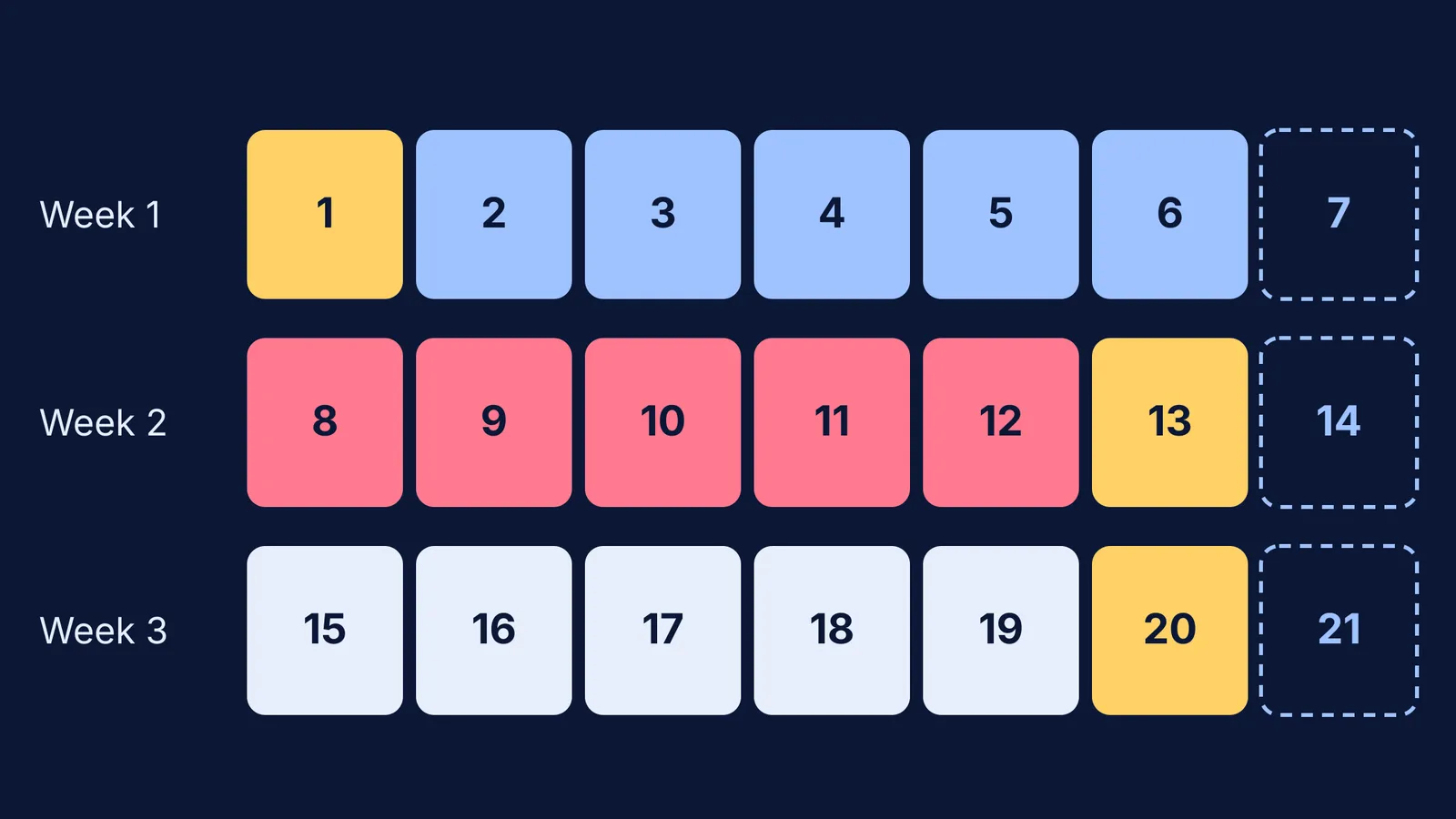
Day 1: a timed diagnostic. Use a past paper if the school shares one, or 10 maths and 10 science questions in 60 minutes. Mark each topic green, amber or red.
Days 2 to 6: rebuild maths, red topics first. Do 15 problems a day from NCERT and old board papers, closed book, then check.
Days 8 to 12: science. Physics numericals, then chemistry equations, then biology if you need it.
Day 13: a 90-minute mixed test. Rewrite every wrong answer correctly.
Days 15 to 19: mixed sets only, maths and science shuffled, plus 15 minutes of reasoning puzzles.
Day 20: a full mock in the school's format and timing.
Days 7, 14 and 21 are for rest and a short look at your error list. If you are not sure where to begin, Fermi's AI tutor can work out what you already know and build a plan for the session, so you start with your weakest topic rather than chapter 1. For a longer version of this rhythm, see our four-week spaced revision schedule.
What does one day of practice look like?
Here is a short mixed set from week 3:
Maths: solve 2x² − 7x + 3 = 0. Split the middle term: 2x² − 6x − x + 3 = (2x − 1)(x − 3), so x = 1/2 or x = 3.
Physics: 6 Ω and 3 Ω resistors are in parallel across 6 V. Total resistance is (6 × 3)/(6 + 3) = 2 Ω, so the battery supplies 6/2 = 3 A.
Chemistry: balance Fe + H₂O → Fe₃O₄ + H₂. Count iron, then oxygen, then hydrogen: 3Fe + 4H₂O → Fe₃O₄ + 4H₂.
If a method keeps going wrong, the Fermi Problem Library has a step-by-step solver that explains the reasoning rather than printing an answer. Our guide to Class 10 maths mistakes and showing working covers the slips that cost marks.
How can parents help without adding pressure?
Your most useful jobs are practical. Find the notice and the dates, keep time for the two mock tests, and run a five-minute practice interview: "Why do you want science?" and "Which Class 10 chapter did you enjoy, and why?" If the stream is still undecided, read our guide to choosing a stream after Class 10 together first.
Some nerves are normal. If worry stops your child sleeping, eating or studying for days, talk to a school counsellor or call Tele MANAS, the government's toll-free mental health helpline, on 14416.


