

On this page
In Class 9, science was a single subject. In Class 10, it officially splits into physics, chemistry and biology, each demanding a completely different way of thinking. Many students try to balance them by spending a whole week on biology, then a week on physics, and then a week on chemistry.
But research shows this "blocked" approach creates a false sense of fluency that disappears by exam day. Here is how to balance the three disciplines and why mixing them up is the better strategy.
What is the weightage of physics, chemistry and biology in Class 10?
The CBSE Class 10 science theory paper is out of 80 marks, and it is divided almost evenly among the three subjects (CBSE).
Biology: 30 marks. This covers the "World of Living" unit (25 marks) and "Natural Resources" (5 marks).
Chemistry: 25 marks. This is the "Chemical Substances" unit.
Physics: 25 marks. This includes "Natural Phenomena" (12 marks) and "Effects of Current" (13 marks).
Because the marks are so balanced, you cannot afford to ignore any one subject. However, the way you study for a chapter on tropic movements in plants is very different from how you practice ray diagrams.
Why is interleaved practice better for science?
Most students prefer "blocked practice"—studying all of chemistry for a week before moving to physics. It feels easier because you only have to hold one set of rules in your head.
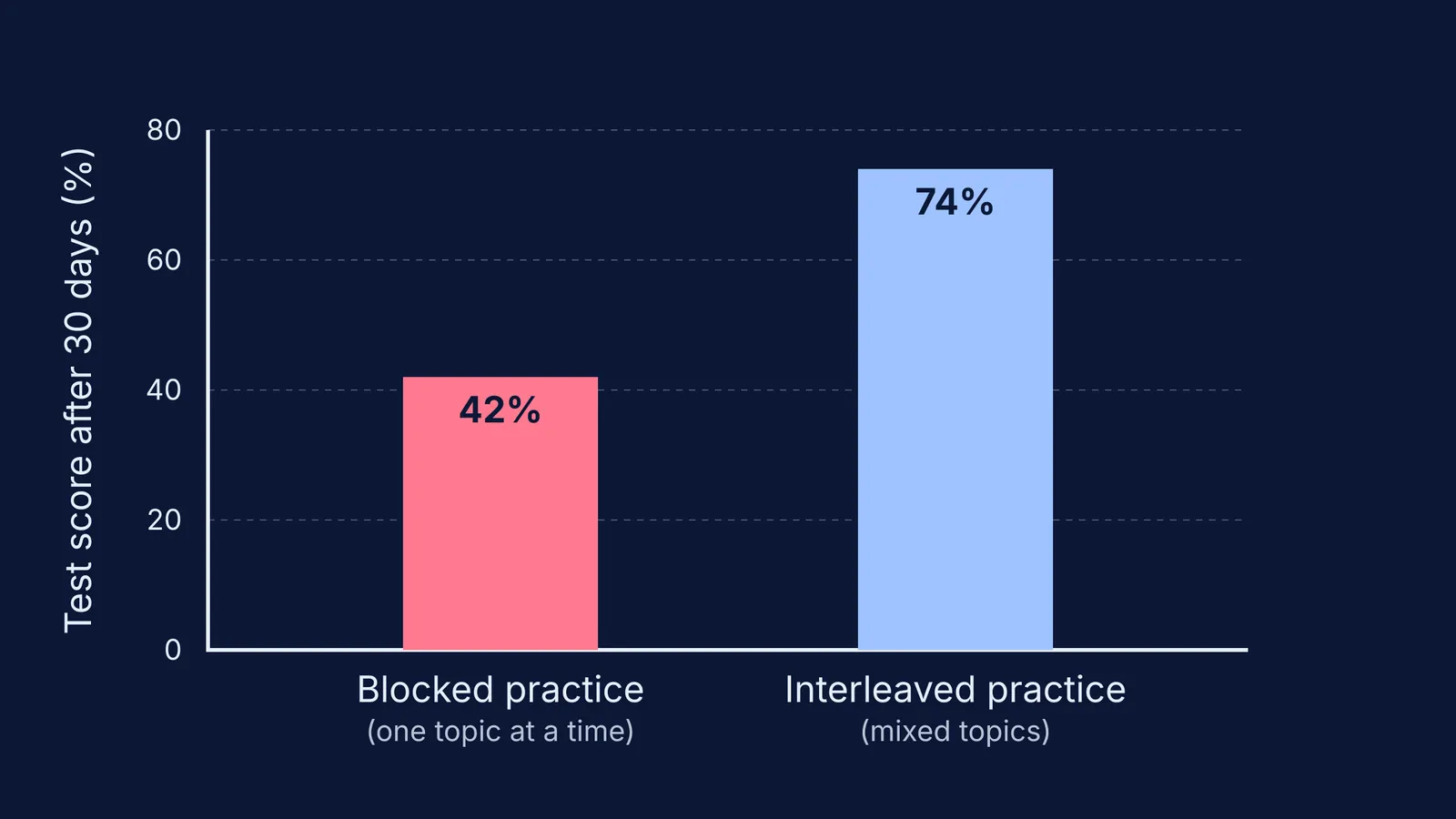
However, cognitive science shows that "interleaved practice" (mixing topics together) works much better for long-term memory. A 2015 study published in the *Journal of Educational Psychology* tested students on mathematical problem-solving (Rohrer et al., 2015). Students who used interleaved practice scored 74% on an unannounced test a month later, while those who studied one topic at a time scored just 42%.
In a real exam, you do not get 15 physics questions followed neatly by 15 chemistry questions. You have to switch gears from balancing equations to applying Ohm's law. Practising mixed topics trains you to choose the right strategy, not just apply the one you just read about.
How to balance physics, chemistry and biology in Class 10 science?
Each subject tests a different cognitive skill. Here is how to approach them:
1. Physics: Focus on the "why" and the maths. Physics in Class 10 is heavily conceptual and numerical. You need to understand the sign conventions before you can solve a problem about concave mirror images. Instead of reading the textbook repeatedly, spend your time solving problems. If you get stuck on a calculation, the Fermi Problem Library has a step-by-step solver that explains the reasoning rather than printing an answer.
2. Chemistry: Master the patterns. Chemistry is about learning the rules of how elements interact. Once you understand the underlying logic—such as how valency dictates naming carbon compounds—you will not need to memorise every equation. Build flowcharts for reactions and use flashcards for functional groups.
3. Biology: Visualise the processes. Biology requires a lot of vocabulary, but the words describe physical, living processes. Do not just read about the human heart; draw it. If a process is hard to picture from a textbook page, Fermi's AI tutor can build a plan for the session and teach through it by drawing the figure and checking your understanding as it goes.
A weekly study schedule for Class 10 science
To get the benefits of interleaved practice, split your weekly study time across all three subjects. If you study science for six hours a week, do not do two hours of physics on Monday and nothing else.
Try this split instead:
Tuesday (2 hours): 1 hour of physics numericals, 1 hour of biology diagrams.
Thursday (2 hours): 1 hour of chemistry equations, 1 hour of physics theory.
Saturday (2 hours): 1 hour of biology revision, 1 hour of mixed-subject mock testing.
This schedule ensures you never go more than a few days without seeing a subject, keeping the concepts fresh in your mind for the board exams.


