

On this page
Board prep doesn't have to begin with a crash timetable in winter. If you start in the first month of the session, or in whatever month you are reading this, you get many small rounds of practice instead of one big panic.
When should you start preparing for Class 10 boards?
Now, in small amounts. Under CBSE's current scheme, the first board examination is mandatory for every Class 10 student, and the optional second exam lets passed and eligible students improve in up to three subjects out of science, maths, social science and languages, according to the CBSE notification of 14 February 2026. That second chance is a safety net, not a plan. Our explainer on how CBSE's two Class 10 board exams work covers the rules in detail.
Starting early also matters because of how memory works. A review of 839 assessments of spaced practice in 317 experiments found that the gap between study sessions that gave the best retention grew as the time until the final test grew (Cepeda and colleagues, Psychological Bulletin, 2006). Starting early is what lets you space your practice at all.
What should the first month of board prep look like?
Three habits, repeated every month: study chapter by chapter, finish the NCERT exercises yourself, and sit one sample paper at the end. A 2013 review of ten study techniques rated practice testing and distributed practice as high utility, and rereading and highlighting as low utility (Dunlosky and colleagues, Psychological Science in the Public Interest). A 2017 meta-analysis found practice tests more beneficial for learning than restudying (Adesope, Trevisan and Sundararajan, Review of Educational Research).
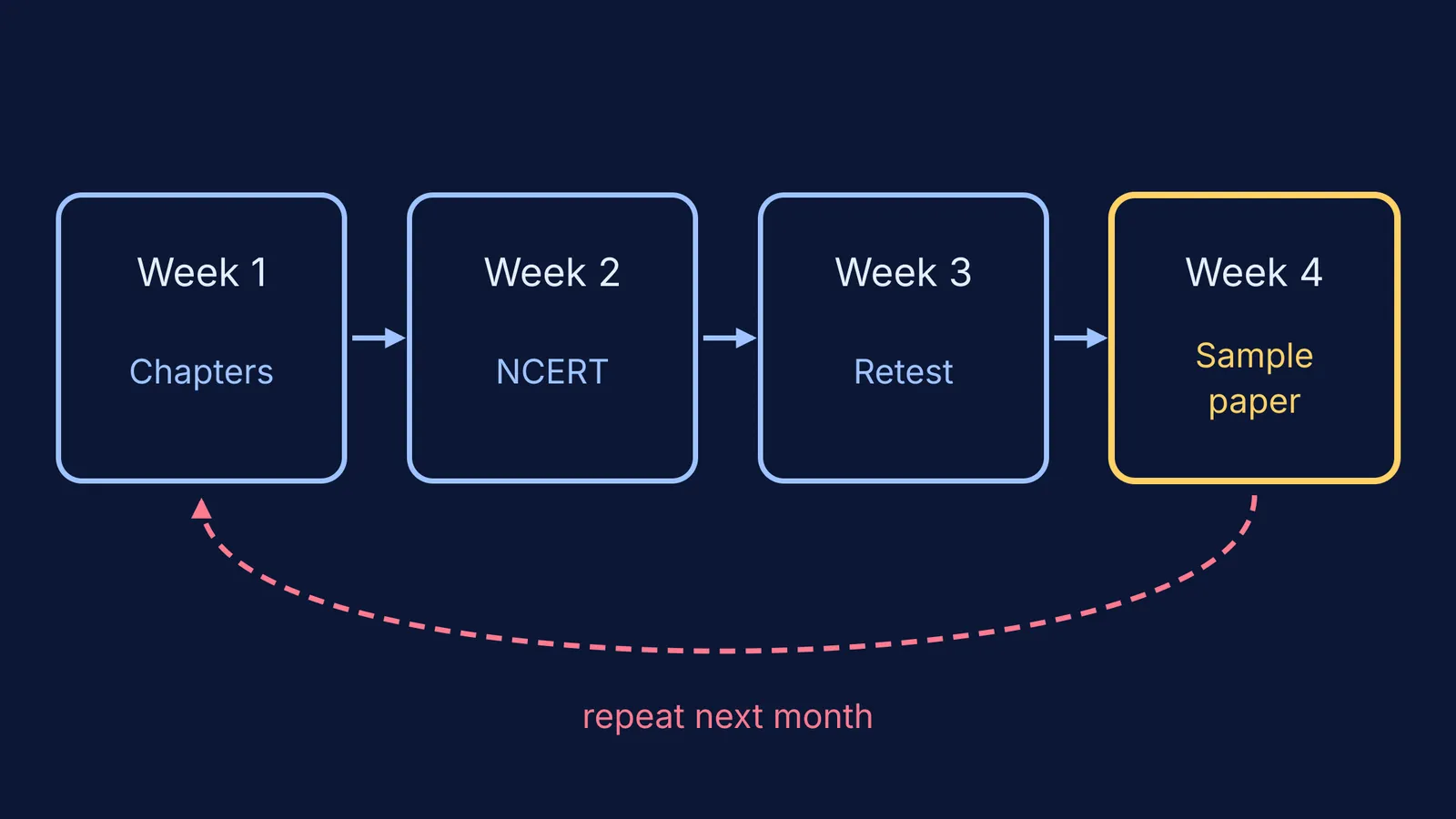
Here is the four-week cycle:
Week 1: chapters. Take the two chapters your school has just taught in each main subject. Answer the in-text questions, then write a one-page summary from memory before checking the book.
Week 2: NCERT exercises. Do every end-of-chapter question in the NCERT textbook without opening a solution. Mark each wrong answer as a concept gap, a wrong method or a careless slip.
Week 3: retest. Redo only the questions you got wrong, cold, on a fresh page. Then add a few harder ones; our guide to using NCERT Exemplar problems for boards explains which to pick.
Week 4: sample paper. Sit one timed paper and mark it with the official marking scheme.
If you sit down and don't know where to begin, Fermi's AI tutor can work out what you already know and build a plan for the session, so you start with a clear next step.
How do you use a sample paper before finishing the syllabus?
CBSE announced on 21 September 2026 that Sample Question Papers and marking schemes for the 2026-27 session are available (CBSE notification); you can download them subject by subject from the CBSE Class X sample paper page. The 2026-27 science sample paper has 39 questions in three sections, for 80 marks in 3 hours (CBSE Science sample paper).
You don't need the whole syllabus to use it. A worked example for month one:
You have covered Chemical Reactions and Equations and Life Processes.
Go through the science sample paper and tick only the questions from those two chapters.
Add up their marks. Say they come to 16.
At 80 marks in 180 minutes, the paper allows 2.25 minutes per mark, so give yourself 36 minutes.
Answer, then mark strictly against the marking scheme, including the steps it gives marks for.
Each month, the ticked questions grow.
Check the syllabus before you plan your chapters. In the 2026-27 science curriculum, the unit marks are 25 for Chemical Substances, 25 for World of Living, 12 for Natural Phenomena, 13 for Effects of Current and 5 for Natural Resources, plus 20 for internal assessment (CBSE Class X Science curriculum 2026-27). The same document says Periodic Classification, Evolution, and the motor, electromagnetic induction and generator topics are assessed only formatively, not in the year-end exam.
Your mistake log tells you what to fix next. Wrong-method errors in numericals are where the Fermi Problem Library helps: its step-by-step solver explains the reasoning rather than printing an answer. If the log keeps showing the same idea, such as refractive index or balancing equations, look it up in the Fermi Concept Library.
How can parents help in the first month?
Keep it short and regular. Try this on Sunday evening, for ten minutes:
"Which chapters did you finish this week?"
"Show me one question you got wrong and how you fixed it."
"What's the plan for next week, and is anything in the way?"
Ask about the process rather than comparing scores with cousins or classmates. Our 4-week spaced revision schedule fits alongside this plan.
If worry about the boards keeps affecting sleep, food or mood, talk to a school counsellor or a doctor. Tele MANAS, the government's 24/7 tele-mental health service, can be reached on the toll-free number 14416 (Ministry of Health and Family Welfare, PIB).
Open this month's sample paper, tick the questions from the chapters you have done, and sit them on Sunday.


