On this page
Many students find that their college experience does not match their expectations after the first year. The commute might be too long, the teaching might feel inadequate, or you might want to switch to a university closer to home.
The good news is that changing your college midway through a degree is possible. Under the new educational frameworks in India, universities have established clear mechanisms for student mobility, provided you meet their academic requirements.
Can I change my college after one year in India?
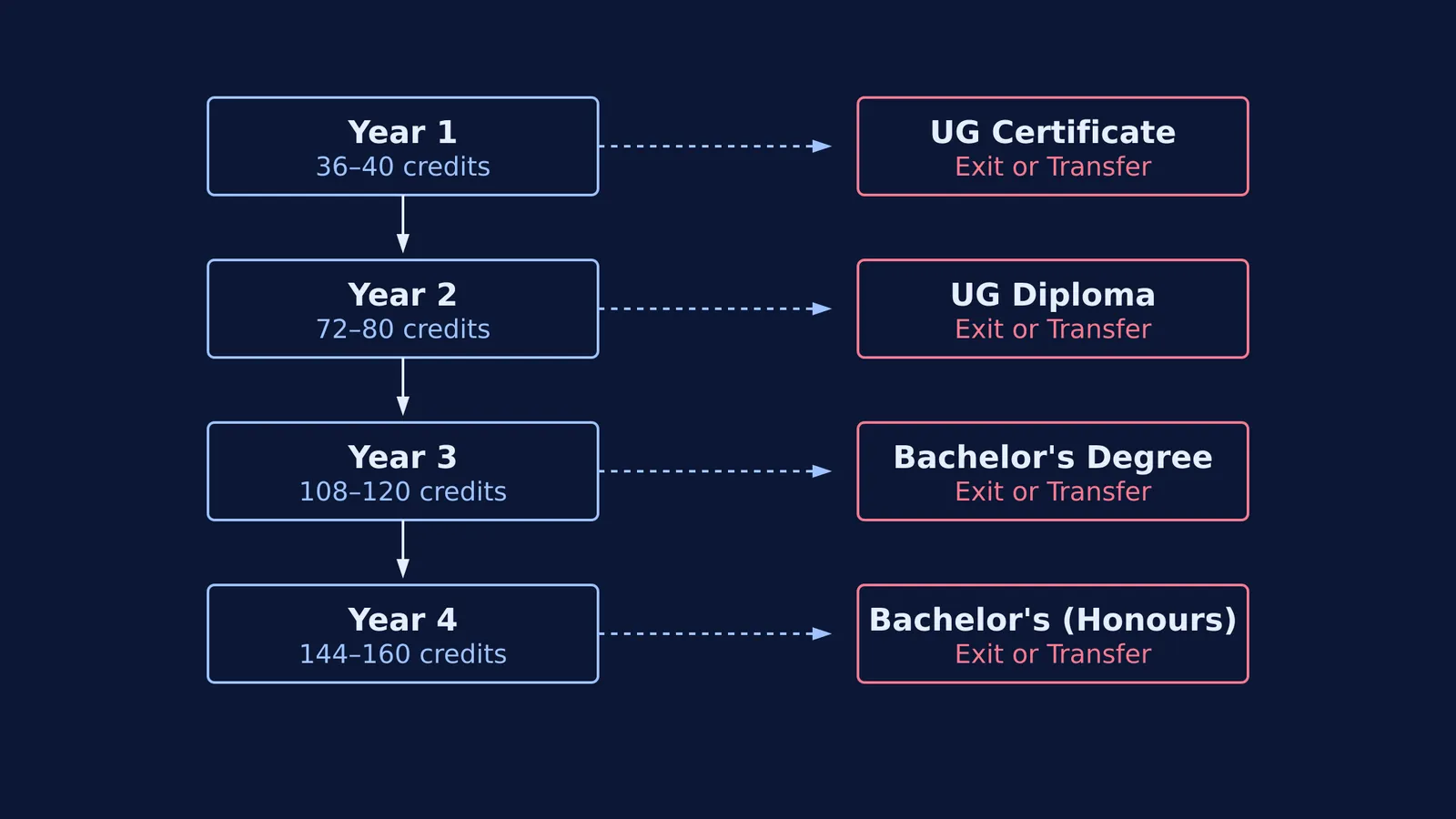
Yes, you can change your college after completing the first year of your undergraduate degree. The University Grants Commission (UGC) issued the Guidelines for Multiple Entry and Exit in Academic Programmes in 2021, which formally allows students to exit an undergraduate program after the first year (two semesters) with an Undergraduate Certificate.
This system relies on the Academic Bank of Credits (ABC). Your credits are stored in this digital repository, which allows for the transfer of credits between different Higher Education Institutions (HEIs). If you earn the required 36 to 40 credits in your first year, you can deposit them in the ABC and redeem them at a different college to enter directly into the second year.
What are the UGC rules for college migration?
While the UGC provides the framework for multiple entry and exit, the final decision rests with the individual university. If you are applying for a transfer, you will encounter two main types of migration:
Intra-University Migration: This involves moving between colleges affiliated with the same university (for example, switching from one college to another within Delhi University). This is usually permitted at the start of the third semester, but you cannot change your course.
Inter-University Migration: This is moving to an entirely different university. You will need a Migration Certificate from your parent university to prove that you have officially exited their program.
For both types, the target college must have vacant seats in your specific branch or course. Colleges typically advertise these vacancies between July and August, shortly after first-year results are declared.
How does the transfer process work?
The process is generally handled directly by the colleges rather than a central university portal.
Clear your first year: You must have passed all subjects in Semester 1 and Semester 2 without any active backlogs.
Find vacant seats: Approach the administrative office of the college you want to join to confirm they have second-year vacancies.
Get the NOCs: You need a No Objection Certificate (NOC) from the Principal of your target college indicating they are willing to take you. You must then submit this to your current Principal to obtain an NOC allowing you to leave.
Transfer your credits: Submit your application to the new college along with your mark sheets, Leaving Certificate, and NOCs. The new college will map your first-year syllabus against their own and redeem your stored credits from the ABC portal.
Is changing colleges the only way to get better teaching?
If your main motivation for migrating is poor teaching quality, it is worth considering whether the disruption is strictly necessary. Migrating is competitive, and the bureaucracy of securing NOCs from reluctant principals can be draining.
If you are struggling because a professor is rushing through complex topics—like differentiating one expression with respect to another or comparing energy bands in conductors and insulators—you do not necessarily have to change institutions to access better instruction. You can explore Courses on Fermi, which are university-level courses taught by working scientists.
Often, a few missing foundational ideas make higher-level material feel impossible. Instead of starting fresh at a new college, you can use the Fermi Concept Library to fill those specific gaps. When you are stuck on a difficult assignment, Fermi's AI tutor works out what you already know and builds a plan for the session, teaching through it by writing on a board and checking your understanding as it goes.
Before committing to a transfer, speak to seniors at your target college. Confirm whether their faculty situation is genuinely better, or if they are simply relying on self-study and external resources just like your current classmates.